2672243194/dsh-read-url
DeepSeek Harness URL reader: fetch any page and return clean main-content text/Markdown. Auto charset (GBK/GB2312/UTF-8/Big5), token-efficient (6000-char cap, cache, offset), zero deps, no API key. 网页一键读全文 → 干净正文 / 结构化 Markdown
Listed
9
Browser
Bundle verified
Preview
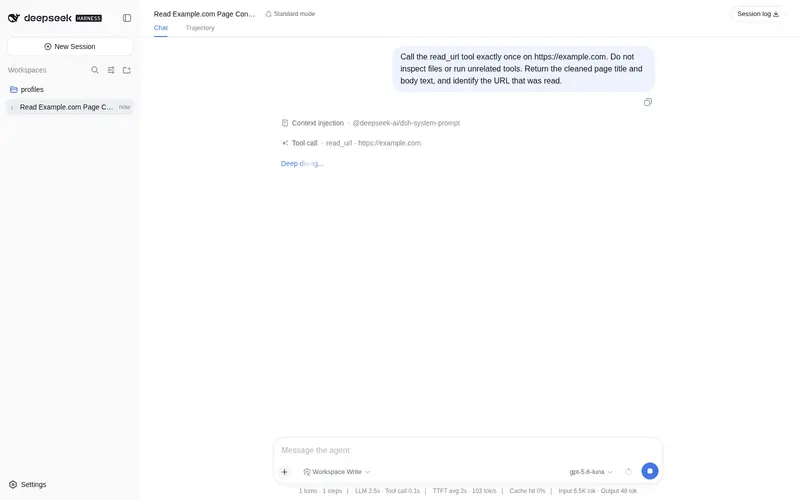
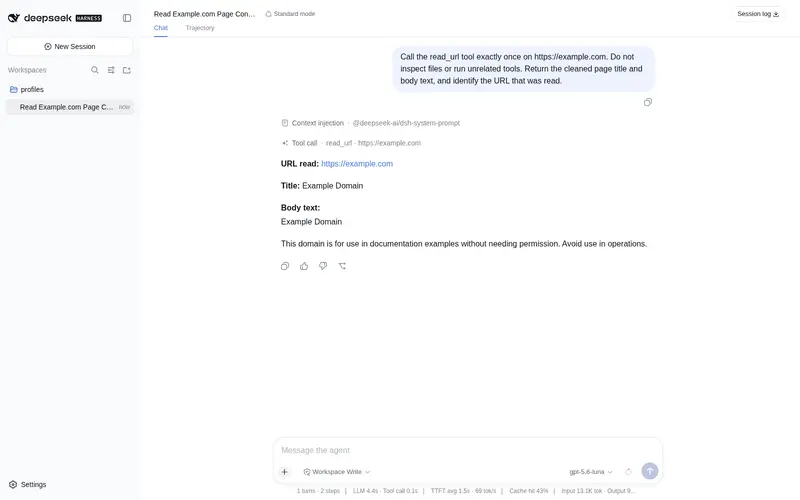
What it does
Read any page as clean main content: charset auto-detect (GBK/GB2312/UTF-8/Big5), noise stripping, compact text/Markdown, offset continuation, optional SPA rendering, batch reads and site crawling.
Best for
- Agents that need clean article or page content after search returns a URL.
- Chinese-web research involving GBK, GB2312, UTF-8, or Big5 pages.
- Token-conscious workflows needing compact text or Markdown, cached continuation, batch reads, or site crawling.
- Pages that optionally require SPA rendering when Playwright is installed.
Not ideal for
- Workflows that need the complete page chrome, advertisements, sidebars, and navigation preserved.
- Pages behind authentication, strong anti-bot controls, or other access boundaries that ordinary fetching cannot cross.
- Users requiring unlimited output in one response; the default compact result is capped and longer content uses offsets.
- SPA rendering workflows where Playwright is unavailable.
README
dsh-read-url
| 🌐 English | 中文 |


URL reader plugin for DeepSeek Harness: fetch any webpage, auto-detect encoding (GBK/GB2312/UTF-8/Big5), extract the clean main content, and return token-efficient compact text or structured Markdown.
Zero dependencies (Node 20+ built-ins), no API key, no server side — install and use.
Why
DSH agents can search (getting links and snippets) but lack the step of “reading a URL into clean body text”. The official tool-web web_fetch does a whole-page turndown conversion (nav/ads/sidebars all preserved) with a default cap of 200,000 characters — a token black hole. This plugin returns only what the model actually needs: cleaned body + essential metadata, truncated by default.
Competitor comparison (measured from source/docs, 2026-08-15)
| Capability | Official tool-web web_fetch |
dsh-webfetch | dsh-scrape-webpage | dsh-read-url |
|---|---|---|---|---|
| Body cleaning (container-level) | ❌ whole page | ⚠️ tag-level, nav/footer leak in | ⚠️ custom, noisy | ✅ article/main containers + noise stripping |
| Default output cap | 200,000 chars | 50,000 chars | 30,000 chars | 6,000 chars + paragraph-aligned truncation |
| Chinese GBK/GB2312 | provider-dependent | ⚠️ not normalized, GB2312 garbles | ❌ not handled | ✅ normalized + mojibake fallback |
| Session-level cache | ❌ | ❌ | ❌ | ✅ 5-min TTL |
ctx.web seam |
✅ (official core) | ❌ global fetch | ❌ | ✅ seam-first, fallback included |
ctx.effect unload cleanup |
✅ | ❌ | ❌ | ✅ |
| Cooperative timeout (hidden from model) | ✅ | ⚠️ self-managed | ⚠️ self-managed | ✅ timeoutMs + exec.signal
|
| Model-facing output | whole-page Markdown | compact text | 15-field JSON | compact text (no JSON parsing) |
| Dependencies | official | TypeScript build | zero deps | zero deps (JS ESM, drop-in) |
| Anti-bot / degraded responses (UA & TLS fingerprint) | ⚠️ Node default UA; measured: https intercepted by middlebox TLS fingerprinting, Baidu returns a degraded page without trending topics | ❓ not disclosed | ❓ not disclosed | ✅ full browser UA; measured: full page fetched (Baidu trending topics intact) |
Measured 2026-08-16 (local environment): with this plugin removed, the official
web_fetchhittinghttps://www.baidu.comhad its TLS handshake intercepted by a middlebox using program fingerprints (fell back to http to succeed), and Baidu returned a server-side degraded page (trending topics moved to JS loading, absent from static HTML). Withdsh-read-urlrestored, https worked and trending topics were fully readable. Root cause: the request’s UA and TLS characteristics decide whether sites/middleboxes treat you as a bot.
DSH architecture compliance
Implemented per official docs (docs/capability-seams.md, docs/cordis-primer.md, docs/tool-execution-pipeline.md):
-
Web access via the
ctx.webcapability seam — all web requests go throughctx.web.fetch()first (provider resolved inside the seam, same as officialtool-web), falling back to global fetch when the seam is absent. The network layer is replaceable, not bound to any provider; -
Reversible side effects — the session cache is registered under
ctx.effect, auto-cleared on plugin unload (temporal composability); -
Cooperative tool-call timeout —
ToolDefinition.timeoutMsdeclares the budget,execute(args, exec)forwardsexec.signalto fetch; the timeout policy is enforced by the pipeline, never exposed to the model; -
Model-facing simplicity — render emits compact text (
title:header + body); the model consumes it directly with no JSON parsing. Defaults are the most token-efficient; structured output is opt-in.
Install
# From GitHub (recommended, easy updates)
npx @deepseek-ai/dsh plugin --profile web add github:2672243194/dsh-read-url

# Local development
npx @deepseek-ai/dsh plugin --profile web add ./dsh-read-url
Restart DSH (Web/TUI); you should see dsh-read-url enabled in Settings → Plugins.
Usage
Just talk to the agent:
Read https://example.com/article and summarize the key points
Read https://docs.example.org/guide in markdown mode
Real examples (measured)
1. Token economy — return only what the model needs
read_url on a portal returns cleaned body capped at maxChars (default 6,000) — not the raw page with nav/ads/footers. Repeat reads hit the 5-min cache ((cached)), so the agent never re-fetches:
title: 新闻中心首页_新浪网
charset utf-8
(chars 800/12398 — 截断,offset 续读)
2. Overseas sites — direct + proxy race
When a proxy is configured, the direct fetch and the proxy curl start together and the first to complete wins. A blocked overseas site that used to cost ~11s (direct-connect timeout + fallback) now reads in under a second:
BBC 中文: OK (633ms) — clean 4,000+ chars of headline news
3. Long-article continuation (offset)
A 12,000-char article is read in slices; offset resumes from cache without repeating earlier text — the model keeps exactly what it needs in context:
chars 800+800/12398 · cached
4. Batch research across pages
read_url_batch reads up to 10 pages in parallel (concurrency 4), each cleaned individually, failures isolated:
读取 2/4 页成功,2 页失败
--- 阮一峰的网络日志 (491 字符) ---
--- Example Domain (127 字符) ---
[失败] https://zh.wikipedia.org/... — Fetch failed: HTTP 403 ...
Tools
read_url(url, maxChars?, offset?, mode?, includeLinks?) — fetch and extract clean body
| Param | Type | Default | Description |
|---|---|---|---|
url |
string | required | http(s) URL |
maxChars |
number | 6000 | Max body characters returned (500–20000) |
offset |
number | 0 | Resume reading from this character offset (long-article continuation; served from cache without repeating earlier text) |
mode |
string | text |
text = plain (most token-efficient); markdown = structured |
includeLinks |
boolean | false |
Also return up to 20 page links (title+URL) |
read_url_batch(urls, maxChars?, mode?, includeLinks?) — read multiple URLs (1–10) in parallel, each cleaned individually, merged into one compact report
| Param | Type | Default | Description |
|---|---|---|---|
urls |
string[] | required | http(s) URL list (1–10) |
maxChars |
number | 3000 | Max body characters per page (500–20000) |
mode |
string | text |
text = plain; markdown = structured |
includeLinks |
boolean | false |
Also return links per page (title+URL) |
- Concurrency capped at 4 (avoids rate-limiting); a failing page is isolated (
[失败]+ reason in the output) and does not affect the others; - Reuses every
read_urlcapability and the session cache (encoding, cleaning, SPA rendering, 5-min cache — repeat batches hit the cache).
read_url_site(url, maxPages?, maxDepth?, includeContent?, maxCharsPerPage?) — recursive site crawl: BFS from the entry URL across same-host pages, returns a compact site map
| Param | Type | Default | Description |
|---|---|---|---|
url |
string | required | http(s) entry URL |
maxPages |
number | 15 | Max pages to crawl (2–50; bounds output) |
maxDepth |
number | 2 | Max link depth from entry (1–5) |
includeContent |
boolean | false |
Attach a short body summary per page (default off — structure first, token-efficient) |
maxCharsPerPage |
number | 500 | Summary length per page when includeContent=true (200–2000) |
- Same-host only; login/API/static-asset paths are skipped; URLs deduped (fragment stripped);
- Concurrency 2 (gentle on the target site); per-page failures recorded as
[失败]without aborting; - Output is an indented tree:
[depth] title (chars) URL; -
No SPA rendering here (crawling favors speed/breadth) — use
read_urlfor JS-only pages.
read_url_links(url, limit?) — list the page’s links without returning body text (lighter; good for sourcing / mapping a site)
| Param | Type | Default | Description |
|---|---|---|---|
url |
string | required | http(s) URL |
limit |
number | 20 | Max links returned (1–50) |
Configuration (optional)
Plugin-level config is overridable via the profile’s cordis.patch.yml (defaults in the plugin’s own cordis.patch.yml):
- id: dsh-read-url
  config:
    timeoutMs: 15000      # per-request timeout
    maxBytes: 3145728     # response body cap (bytes)
    maxChars: 6000        # default body truncation
    maxLinks: 20          # read_url_links default count
    spaRender: true       # SPA rendering enhancement (needs playwright installed; degrades with a hint otherwise)
    userAgent: '...'      # request UA
Output (compact)
{
  "url": "...",
  "title": "...",
  "siteName": "...",
  "lang": "zh-CN",
  "charset": "gbk",
  "mode": "text",
  "truncated": true,
  "charsTotal": 12990,
  "charsReturned": 6000,
  "text": "...",
  "links": []          // only when includeLinks=true
}
PTC mode
Output is pure JSON and composable; orchestrate parallel multi-URL reads in PTC mode:
const results = await Promise.all([
  read_url({ url: 'https://a.example.com', maxChars: 4000 }),
  read_url({ url: 'https://b.example.com', maxChars: 4000 }),
])
Token economy (core)
- Body text only by default — no redundant headings/keywords/images/word-count fields; take them via params only when needed;
-
Paragraph-aligned truncation + offset continuation — 6,000 chars by default (~3,000 tokens), cut at paragraph boundaries to keep semantics; output notes a single line
(chars 6000/12990 — truncated, continue via offset); resume starts at the given offset, sliced from cache — no repetition of already-read text (measured 0+500 → 500+500, no overlap); offset past the end returns empty instead of repeating the head; -
textmode first — Markdown structure is opt-in; -
Compact text render — the model sees a
title:header + body directly, no JSON parsing;siteNameis omitted when identical to the hostname; every status hint is one short line (truncated / cached / rendered), no verbose paragraphs; - Two-tier cache — successful results cached per URL for 5 minutes (repeat reads hit cache: fewer network calls and fewer model retries); failed results cached for 30 seconds so a broken URL never triggers a re-fetch loop;
-
KV-cache friendly (DeepSeek cost tuning) — tool schema/description stay static text (no config values embedded), so changing config never invalidates the reusable prompt prefix and KV cache keeps hitting. DeepSeek’s cache-hit tokens cost about 1/10 of misses — the more stable the prefix, the cheaper the run (same analysis as the official
tool-webdocs); -
Batch shares the cache —
read_url_batchreuses the same cache (repeat batches hit it directly) and caps each page at 3,000 chars (below the single-page 6,000) to bound total output; -
Compact fixed cost — the four tool descriptions total ~990 chars (audited by a budget assertion in tests, kept static for KV-cache); extended HTML-entity decoding (45 named entities) means leftovers like
—/…never waste tokens or render as mojibake.
Technical notes
-
Encoding: three-level detection (HTTP
Content-Typecharset → HTML meta → BOM), built-inTextDecodertranscoding (Node 20+ full-icu), GB2312 normalized to GBK, auto-fallback to UTF-8 on mojibake; -
Extraction: prefers
<article>/role="main", stripsnav/footer/header/aside/form/iframeand ad-like containers, heuristic fallback to<body>; - Markdown: self-written lightweight tag state machine (headings/paragraphs/lists/blockquotes/code/tables/inline bold-italic-links), zero deps;
-
Safety: http/https only; no page scripts executed; responses over 3 MB rejected; 15s timeout; structured errors (HTTP status / timeout / unsupported type / DNS cause such as
getaddrinfo ENOTFOUNDvs blocked-network timeout); -
Network fallback (proxy, raced): when a proxy is configured (env
HTTPS_PROXY/HTTP_PROXY, falling back to the Windows system proxy registry where Clash-type apps persist it), the plugin starts the direct fetch and a proxycurl(-xpassed explicitly, zero npm deps) at the same time and uses whichever completes first — so overseas sites that are blocked on direct connect are served through the user’s own proxy in ~0.6s instead of waiting out the direct-connect timeout (~11s measured, -94%). The loser is aborted (curl killed / fetch aborted) and never enters the model context, so token cost is unchanged. A failed race returns the original direct error with the proxy attempt noted (已尝试代理 …); with no proxy configured the behaviour is exactly the plain direct connect; - Privacy: the plugin never uses the developer’s network configuration — the proxy fallback only reads your own machine’s proxy (env vars or Windows system proxy) at runtime. No telemetry, no analytics, no data collection: the only outbound action is fetching the URL you asked it to read;
-
Optional enhancement 1 (Firefox Reader Mode algorithm): run
npm i @mozilla/readability happy-domin the DSH profile directory to auto-enable@mozilla/readability(MPL-2.0, referenced unmodified) for higher-quality extraction; falls back to the built-in heuristic when not installed — the core stays zero-dependency; -
Optional enhancement 2 (SPA page rendering): run
npm i playwright && npx playwright install chromiumin the DSH profile directory to auto-enable it. When the extracted body is empty and the page is script-heavy (likely Vue/React client-rendered), the plugin automatically renders it with headless Chromium before extracting (arenderedflag tells the model); rendering waits for the DOM to stabilize (content stops growing) instead ofnetworkidle— heartbeat-polling sites never idle, so this avoids 30s timeouts; when not installed it degrades with a clear install hint, never errors — the core stays zero-dependency; - Boundaries: login-walled pages are not readable; SPA pages need the Playwright enhancement; structured data (e.g. which like-count belongs to which comment) is out of text-extraction scope — this plugin flattens HTML into readable text, so exact field↔value associations are lost; for precise fields, intercept the page’s actual data API (see “Real-world validation” below).
Real-world validation (2026-08-19, v0.4.8)
41-site sweep driven by multi-site.mjs (committed, re-runnable): 23 OK / 8 expected boundaries / 10 network·anti-bot boundaries / 0 crashes — overseas sites (BBC/V2EX) served in ~1s via the direct+proxy race; doc sites (vuejs.org) fixed via bare-<main> picking; wikipedia/httpbin remain clear attributed network boundaries.
| Category | Sites | Result |
|---|---|---|
| Portal navigation cleaning | Baidu / QQ / NetEase / Sina / Douban / CSDN / Sohu / Ifeng | ✅ clean text, no CSS noise |
| SPA rendering | Bilibili / Xiaoheihe / Juejin / QQ News / SSPAI | ✅ rendered flag, post-JS body |
| Multi-article aggregation | Cnblogs / Ruan Yifeng blog | ✅ 800+ chars across articles |
| Static doc pages | MDN / Ruan Yifeng / example.com / GitHub | ✅ clean extraction (example.com = short page, expected) |
| Login wall | Zhihu / Weibo | ✅ clear content or empty (expected) |
| Proxy fallback (overseas) | BBC Chinese / V2EX | ✅ direct connect blocked → auto-retried through the user’s system proxy → clean body |
| Network / anti-bot boundary | W3C (403 for Chrome UA); Wikipedia (403 via proxy); httpbin (503 service-down); PDF (404); DNS-fail (proxy unreachable) | ✅ accurately attributed errors (HTTP status / 403 / 503 / ENOTFOUND) — not plugin defects |
| offset continuation | Sina News (12,284 chars) | ✅ 800+800 seamless, cache hit |
| Batch + failure isolation | 4-URL mix | ✅ 2/4 ok, failures isolated |
| Site crawl | Ruan Yifeng blog | ✅ 5/5 pages tree map |
- 39 zero-dep assertions (incl. entity decoding, description-budget guard, link dedupe, table-separator escaping, proxy-fallback function, missing-args tolerance, race logic, empty-race guard, schema budget, bare-main pick) + 10 SPA-test assertions all green;
- Real case: on a Xiaoheihe post, comment like-counts (
upfield) could not be attributed from flattened text — precise fields should come from the page’s underlying data API (e.g./bbs/app/link/treeJSON). This is a shared boundary of text extractors, not a defect.
Roadmap
-
Single-page continuation (
offsetparameter) - On-demand SPA rendering (optional Playwright enhancement, auto-enabled once the browser is installed)
-
Batch reading (
read_url_batch) -
Recursive site crawl (
read_url_site)
Development
node test.mjs          # zero-dependency self-tests (charset/extract/markdown/truncate)
node test-spa.mjs      # SPA rendering tests (10 assertions; SKIPs if playwright absent)
node multi-site.mjs    # 29-site real-world sweep (needs network): portals/SPA/login-walls/static/anti-bot/net-boundaries

# End-to-end (requires DSH CLI)
npx @deepseek-ai/dsh plugin --profile headless add .        # run from the parent dir of the plugin
npx @deepseek-ai/dsh --profile headless "use read_url to read https://example.com and output the title"
Verified against real DSH v0.1.0-rc.6: plugin loads, read_url registers, model calls it, real page content returned.
Support
If dsh-read-url helps you, please give it a ⭐ Star on GitHub.
- Completely free and open source (MIT): zero dependencies, no API key, fully local processing, no data collection;
- Independently developed and maintained — your Star is the direct signal for whether I keep investing in it;
- More users means more features — the next one might be exactly what you need.
A Star costs nothing but helps this project go further. Thanks ⭐
License
MIT
Frequently Asked QuestionsFAQ
Use the verified command dsh plugin --profile default add github:2672243194/dsh-read-url in a DSH-enabled shell. The command resolves the public package metadata and keeps the plugin attached to the catalog identity shown on this page.
Compatibility follows the bundle and profile status shown above. If a profile is not detected, keep the plugin disabled there and check the repository documentation before enabling it in production.
The GitHub link and activity metadata are the source of truth for releases and maintenance. Revisit this page after a new release to confirm the catalog has observed the latest version.