863683348/dsh-plugin-gate
Installation safety gate & data-protection guard for DeepSeek Harness: 60 static signature rules (31 high/24 medium/5 low) scan plugin sources before dsh plugin add; 12 destructive-command patterns + workspace-boundary checks block accidental deletion. | 安装安全闸门与数据保护闸:60 条静态签名规则,12 种危险命令模式拦截误删。
Listed
0
Security
Bundle verified
Preview
What it does
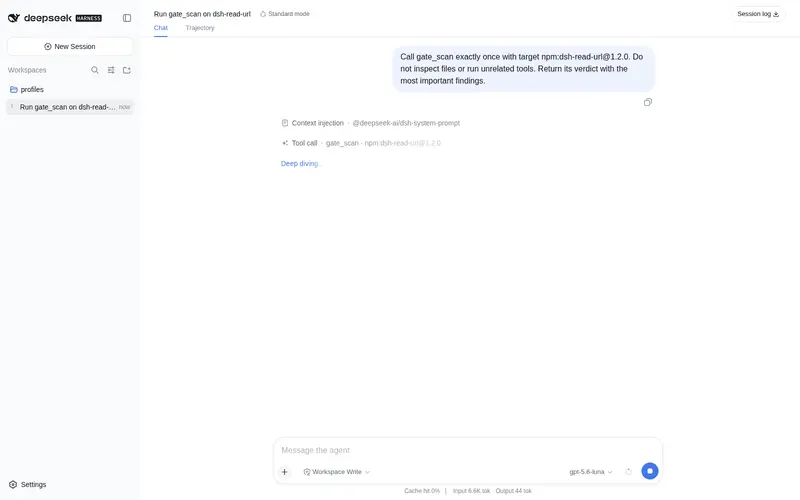
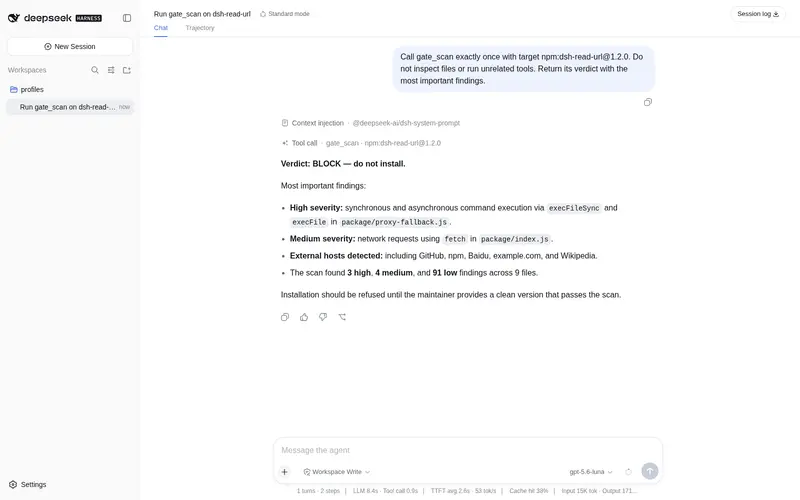
Installation safety gate for DSH plugins: antivirus-style scan of install scripts, permissions, secrets and network callbacks on local directories or npm tarballs, returning a BLOCK/WARN/PASS verdict before "dsh plugin add".
Best for
- Users screening a local plugin directory or npm tarball for risky install scripts, secrets, permissions, obfuscation, and network callbacks before installation.
- Teams that want a preflight check for destructive shell commands or paths outside the workspace.
- Reviewers who need evidence-bearing BLOCK, WARN, or PASS results without executing scanned code.
Not ideal for
- Treating PASS as a security guarantee, because signature scanning can miss novel malware and can also produce false positives.
- Complete offline vulnerability checking of dependencies, because the optional OSV lookup requires network access and degrades when offline.
- Unbounded deep scans of very large trees, because file count, file size, tarball size, and checked dependencies have configurable caps, and node_modules is excluded by default.
README
dsh-plugin-gate
Installation safety gate & data-protection guard for DeepSeek Harness — 60 static signature rules (31 high / 24 medium / 5 low) scan plugin sources for malicious install scripts, credential theft, obfuscation and network callbacks before you run dsh plugin add, and 12 destructive-command patterns plus workspace-boundary checks stop rm -rf-class accidents before they happen.
The plugin marketplace is growing fast (thousands of entries), and malicious code mixed into a plugin is only a matter of time. dsh-plugin-gate gives the agent a gate_scan tool that inspects a plugin source — a local directory or an npm tarball — for the classic malware shapes:
| Domain | What it checks | |
|---|---|---|
| Scripts | npm lifecycle scripts (pre/install/postinstall), exec/spawn/shell:true, curl | sh, encoded PowerShell, cmd/WSH launch, dynamic require |
| Obfuscation | eval / new Function / vm.runIn*, hex-escape floods, base64 blobs, char-array packing | |
| Permissions | credential env reads (OPENAI_API_KEY etc.), ssh/aws/npmrc file reads, writes to system/home/dotfile paths, chmod 777, sandbox-escalation requests |
|
| Network | external URLs & hosts, fetch/axios/socket/WebSocket/DNS APIs, cloud-metadata endpoints (169.254.169.254), Discord/Telegram/Slack webhooks, .onion, read-then-send exfiltration shape | |
| Secrets | hardcoded sk- keys, ghp_ tokens, AWS keys, private key blocks, bearer tokens |
|
| Supply chain | exact-version direct dependencies checked against Google OSV (ranges and official @deepseek-ai packages skipped; configurable, offline-degrades) |
The gate is read-only: it never executes scanned code and never writes files.
Install
In your DSH profile:
dsh plugin --profile <profile> add dsh-plugin-gate
# or add the bundle patch manually:
#   dsh --profile <profile> --patch ./node_modules/dsh-plugin-gate/cordis.patch.yml
Usage
Ask the agent to scan a plugin before installing it (the plugin also injects prompt guidance that tells the agent to do this automatically):
gate_scan target: "npm:dsh-plugin-some-package"
gate_scan target: "npm:dsh-plugin-some-package@1.2.3"   # pinned version
gate_scan target: "./downloaded-plugin"                 # local directory
v1.1 - Data-protection guard
Before any destructive operation, ask the agent to evaluate it with gate_guard (also injected into prompt guidance):
gate_guard command: "rm -rf ./node_modules"
gate_guard path: ".dsh-memory-setup/memory.json" action: "delete"
- BLOCK - device/root-level destruction (rm -rf /, rmdir /s /q, format, dd to a block device, mkfs, drive-root deletes): refuse.
- WARN - recursive/force deletes, targets outside the workspace, or critical files (memory.json, .git, …): confirm the exact target first.
- PASS - no destructive signature detected.
Result shape:
{
  "verdict": "BLOCK" | "WARN" | "PASS",
  "score": 254,
  "summary": { "high": 0, "medium": 1, "low": 3, "categories": { "network": 4 } },
  "network": { "hosts": [...], "unallowlisted": [...], "readAndSendFiles": [...] },
  "hits": [{ "rule": "fetch_call", "category": "network", "severity": "medium",
             "file": "lib/index.js", "line": 12, "evidence": "...", "hint": "..." }],
  "recommendations": [...]
}
Verdict semantics
- BLOCK — at least one high-severity signature. Do not install until the maintainer ships a clean rebuild you can scan again.
- WARN — medium-severity patterns that need manual review (network I/O, home-path writes, base64 blobs). Inspect every hit in context.
- PASS — no risky signatures. Heuristic only — keep normal caution with unknown maintainers.
Context-aware rules: exec()/execSync() hits are downgraded when the file does not import child_process (typical RegExp#exec false positive); code-context rules (exec, eval, curl |
sh, PowerShell…) are downgraded to low when found in comments or documentation (examples, not behavior) — while secrets and webhooks stay flagged even in comments. Dependencies installed from git/http/file URLs are flagged as risky_dependency, and >4000-char minified lines as minified_line (low). |
Configuration
| Key | Default | Meaning |
|---|---|---|
maxFiles |
1000 | hard cap on scanned files per directory walk |
maxFileBytes |
2 MiB | per-file text cap |
includeNodeModules |
false | descend into node_modules |
maxTarballBytes |
32 MiB | npm tarball download cap |
allowlistHosts |
[] | hosts never listed as unallowlisted |
osvCheck |
true | query Google OSV for known vulnerabilities on exact-version deps |
osvMaxDeps |
8 | max exact-version direct deps checked |
osvTimeoutMs |
10000 | per-dep OSV query timeout |
promptSection |
true | inject agent guidance |
sectionOrder |
5 | prompt section order |
Development
node --check lib/*.js
node test/rules.test.mjs   # main-module mode (node --test is blocked in the DSH sandbox)
node test/scan.test.mjs
Pure logic lives in lib/rules.js (signatures), lib/targz.js (in-memory tar.gz), lib/scan.js (orchestration + verdict). The Cordis plugin is lib/index.js.
Security
The gate never executes scanned content. It is a heuristic signature scanner — it can miss novel malware and over-flag innocent code. Review BLOCK/WARN hits yourself; see SECURITY.md.
License
MIT
Frequently Asked QuestionsFAQ
Use the verified command dsh plugin --profile default add github:863683348/dsh-plugin-gate in a DSH-enabled shell. The command resolves the public package metadata and keeps the plugin attached to the catalog identity shown on this page.
Compatibility follows the bundle and profile status shown above. If a profile is not detected, keep the plugin disabled there and check the repository documentation before enabling it in production.
The GitHub link and activity metadata are the source of truth for releases and maintenance. Revisit this page after a new release to confirm the catalog has observed the latest version.