bill9109/dsh-101
DSH 文档阅读模式
Listed
4
Docs
Bundle verified
Preview
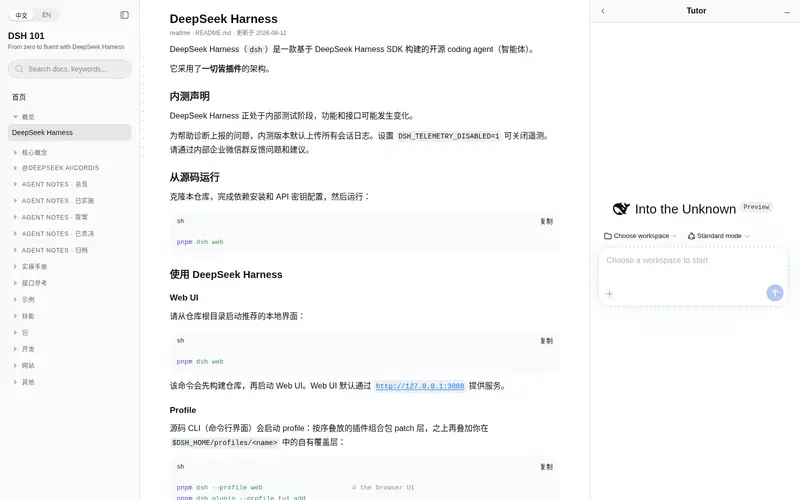
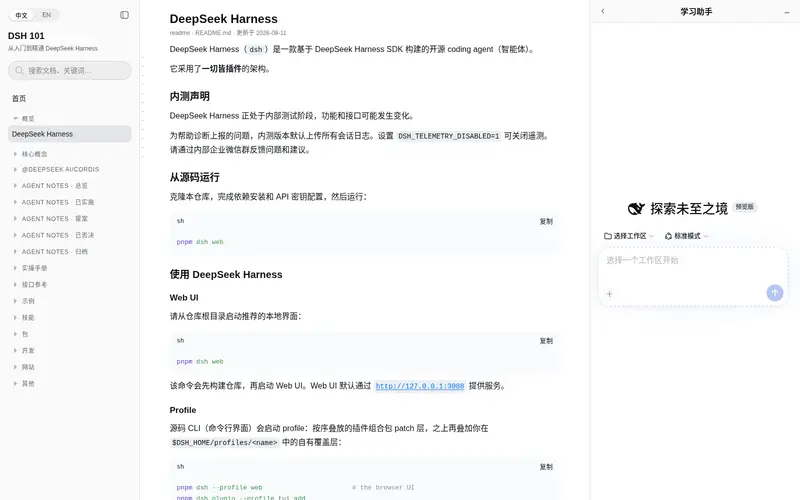
What it does
Document reading mode for DSH.
Best for
- People learning DSH through its built-in documentation in a curated reading order.
- Readers who need document search, translation, a table of contents, and an adjacent conversation panel.
- Users who want a dedicated document-first DSH profile that can coexist with the normal web UI.
Not ideal for
- General-purpose DSH web usage where document reading is not the primary workflow.
- Installation into the existing web profile; the bundle disables the default UI layout and must use its own profile.
- Environments outside the documented Node.js requirement of ^20 or >=22.
README
dsh-101 — A document-first reader profile bundle for DSH




Install: bash <(curl -fsSL https://raw.githubusercontent.com/bill9109/dsh-101/main/scripts/install.sh) github:bill9109/dsh-101#v0.1.7
DSH 101 is a document-first reading interface built on top of dsh-base + dsh-web-app: it organizes DSH’s own documentation into an ordered, searchable, translatable reader.
| English | 中文 |
Why this exists
DSH ships a large body of built-in documentation, but in its raw form it is a file dump: scattered across the source tree, with no order, no search, and no comfortable way to read it. dsh-101 makes that documentation a first-class part of the DSH experience — a curated, ordered, searchable, translatable reader instead of raw files, with the conversation panel alongside so you can ask questions while you read.
Features
- DSH’s built-in documentation, curated and ordered by topic
- Built-in document translation
- A sliding hidden table of contents
- Conversation panel on the right
Usage
Boot the profile (default port 3081, coexists with the web GUI on 3080):
dsh --profile dsh-101
Open http://127.0.0.1:3081 (or the port you chose): the reader shows the curated corpus with the sliding table of contents, search filters the documents, translation switches the reading language, and the right-hand panel is the DSH conversation you already know.
Install
This repository ships both a bundle (@bill9109/dsh-101, installable via dsh plugin add) and a
profile/ directory (a ready-to-use dsh-101 profile composing dsh-base + dsh-web-app +
this bundle). DSH’s official distribution model is “distribute bundles, compose profiles” — there is
no official command to distribute a profile, but a profile is just a directory under
$DSH_HOME/profiles/<name>/, so the repository’s profile/ is directly usable.
Recommended: one-liner script (places profile/ into ~/.dsh/profiles/dsh-101/ and installs the bundle):
# Install from GitHub (pin to a tag/commit when possible):
bash <(curl -fsSL https://raw.githubusercontent.com/bill9109/dsh-101/main/scripts/install.sh) github:bill9109/dsh-101#v0.1.7

# Or install from a local checkout, specifying the port (default 3081):
./scripts/install.sh --port 3081 .

# Boot:
dsh --profile dsh-101
What the script does: places the three profile/ files into $DSH_HOME/profiles/dsh-101/
(only fills in missing dsh-base/dsh-web-app layers if the profile already exists), primes the
DSH module fallback (so in-box peers resolve at runtime), then runs dsh plugin --profile dsh-101 add
to install this bundle.
Manual install:
mkdir -p ~/.dsh/profiles/dsh-101
cp profile/package.json profile/pnpm-workspace.yaml ~/.dsh/profiles/dsh-101/
# Optional: port patch
cp profile/cordis.patch.yml ~/.dsh/profiles/dsh-101/
# Install the bundle (appends to the bundles list)
dsh plugin --profile dsh-101 add github:bill9109/dsh-101#v0.1.7
dsh --profile dsh-101
Verify the bundles list has the three layers:
python3 -c "import json; print(json.load(open('$HOME/.dsh/profiles/dsh-101/package.json'))['dsh']['profile']['bundles'])"
# expected: ['@deepseek-ai/dsh-base', '@deepseek-ai/dsh-web-app', '@bill9109/dsh-101']
Do NOT install into the
webprofile. dsh-101’s bundle disablesui-layout(the default browser shell); installed into any web-app profile it takes down the whole web (sidebar / conversation / app-shell all wait for thelayoutservice and stay pending). Always use dsh-101 as its own profile (dsh --profile dsh-101, default port 3081, coexists with the web GUI on 3080).install.shnow rejects--profile weboutright.
Port
Defaults to 3081 (coexists with the web GUI on 3080). Two ways to change it:
At launch (recommended, no config change, dsh 0.1.0-rc.6+):
dsh --profile dsh-101 --port 8080
Persist a different default in the profile config:
# ~/.dsh/profiles/dsh-101/cordis.patch.yml
- id: webserver
  inject: [webStartup]
  config:
    host: !!js ctx.webStartup.host ?? '127.0.0.1'
    port: !!js ctx.webStartup.port ?? 8080
(Launch flags win; the patch value is only the fallback.)
Git installs ship build artifacts.
lib/is committed to this repository, so a git install gets the built host + client bundles directly — no build, no credentials needed. If you install from a pristine clone before building, runnode scripts/build.mjsfirst (needs a DSH source checkout, see below).
Upgrade
Re-run the one-liner with the new pinned tag:
bash <(curl -fsSL https://raw.githubusercontent.com/bill9109/dsh-101/main/scripts/install.sh) github:bill9109/dsh-101#v<new-version>
For a local-checkout installation, re-run ./scripts/install.sh . against the updated checkout (it
only fills in missing layers, so your profile state is preserved). When DSH itself publishes a new
snapshot, sync the bundle sources from the upgraded checkout with node scripts/upgrade.mjs
(see “Upgrading from a newer DSH snapshot”).
Uninstall
dsh plugin --profile dsh-101 remove @bill9109/dsh-101
# and, if you no longer want the standalone profile:
rm -rf ~/.dsh/profiles/dsh-101
The first command runs pnpm remove in the profile directory and removes the bundle from
dsh.profile.bundles; the second deletes the standalone profile itself.
Troubleshooting
| Symptom | Resolution |
|---|---|
| Web GUI (3080) is down / sidebar stays pending after installing dsh-101 | dsh-101 was installed into the web profile and disabled ui-layout — remove @bill9109/dsh-101 from the web profile and reinstall dsh-101 as its own profile with the one-liner |
dsh --profile dsh-101 fails to start |
Confirm $DSH_HOME/profiles/dsh-101/ exists and its bundles list contains the three layers (dsh-base, dsh-web-app, @bill9109/dsh-101); re-run install.sh if a layer is missing |
| Port 3081 already in use | Pass --port <port> at launch, or persist a different default in the profile’s cordis.patch.yml
|
| GitHub install fails or installs stale code | Pin the install to a tag (github:bill9109/dsh-101#v0.1.7) or install from a local checkout (./scripts/install.sh .) |
| Documents missing or outdated | Regenerate the corpus from a DSH source checkout: DSH_CHECKOUT=/path/to/dsh node scripts/build.mjs --corpus
|
| Broken after DSH published a new snapshot | Sync sources and rebuild with node scripts/upgrade.mjs --checkout /path/to/upgraded-dsh
|
Directory layout
src/
  app/        host plugin: corpus service + /api/dsh101 routes (from dsh-101-app)
  app/invariant.ts
  core/       corpus model: loading, merging, search (from dsh-101-core)
  tutor/      host plugin: model tools, curator skill (from dsh-101-tutor)
  client/     browser side: reader shell (from dsh-101-app/src/client)
  invariant.ts
assets/dsh-101/   generated corpus (corpus.json + documents/ + images/)
cordis.patch.yml  bundle patch: mounts app (package root) + tutor (./tutor subpath)
profile/          ready-to-use dsh-101 profile (package.json + pnpm-workspace.yaml + cordis.patch.yml)
scripts/
  install.sh            one-liner profile installer (install.sh --port <port> <src>)
  build.mjs             builds host + client bundles against a DSH checkout
  gen-dsh-101-corpus.ts regenerates the corpus from a DSH source tree
  upgrade.mjs           syncs sources from an upgraded DSH checkout and rebuilds
  verify-i18n.mjs       bilingual README consistency check (node scripts/verify-i18n.mjs)
Build
The bundle’s peer dependencies resolve from a DSH install — either a source checkout
(DSH_CHECKOUT) or the module fallback of a running DSH ($DSH_HOME/profiles/node_modules).
Toolchain binaries (tsc, tsdown) prefer the DSH source checkout.
DSH_CHECKOUT=/path/to/dsh node scripts/build.mjs
# Rebuild after regenerating the corpus:
DSH_CHECKOUT=/path/to/dsh node scripts/build.mjs --corpus
build.mjs symlinks DSH’s peers into node_modules, runs tsc (types into types/) then
tsdown (host bundle + client bundle into lib/), and removes the symlinks afterwards.
Usually no build needed.
lib/is committed;dsh plugin add(GitHub / tarball / local checkout) installs the built bundle. Build only when developing this repo or after anupgradesync.
Regenerating the corpus
The corpus is a snapshot of the DSH repository’s docs. Regenerate it from any DSH source checkout (uses that checkout’s tsx):
DSH_CHECKOUT=/path/to/dsh node scripts/build.mjs --corpus
# or explicitly:
/path/to/dsh/node_modules/.bin/tsx scripts/gen-dsh-101-corpus.ts /path/to/dsh
Upgrading from a newer DSH snapshot
After DSH publishes a new snapshot, sync this bundle from the upgraded checkout:
node scripts/upgrade.mjs --checkout /path/to/upgraded-dsh
The script copies the 101 packages’ sources into src/, rewrites internal imports to relative
paths, regenerates the corpus, and rebuilds. Then review the diff, commit, bump the version and tag:
git add -A && git commit -m "sync with DSH <snapshot>"
git tag v0.2.0 && git push origin main --tags
Development and verification
pnpm install
pnpm run build       # tsc + tsdown -> lib/ (committed)
pnpm run gen-corpus  # regenerate corpus from a DSH source tree (needs DSH_CHECKOUT)
node scripts/verify-i18n.mjs   # bilingual README consistency
pnpm run build emits the host + client bundles into lib/, which is committed so consumers
install without building. Keep the bilingual README in sync: edit both README.md and
README.zh.md, then node scripts/verify-i18n.mjs --write to re-record the blob hashes.
Community and About
- Use GitHub Issues for reproducible bugs, focused feature requests, and usage questions.
- Read CONTRIBUTING.md before proposing changes; report vulnerabilities privately via SECURITY.md.
- Follow releases and compatibility notes in CHANGELOG.md.
License
BSD-3-Clause
Frequently Asked QuestionsFAQ
Use the verified command dsh plugin --profile default add github:bill9109/dsh-101 in a DSH-enabled shell. The command resolves the public package metadata and keeps the plugin attached to the catalog identity shown on this page.
Compatibility follows the bundle and profile status shown above. If a profile is not detected, keep the plugin disabled there and check the repository documentation before enabling it in production.
The GitHub link and activity metadata are the source of truth for releases and maintenance. Revisit this page after a new release to confirm the catalog has observed the latest version.