DeepTrial/dsh-bash-rtk
DeepSeek Harness bash executor plugin that routes eligible commands through rtk (Rust Token Killer) to compress tool output and save tokens.
Listed
2
Tools
Bundle verified
Preview
What it does
Route eligible shell commands through rtk to compress tool output and save tokens.
Best for
- DSH users who want lower token use from verbose output produced by supported developer commands.
- Workflows dominated by simple, whitelisted commands such as Git, Cargo, or test-runner invocations.
- Deployments that need command semantics, working directory, timeout, environment, exit code, and sandbox behavior preserved.
Not ideal for
- Workflows dominated by pipelines, redirects, command substitution, environment assignments, or other complex shell syntax, which pass through unchanged.
- Environments without Node.js 20+ or a separately installed and maintained rtk binary on PATH.
- Users expecting compression for arbitrary commands outside rtk's supported whitelist.
README
dsh-bash-rtk




Route eligible shell commands through rtk (Rust Token Killer) inside the DeepSeek Harness (
dsh) bash executor — compress tool output, save tokens, change nothing else.
Table of Contents
- Quick Example
- Requirements
- Why
- How it works
- Install & enable
- API / Configuration
- Which commands are routed
- Development
- License
Quick Example
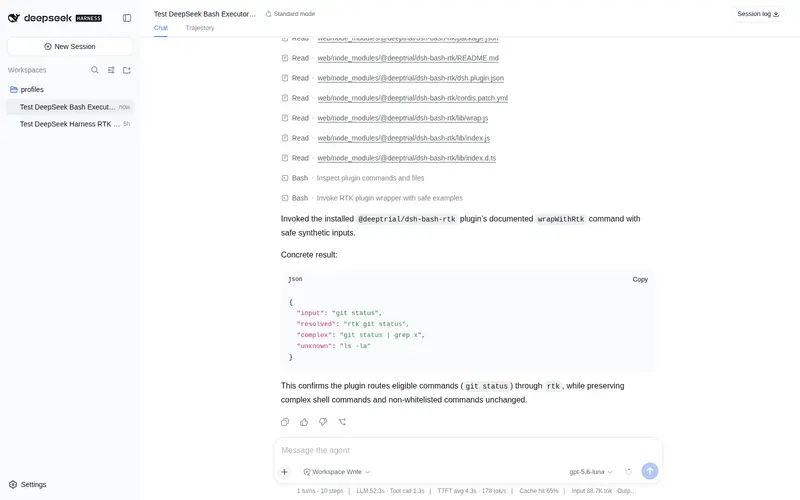
The plugin rewrites commands at the resolve() boundary — before anything runs:
Input (command) |
Resolved output | Reason |
|---|---|---|
git status |
rtk git status |
Simple + whitelisted |
cargo build --release |
rtk cargo build --release |
Simple + whitelisted |
git status \| grep x |
git status \| grep x |
Complex shell — passthrough |
ls -la |
ls -la |
Not whitelisted — passthrough |
git status (rtk absent) |
git status |
Binary missing — identity fallback |
Everything else — workdir, timeout, env, exit code, sandbox confinement — is inherited unchanged.
Requirements
- Node.js: >= 20.0.0
-
rtk:
rtk --versionmust exit 0 on PATH (install separately, e.g.cargo install rtk)
Why
LLM agents burn tokens on verbose tool output (git log, cargo build, pytest trails…). rtk already knows how to shrink those for 30–90%. This plugin bolts that filtering onto dsh’s bash executor so every eligible command is auto-routed through rtk — with zero semantic change to what actually runs.
How it works
model → dsh bash tool → RtkBashExecutor.resolve()
                              │
              ┌───────────────┴────────────────┐
         eligible?                         not eligible
     (simple + whitelisted)           (complex / unknown)
              │                                │
      rtk <subcommand> …              command runs unchanged
   (rtk compresses output)            (byte-for-byte passthrough)
Three independent guards decide (see src/wrap.ts):
-
Complexity — any shell metacharacter (
| & ; < > \$`) disqualifies the command. Wrapping those would silently alter what runs, so they pass through untouched. -
Whitelist — only known dev tools that
rtkactually implements are eligible (map inwrap.ts). -
Availability — if the
rtkbinary is absent onPATH, the transform is the identity: the deployment behaves exactly like the stock local executor.
Versioning note
The plugin does not bundle or pin rtk. At dsh startup it probes rtk --version on PATH (see resolveRtk() in src/index.ts). Therefore:
- When rtk ships a new release, any user who upgrades
rtkon their machine automatically gets the new behavior — no plugin update required. - The plugin version (this repo) and the rtk version are independent; keep them separate. This README states the minimum rtk version tested against, not a lockstep number.
Requires:
rtkonPATH(rtk --versionexits 0). The plugin does not install or manage rtk — you must install and update rtk yourself (e.g.cargo install rtkor download a release binary). When rtk is absent the plugin is a silent no-op passthrough.
Install & enable
The plugin is disabled by default — installing it does nothing until you opt in.
# 1) from a local checkout
dsh plugin --profile web add "<path-to-this-dir>"

# 2) or directly from the latest GitHub release tarball (no local clone needed)
dsh plugin --profile web add \
  "https://github.com/DeepTrial/dsh-bash-rtk/releases/latest/download/dsh-bash-rtk.tar.gz"

# enable it via an optional overlay — add to your profile's cordis.patch.yml:
#   - id: bash-sandbox
#     disabled: true
#   - id: bash-rtk
#     disabled: false

dsh web   # restart to apply
The bundled overlay snippet lives in cordis.patch.yml. It swaps the stock sandbox executor for RtkSandboxBashExecutor (file confinement preserved) and leaves the unconfined RtkBashExecutor available for danger-full-access setups.
API / Configuration
Both executors accept the same base config as their stock counterparts (LocalBashExecutor / SandboxBashExecutor) plus one optional field:
| Option | Type | Default | Description |
|---|---|---|---|
rtkAvailable |
boolean |
resolveRtk() result |
Force-enable or force-disable rtk wrapping. Useful for tests or deployments where the binary path is non-standard. |
All other options — cwd, timeoutMs, graceMs, etc. — are inherited unchanged from the upstream executors.
Which commands are routed
The set of commands eligible for rtk-wrapping is defined by rtk itself — see the rtk command reference / README.md for the authoritative, maintained list. This plugin mirrors that list; when rtk adds a new subcommand, upgrade rtk (not this plugin) to pick it up.
Complex commands — pipelines, &&/;, redirects, $( ), env assignments — always run natively regardless of the whitelist.
Development
# 1. clone the plugin and its sibling harness
git clone https://github.com/DeepTrial/dsh-bash-rtk.git
git clone https://github.com/deepseek-ai/deepseek-harness.git

# 2. install harness deps and build the libraries the plugin links against
cd deepseek-harness && pnpm install && pnpm build:lib:host

# 3. install plugin deps and run checks
cd ../dsh-bash-rtk && pnpm install --ignore-scripts
pnpm run check        # typecheck + test + build
pnpm run test         # tests only
pnpm run typecheck    # tsc only
devDependencies use link: into the local deepseek-harness checkout; tests run inside that workspace (the @deepseek-ai/dsh-* packages must resolve).
License
MIT
Frequently Asked QuestionsFAQ
Use the verified command dsh plugin --profile default add github:DeepTrial/dsh-bash-rtk in a DSH-enabled shell. The command resolves the public package metadata and keeps the plugin attached to the catalog identity shown on this page.
Compatibility follows the bundle and profile status shown above. If a profile is not detected, keep the plugin disabled there and check the repository documentation before enabling it in production.
The GitHub link and activity metadata are the source of truth for releases and maintenance. Revisit this page after a new release to confirm the catalog has observed the latest version.