EvilIrving/dsh-proof
Read-only acceptance layer for DeepSeek Harness: a verifier gates every turn and steers gaps back into the agent.
Listed
1
Workflow
Bundle verified
Preview
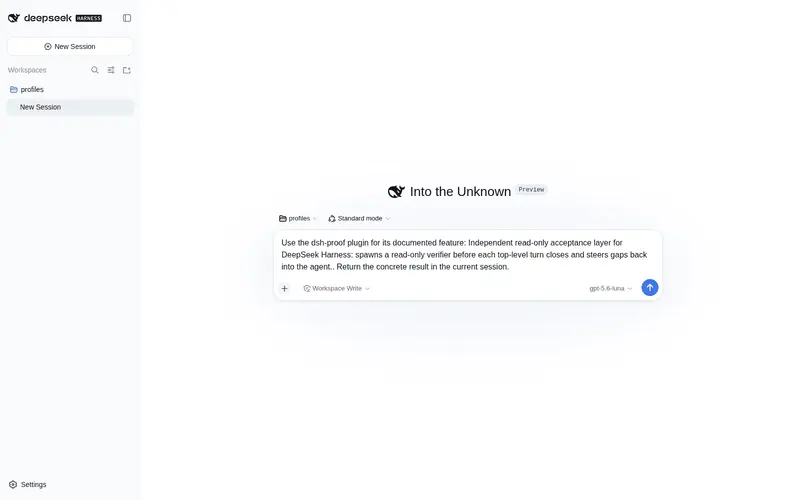
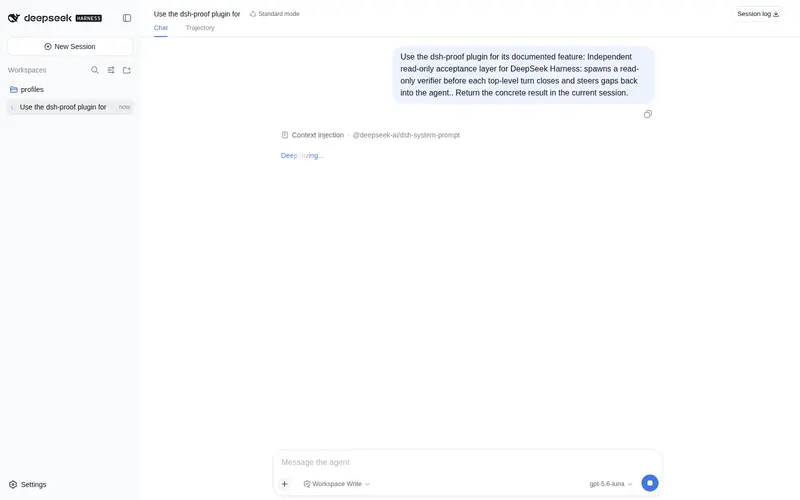
What it does
Independent read-only acceptance layer: spawns a read-only verifier before each top-level turn closes and steers non-pass gaps back into the agent.
Best for
- Agent workflows that need an independent read-only completion check before each top-level turn closes.
- Teams that want acceptance gaps automatically returned to the driving agent for another attempt.
- Deployments that can maintain an accurate deny list while allowing the verifier to use read-only discovery tools.
Not ideal for
- Deployments without a working subagent provider; verifier spawn failures degrade to a logged no-op.
- Environments whose configured deny-list tool names do not match registered tools, because verifier startup fails loudly.
- Workflows requiring deterministic test or lint enforcement; the plugin does not normalize evidence and treats incomplete verifier runs as no objection.
README
dsh-proof
Independent read-only acceptance layer for the DeepSeek Harness.

Before each top-level turn closes, dsh-proof spawns a read-only verifier
subagent, collects its structured verdict, and steers any non-pass gaps back
into the driving agent. It is the harness’s missing “is the agent actually
done” gate — no other plugin can substitute for it.
Install
dsh plugin --profile <name> add github:EvilIrving/dsh-proof
Or, from a checkout:
dsh plugin --profile <name> add ./dsh-proof
The bundle patch inserts one plugin row (dsh-proof); it needs the
subagents service (the official dsh-subagent providers), which the base
profile already mounts.
How it works
| Step | Mechanism |
|---|---|
| Intercept “about to close” |
agent/turn-stopping (serial, awaited before the turn commits) |
| Spawn a read-only verifier |
ctx.subagents.start('spawn', …) with toolFilter.deny + outputSchema
|
| Block recursion |
delegationDepthOf(agent) > 0 filter + maxDepth: 0
|
| Steer gaps back |
agent.inject(gap details) + agent.steer(followup) on fail / insufficient-evidence
|
The verifier inherits the parent’s tool set and is narrowed by the deny list
(see deny list); it never sees a whitelist that could
accidentally hide a newly added read-only tool. A verifier that ends with
stopReason !== 'completed' or a missing structured result is treated as
“no objection”, so a failed proof never fails the user’s turn.
Config
export interface Config {
  providerName: string          // default 'spawn'
  maxAttemptsPerTurn: number    // default 3
  denyTools: string[]           // default mutating-tool deny list
  verifierPrompt: string        // read-only acceptance instruction
  followupInstruction: string   // steering text after a failed verdict
}
Set any field from cordis.yml:
plugins:
  dsh-proof:
    config:
      maxAttemptsPerTurn: 2
      denyTools: [write, edit, str_replace_editor, bash, run_code, subagent]
Deny list
toolFilter.deny removes tools from the verifier’s inherited full set.
tools.restrict validates every name loudly, so denyTools must name tools the
deployment actually registers. The default is
write, edit, str_replace_editor, bash, run_code, subagent, which keeps
read-only discovery tools (read, read_image, glob, grep) available. A
deployment that adds its own mutating tools must extend the list; a deployment
that forbids even shell/read access should switch to an explicit allow
whitelist (set denyTools and verifierPrompt to match, or extend the plugin
for an allowTools field).
Model Experience
Request context and condition
What the model sees
The top-level agent receives an injected user message listing the verifier’s
gaps and evidence, followed by the configured followupInstruction. Only a
non-pass verdict injects anything; a passing turn adds nothing.
Token effect
Zero-direct effect on passing turns. A failing turn adds one bounded injected message (gaps + evidence) plus the short follow-up line.
KV Cache effect
Append-only: the injected context and follow-up are appended as new user messages, never rewriting earlier request tokens.
Known Limitations and Deferred Work
-
Deny list must match the deployment’s tools —
tools.restrictfails loud on unknown names, so a mismatched default blocks verifier startup. The exact mutating-tool set is deployment-specific and is resolved at first install. -
No evidence normalization — the verifier gathers evidence itself; this
plugin does not re-implement diff/test/typecheck/lint. A deployment wanting
specific evidence channels should extend
verifierPrompt. - Best-effort spawn — a provider that is absent or rejects the request degrades to a no-op (logged), rather than failing the user’s turn.
Frequently Asked QuestionsFAQ
Use the verified command dsh plugin --profile default add github:EvilIrving/dsh-proof in a DSH-enabled shell. The command resolves the public package metadata and keeps the plugin attached to the catalog identity shown on this page.
Compatibility follows the bundle and profile status shown above. If a profile is not detected, keep the plugin disabled there and check the repository documentation before enabling it in production.
The GitHub link and activity metadata are the source of truth for releases and maintenance. Revisit this page after a new release to confirm the catalog has observed the latest version.