GPIOX/dsh-api-balance
DeepSeek Harness 动态 Cordis 插件:可拖动、可缩放、亚克力质感的 API 余额悬浮徽章
Listed
1
Usage
Bundle verified
Preview
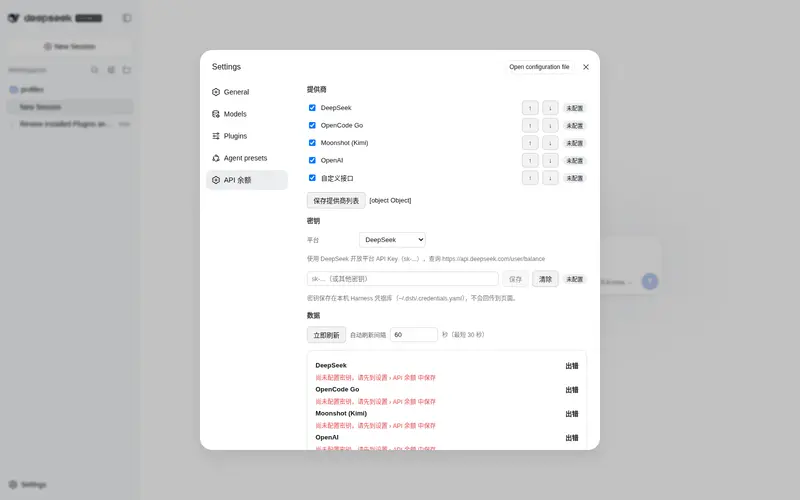
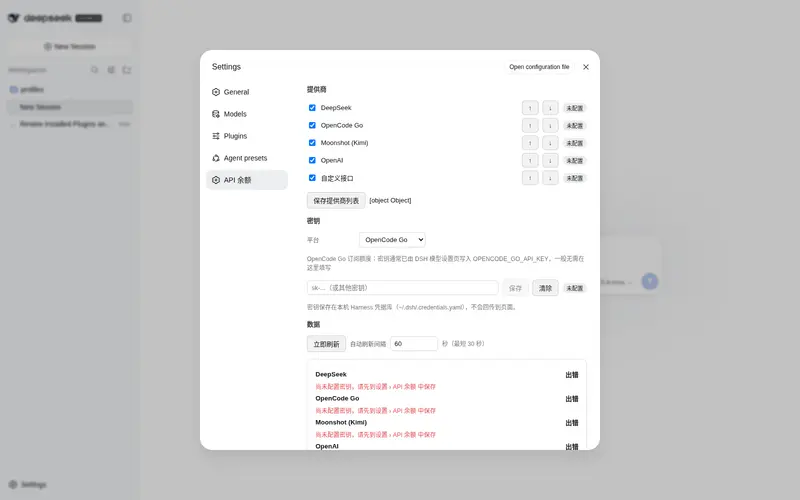
What it does
Floating API-balance badge for DeepSeek Harness: live balance for DeepSeek, Moonshot, OpenAI and custom endpoints; draggable, resizable, frosted-glass look, with text color adapting to the content beneath.
Best for
- DeepSeek Harness users who monitor balances across DeepSeek, Moonshot, OpenAI, or custom endpoints.
- Users who want provider balances or OpenCode Go quotas visible without opening separate billing pages.
- Multi-provider setups that benefit from independently positioned, resizable badges and scheduled refreshes.
Not ideal for
- Workflows outside the DeepSeek Harness Web GUI.
- OpenAI users who cannot provide a browser session token; OpenAI has no API-key balance endpoint, and session tokens expire.
- Users who do not need persistent at-a-glance balance or quota monitoring.
README
DSH API Balance · Floating API Balance Badge
A floating badge for the DeepSeek Harness (DSH) Web GUI. Shows your LLM API account balance, drags anywhere, resizes, and switches text color to match whatever sits beneath it.


Screenshots


The screenshots show the badge itself only. No real UI or conversation content.
Features
- Floats in a frame-wide overlay above every column. Click-through, so it never blocks the app underneath.
- One badge per configured provider. Drag each one anywhere and resize it from 70% to 250% with its bottom-right handle.
- Frosted-glass look: translucent neutral tint, backdrop blur, a thin border. Reads fine on light and dark skins.
- Text color follows the brightness of the content beneath each badge, light text over dark areas and dark text over light ones. Sampled every 1.5 seconds.
- Balance providers (DeepSeek, Moonshot, OpenAI, custom endpoint) show the currency balance. OpenCode Go shows its subscription quota in three windows: rolling 5h, weekly, and monthly, each with used and remaining percentages and a reset countdown.
- Click a badge to refresh all of them. Data refreshes itself every minute by default, configurable down to 30 seconds.
- API keys stay in the Harness credential store (
~/.dsh/.credentials.yaml) and never reach the browser. - The settings page manages the provider list (enable/disable, order), per-provider keys, balance and quota details, badge visibility, and position reset.
Installation
One command installs the plugin into your DSH web profile and registers it automatically (dsh plugin reconciles dsh.profile.bundles for you). The tarball form is plain HTTPS. You don’t need a GitHub account, an SSH key, or git:
dsh plugin --profile web add https://github.com/GPIOX/dsh-api-balance/archive/refs/heads/main.tar.gz
Alternative git-based form (resolves through your local git configuration):
dsh plugin --profile web add github:GPIOX/dsh-api-balance.
Then restart DSH (stop the dsh process and run it again, e.g. dsh web), refresh the page, and open Settings › API Balance to save your key. The badge shows up right away.
Uninstall / rollback:
dsh plugin --profile web remove dsh-api-balance-badge
The in-app Market (Settings › Plugins/Market) can install it too once it is listed in the awesome-dsh-plugin registry. For local development:
dsh plugin --profile web add link:/path/to/dsh-api-balance-badge.
Zero-install quick start (dynamic plugin)
If you would rather not touch your profile, paste the plugin into any DSH Web GUI session as a dynamic plugin. No build step and no restart:
- Call the
cordis_definetool (kind: "new", any 3-6 letter prefix) and pasteplugins/api-balance/host.js/plugins/api-balance/client.jsascode.host/code.client - Activate the returned Package with
cordis_runand click Approve on the run card - Open Settings › API Balance, pick a provider, paste your key, and save. The badge shows your balance immediately
Dynamic plugins live in the process, not on disk. After a DSH restart, define and activate it again (both source files are in this repo).
Supported providers
| Provider | Balance endpoint | Auth | Notes |
|---|---|---|---|
| DeepSeek | GET https://api.deepseek.com/user/balance |
API Key (sk-...) |
total / granted / topped-up (CNY) |
| Moonshot (Kimi) | GET https://api.moonshot.cn/v1/users/me/balance |
API Key (sk-...) |
available / voucher / cash (CNY) |
| OpenAI | GET https://api.openai.com/dashboard/billing/credit_grants |
Browser session token (sess-...) |
OpenAI offers no API-key balance endpoint; session tokens expire |
| OpenCode Go | GET https://opencode.ai/zen/go/v1/usage |
API key (usually OPENCODE_GO_API_KEY, written by the DSH Models page) |
subscription quota: rolling 5h / weekly / monthly, each with used and remaining percentage plus reset time |
| Custom | any GET endpoint (Bearer auth) | your own | JSON field paths like data.available_balance or balance_infos[0].total_balance, such as relay stations |
Security
- The browser only sees whether a key is configured. The plaintext key is never sent back to the page.
- Keys are stored by the Harness credential service (
~/.dsh/.credentials.yaml), the same place DSH keeps its other secrets. - Requests use native fetch (packaged install) or
curlwith the key via environment variable (dynamic plugin). Either way the key never lands in process listings or the browser.
Repository layout
.
├── assets/                  # README screenshots (badge renders, no real UI content)
├── lib/index.js             # Host half: /dsh-api-balance-badge/* HTTP routes + credential handling
├── client/client.js         # Client half: floating badge + settings page (factory bundle)
├── cordis.patch.yml         # Bundle patch inserting this plugin into a profile
├── package.json             # DSH plugin package manifest (dsh.bundle / dsh.client)
├── plugins/api-balance/     # Same halves as dynamic-plugin sources (zero-install path)
│   ├── host.js
│   ├── client.js
│   └── README.md
├── LICENSE                  # MIT
├── README.md                # this file (English)
└── README.zh-CN.md          # 中文文档
License
MIT © 2026 GPIOX
Frequently Asked QuestionsFAQ
Use the verified command dsh plugin --profile default add github:GPIOX/dsh-api-balance in a DSH-enabled shell. The command resolves the public package metadata and keeps the plugin attached to the catalog identity shown on this page.
Compatibility follows the bundle and profile status shown above. If a profile is not detected, keep the plugin disabled there and check the repository documentation before enabling it in production.
The GitHub link and activity metadata are the source of truth for releases and maintenance. Revisit this page after a new release to confirm the catalog has observed the latest version.