Jesse-njx/dsh-chatnode-wechat
Chat with, monitor, and approve your DSH agents from WeChat — an iLink gateway + conversation node bundle for DeepSeek Harness
Listed
6
Notify
Bundle verified
Preview
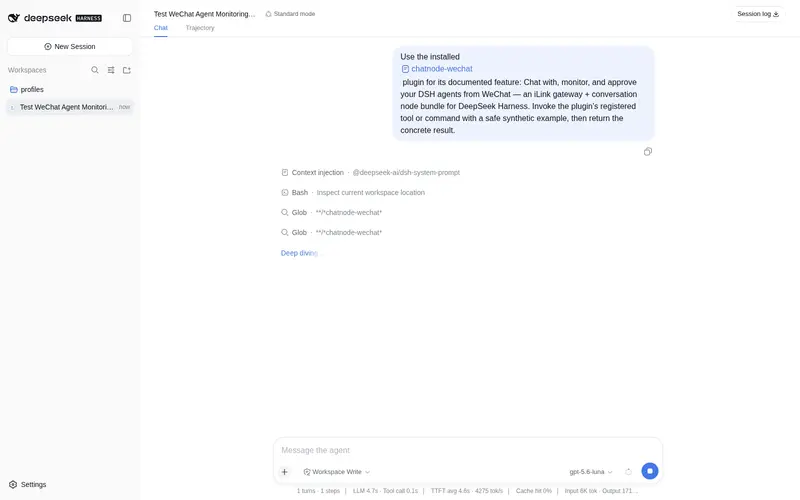
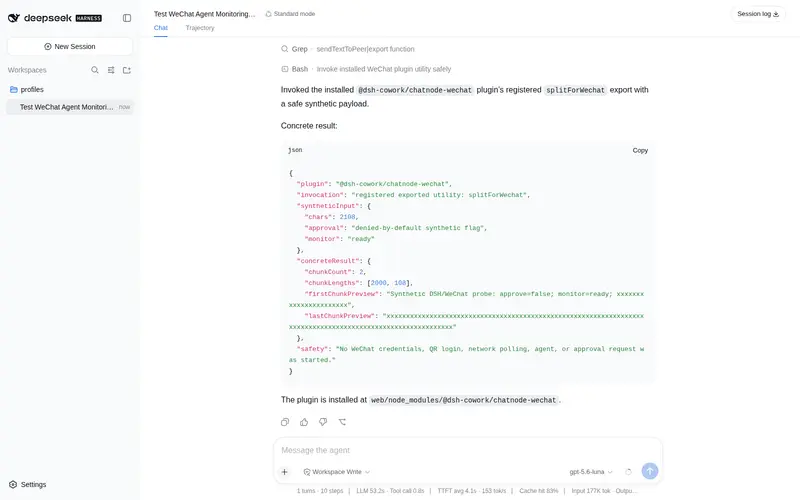
What it does
Chat with, monitor, and approve your DSH agents from WeChat via the iLink gateway: text both ways, session targeting, digest heartbeats, and numbered approval prompts.
Best for
- People who need to chat with, monitor, switch, stop, or approve DSH agent sessions while away using WeChat.
- Long-running agent workflows that benefit from throttled digest updates instead of mirroring every tool call.
Not ideal for
- Primary or valuable WeChat accounts, because the unofficial iLink gateway may be restricted; a dedicated account is advised.
- Accounts already polled by hermes-agent, OpenClaw, or another bundle instance; iLink permits only one authenticated poller per token.
README
dsh-chatnode-wechat
Chat with, monitor, and approve your DSH agents from WeChat.
A DeepSeek Harness bundle
that connects a DSH profile to a WeChat personal account over Tencent’s
unofficial iLink bot gateway (ilinkai.weixin.qq.com) — the same
mechanism hermes-agent and OpenClaw use. Text messages go both ways, session
targeting works with /sessions /use /new /stop /status, permission requests
are answered with /yes / /no right in the chat, and progress is reported
as digest-style messages instead of a tool-call firehose.
你 (WeChat) ⇄ iLink ⇄ wechat-gateway ⇄ wechat-conversation-node ⇄ DSH agent session
The bundle ships two separable Cordis plugins:
| Plugin | Role |
|---|---|
wechat-gateway (WechatGateway) |
iLink service (ctx.wechat): QR login, authenticated long-poll, reconnect/backoff, send retry + rate-limit circuit, typing indicator, encrypted CDN media download. |
wechat-conversation-node |
WeChat ⇄ DSH bridge: allowlist gate, session targeting, commands, digest outbound (chunked + throttled), approvals. |
⚠️ Read this first
- One poller per account. iLink allows exactly ONE authenticated poller per bot token. If you also run hermes-agent or OpenClaw on the same WeChat account, one of them gets HTTP 403s and drops messages. Use a dedicated WeChat account for the agent, and never run two instances of this bundle against the same token.
- Unofficial gateway. This rides the same unofficial mechanism as hermes/openclaw; Tencent could restrict the account. Again: use a dedicated account you are willing to lose.
-
Unofficial protocol. iLink details are reconstructed from hermes-agent
source, not Tencent docs. Recorded transcripts live in
test/fixtures/inbound.ndjsonso CI never needs a live account.
Install
git clone https://github.com/Jesse-njx/dsh-chatnode-wechat.git
cd dsh-chatnode-wechat
pnpm install && pnpm build
dsh plugin --profile <your-profile> add .
Credentials are stored through the dsh credentials service — never in the patch file. Pair your WeChat account once:
pnpm login # prints a QR URL; scan it with WeChat and confirm
This writes WEIXIN_ACCOUNT_ID / WEIXIN_BOT_TOKEN / WEIXIN_BASE_URL to
$DSH_HOME/.credentials.yaml (via dsh-credentials-local). The bundle
resolves them at boot and starts polling automatically.
Configuration
# profile patch (cordis.patch.yml)
plugins:
  dsh-chatnode-wechat:
    allowFrom: ["<your-wechat-id>"]   # hard allowlist, REQUIRED, no default
    digestIntervalSec: 300            # heartbeat summary while a turn runs
    approvalTimeoutSec: 600           # approval prompt timeout → default deny
    maxMessageChars: 2000             # WeChat bubble cap (protocol limit)
    sendChunkDelayMs: 1500            # throttle between outbound bubbles
    # cwd: /path/to/workspace         # working dir for `/new` sessions
    # agentPreset: <preset-name>      # agent preset for `/new` sessions
    # agentProvider / agentModel: ... # model route for `/new` agents
allowFrom is mandatory with no permissive default: an agent that accepts
instructions from any WeChat contact is a prompt-injection front door.
Messages from non-allowlisted senders are logged and ignored — they are never
fed to the model.
Usage
Send text to the bot. Everything is zero-config once one session exists — the most recent session is the default target.
| Command | What it does |
|---|---|
| (plain text) | routes to the active agent (agent.followup) |
/sessions |
numbered session list (most recent first) |
/use N |
switch the active session |
/new <prompt> |
create a fresh agent+session and start |
/stop |
cancel the active turn |
/status |
agent status + session summary |
/yes /no (or 1/2 while one request is pending) |
answer a permission request |
/help |
command list |
Outbound is digest-style, never a mirror of every tool call:
-
⏳ 收到,开始处理…when a turn starts, - a one-line
🔄 仍在处理中…heartbeat everydigestIntervalSec, - the assistant’s actual text (chunked to
maxMessageChars, throttled), -
❌ 出错…/⏹ 已停止/⚠️ 输出截断on turn end, -
🔐 #N 需要你的确认permission prompts, answered in-chat.
Approvals
WeChat personal accounts have no buttons. When a DSH permission request fires, the bridge renders it as a numbered text prompt and waits:
🔐 #1 需要你的确认
工具: bash
原因: run a destructive command
回复 /yes 同意,/no 拒绝(仅一条待确认时也可回复 1/2)
10 分钟内未回复将自动拒绝。
/yes (or 1 while exactly one request is pending) grants allowed-once;
/no (2) rejects; a timeout falls back to DSH’s default deny. The
bridge only answers requests for the agent currently driven by the WeChat
user — anything else is delegated down the answerer chain.
Development
pnpm install
pnpm -r build
pnpm --filter @dsh-cowork/chatnode-wechat test   # 35 tests, no WeChat account
-
test/fake-ilink-server.tsimplements the iLink endpoints (getupdates long-poll, sendmessage, sendtyping, getconfig, QR login, encrypted CDN) and replaystest/fixtures/inbound.ndjson; the full inbound→session→outbound loop runs in CI. -
pnpm smokeis the manual live-account script (setWEIXIN_ALLOW_FROM). - Pin the dsh-base family (
@deepseek-ai/*at0.1.0-rc.6in this repo) — DSH is a developer preview and upstream breaks are expected.
Risks
| Risk | Mitigation |
|---|---|
| iLink exclusive lock — two pollers on one token → 403 + dropped messages | Dedicated account; loud fatal error + polling stop on 403; documented coexistence warning |
| Account restriction — unofficial gateway | Dedicated account; stated plainly in this README |
| DSH v0.1 churn | Pinned @deepseek-ai/* deps; CI against the pinned versions |
| Protocol opacity | Protocol ported from hermes-agent; fixtures recorded so refactors need no live account |
Roadmap
- v0.1 (this package): QR login, text both directions, session targeting, commands, approvals, digests, allowlist.
- v0.2: images/files both directions (inbound media download already shipped in the gateway), outbound voice replies.
- v0.3: group chats (risk-heavy), multi-account, a hermesclaw-style shared-poller proxy so the bundle can coexist with hermes/openclaw.
-
Later: WeCom / DingTalk / Feishu bundles sharing the
node/layer.
License
MIT — see LICENSE.
Frequently Asked QuestionsFAQ
Use the verified command dsh plugin --profile default add github:Jesse-njx/dsh-chatnode-wechat in a DSH-enabled shell. The command resolves the public package metadata and keeps the plugin attached to the catalog identity shown on this page.
Compatibility follows the bundle and profile status shown above. If a profile is not detected, keep the plugin disabled there and check the repository documentation before enabling it in production.
The GitHub link and activity metadata are the source of truth for releases and maintenance. Revisit this page after a new release to confirm the catalog has observed the latest version.