JohnXu22786/hooks-adapter
Universal hooks compatibility layer for DeepSeek Harness: run hooks declared in Claude Code / Codex / opencode configs on dsh
Listed
0
Dev
Bundle verified
Preview
What it does
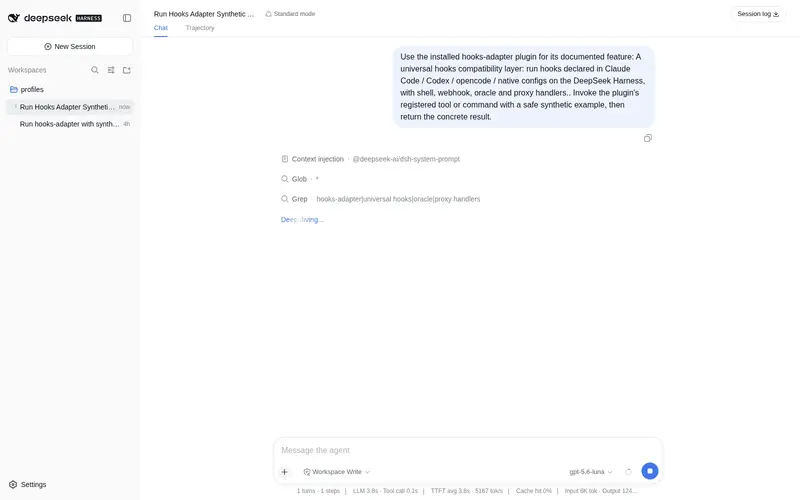
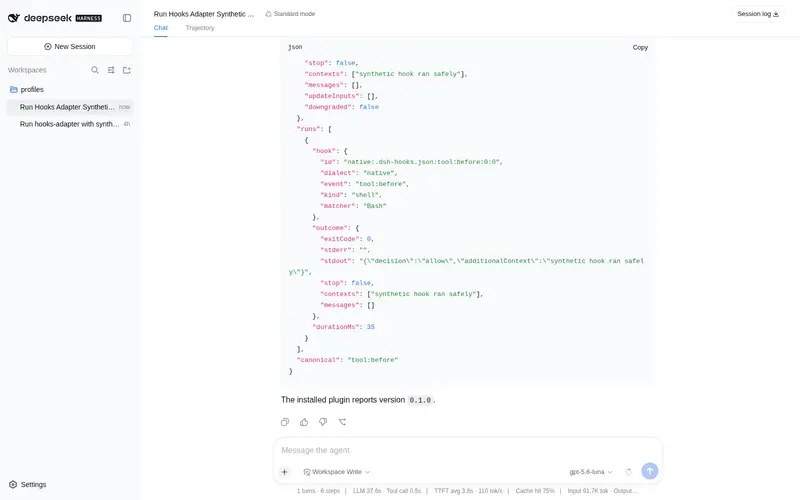
Reuses hooks declared in Claude Code, Codex and opencode configs on dsh, executing shell, webhook, oracle and proxy handlers with zero runtime dependencies.
Best for
- Teams migrating among Claude Code, Codex, opencode, and DSH while retaining existing hook configurations.
- DSH workflows needing lifecycle handlers for shell commands, webhooks, model evaluation, or subagent delegation.
Not ideal for
- Projects without existing hook declarations or lifecycle automation needs.
- Configurations that are not strict JSON, or environments unable to provide the external endpoints or commands required by their handlers.
README
hooks-adapter
A hooks configuration compatibility layer for DeepSeek Harness (dsh): it reads existing hooks config files from mainstream agent harnesses (such as the hooks declarations in .claude/settings.json, .codex/hooks.json, and the hooks section of opencode.json), maps their lifecycle events to dsh extension points, and executes four kinds of handlers — shell / webhook / oracle / proxy — so the same hooks config can be reused as-is across different harnesses.
- Zero runtime dependencies (Node ≥ 18, pure ESM + JSDoc types)
- Config is read-only, not migrated: your existing hooks declarations stay unchanged
- All four handler kinds supported: command execution, HTTP callbacks, LLM evaluation, subagent delegation
- Timeout control, failure degradation policy, and friendly config validation (
validatesubcommand) - Three integration modes: dsh plugin (Cordis
apply), stdio JSON-lines protocol (any host), one-shot CLI
hooks-adapter/
├── package.json        # dsh bundle manifest (dsh.bundle + exports)
├── cordis.patch.yml    # composite package layer: inserts this plugin into the plugin tree
├── dsh/plugin.js       # dsh entry: Cordis plugin (name + apply(ctx, config))
├── lib/                # runtime core (usable independently of dsh)
│   ├── index.js        # CLI entry + programmatic API exports
│   ├── events.js       # canonical event catalog + four-dialect mapping table + matcher semantics
│   ├── discover.js     # config file discovery (global/project/local)
│   ├── parse.js        # four-dialect parsers (all go through diagnostics, never throw)
│   ├── config.js       # runtime assembly: merging, disableAllHooks, defaults
│   ├── contract.js     # stdin JSON contract construction + response decoding + decision folding
│   ├── execute.js      # four-kind handler executor + timeout + process tree cleanup
│   ├── dispatch.js     # dispatch pipeline: matcher matching, ordered execution, blockable constraints
│   └── serve.js        # stdio JSON-lines protocol server
├── docs/               # config formats, event mapping, contract, integration notes, CLI guide
├── examples/           # four-dialect example configs + local mock LLM
└── test/               # node:test tests (111 items)
What It Can Do
Declare hooks in .claude/settings.json (no matter which harness you wrote them for) and they keep working in dsh:
{
  "hooks": {
    "PreToolUse": [
      {
        "matcher": "Bash",
        "hooks": [
          { "type": "command", "command": "guard.sh", "timeout": 10 }
        ]
      }
    ],
    "Stop": [
      { "hooks": [ { "type": "command", "command": "notify-send done" } ] }
    ]
  }
}
Config files must be strict JSON (no comments); see examples/ for complete four-dialect examples.
-
PreToolUse→ interception point before tool execution: handler exit code 2 / JSONdecision: "block"will block the tool call (or turn it into ask for human confirmation) -
PostToolUse/PostToolUseFailure→ after tool execution (mutually exclusive triggers): reject the write-back as result feedback, append context -
UserPromptSubmit/SessionStart/Stop/SubagentStart/SubagentStop/SessionEnd→ inject context, reject prompts, force the model to continue -
Notification/PreCompact→ triggered manually or via the stdio protocol
The four handler kinds (the type field in config follows each harness’s conventions; normalized internally):
| Config type | Internal kind | Behavior | Default timeout |
|---|---|---|---|
command |
shell |
spawn a shell process, feed the JSON contract on stdin | 600s |
http |
webhook |
POST JSON to a URL, the response body is the decision | 600s |
prompt |
oracle |
call an LLM endpoint to evaluate, {ok:false} rejects |
30s |
agent / subagent
|
proxy |
delegate to a subagent runner (configurable command) | 60s |
Quick Start
Mode one: dsh plugin (recommended)
# From a directory containing this plugin checkout
dsh plugin --profile demo add ./hooks-adapter
dsh --profile demo
After loading, the plugin automatically discovers hooks configs in project and user directories (see below). You can also override the config line in the profile’s cordis.patch.yml:
- replace:
    - id: hooks-adapter
      config:
        configPath: /abs/path/to/hooks.json   # pin a single file (skip discovery)
        discover: false
        llm: { baseUrl: "https://api.example.com/v1", model: "eval-small" }
        proxy: { command: "dsh run --quiet" }
Integration details: docs/INTEGRATION.md.
Installing in DSH
Install directly from the GitHub repository with the dsh plugin command:
dsh plugin --profile demo add github:JohnXu22786/hooks-adapter
The package is a dsh bundle (dsh.bundle.patch → cordis.patch.yml); once added, it inserts itself into the plugin tree and automatically discovers hooks configs on the next dsh run. Remove it with:
dsh plugin --profile demo remove hooks-adapter
Mode two: stdio protocol (any host)
echo '{"op":"ping"}' | node lib/index.js listen --config hooks.json
echo '{"op":"dispatch","event":"PreToolUse","payload":{"tool_name":"Bash","tool_input":{}}}' | node lib/index.js listen
Protocol details: docs/CONTRACT.md.
Mode three: one-shot CLI
node lib/index.js validate            # check all discoverable configs, exit code 0/1
node lib/index.js run --event PreToolUse --payload payload.json
node lib/index.js dump                # print the merged effective config
node lib/index.js list                # list discovered config files
Where the Config Comes From
Auto-discovered and merged in order (later files append groups for same-named events; disableAllHooks follows the most specific file):
| Order | File | Dialect |
|---|---|---|
| 1 | ~/.claude/settings.json |
claude |
| 2 | ~/.codex/hooks.json |
codex |
| 3 | ~/.config/opencode/opencode.json |
opencode |
| 4 | ~/.config/hooks-adapter/hooks.json |
native |
| 5 | <project>/.claude/settings.json |
claude |
| 6 | <project>/.codex/hooks.json |
codex |
| 7 | <project>/opencode.json |
opencode |
| 8 | <project>/.dsh-hooks.json |
native |
| 9 | <project>/.claude/settings.local.json |
claude |
- Environment variables
HOOKS_ADAPTER_CONFIG(same as--config) andHOOKS_ADAPTER_HOME(same as--home) - Any missing file is silently skipped; if an existing file has issues, it only produces diagnostics, it never blocks startup
- Config file format details: docs/CONFIG.md
Event Mapping
Every harness’s event names map to a set of canonical events (session:start, tool:before, …), which then bind to dsh extension points:
| Canonical event | claude dialect | codex dialect | opencode dialect | dsh extension point |
|---|---|---|---|---|
session:start |
SessionStart |
SessionStart |
session.created |
agent/session-start |
session:end |
SessionEnd |
SessionEnd |
session.deleted |
session/disposed |
prompt:submit |
UserPromptSubmit |
UserPromptSubmit |
chat.message |
agent/pre-step |
tool:before |
PreToolUse |
PreToolUse |
tool.execute.before |
tools/pre-execute |
tool:after |
PostToolUse / PostToolUseFailure
|
PostToolUse |
tool.execute.after |
tools/post-execute |
turn:stop |
Stop |
Stop |
session.idle |
agent/turn-stopping |
subagent:start |
SubagentStart |
SubagentStart |
tool.execute.before.subagent |
subagent/start |
subagent:end |
SubagentStop |
SubagentStop |
tool.execute.after.subagent |
subagent/end |
notice |
Notification |
Notification |
notification |
manual / stdio |
compact:before |
PreCompact |
— | experimental.session.compacting |
manual / stdio |
Full semantics (blockability, matcher rules, payload fields): docs/EVENTS.md.
Contract
-
stdin JSON:
session_id,transcript_path,cwd,hook_event_name,permission_mode+ event fields (tool_name/tool_input/tool_use_id/tool_response/prompt/source…) -
Exit codes:
0= allow (when stdout is JSON, the decision is parsed from it);2= block (stderr is the reason); any other non-zero = non-blocking error -
stdout JSON:
decision,continue/stopReason,systemMessage,hookSpecificOutput.permissionDecision(allow/deny/ask),additionalContext,updatedInput; oracle answers{ok: true|false, reason} -
Multi-hook folding:
deny > ask > allow; anycontinue:falsestops; context accumulates in hook order - Details and the stdio protocol: docs/CONTRACT.md
Testing
node --test
(The default test-discovery mode runs all 111 tests; helper scripts live in test-support/ and are not mistaken for tests.)
License
Released under the MIT License.
Frequently Asked QuestionsFAQ
Use the verified command dsh plugin --profile default add github:JohnXu22786/hooks-adapter in a DSH-enabled shell. The command resolves the public package metadata and keeps the plugin attached to the catalog identity shown on this page.
Compatibility follows the bundle and profile status shown above. If a profile is not detected, keep the plugin disabled there and check the repository documentation before enabling it in production.
The GitHub link and activity metadata are the source of truth for releases and maintenance. Revisit this page after a new release to confirm the catalog has observed the latest version.