labmimors/dsh-mcp-lens
DeepSeek Harness MCP tool search for large catalogs: 1,000 MCP tools behind 2 MCP-facing schemas, exact-schema calls, allow/deny controls, and a local calculator.
Listed
5
Dev
Bundle verified
Preview
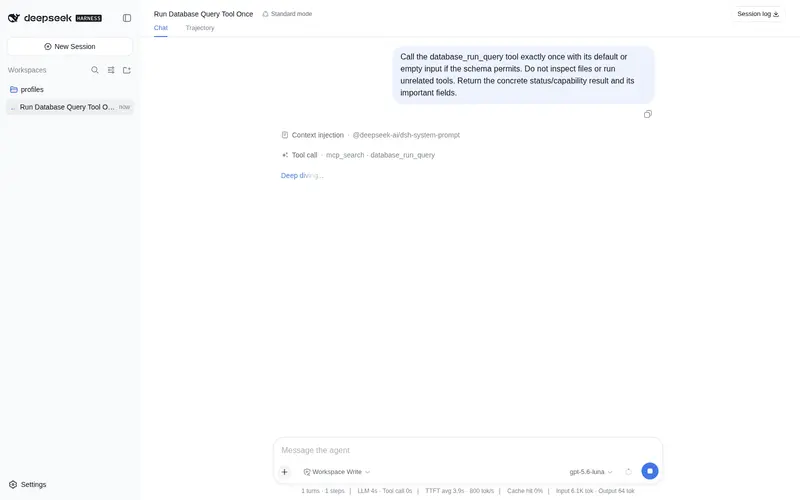
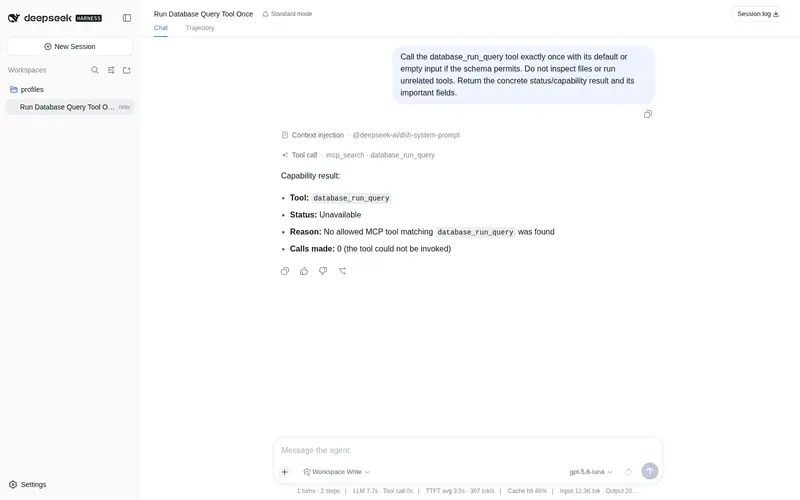
What it does
Progressive-disclosure MCP gateway that searches large remote catalogs through `mcp_search`, then invokes exact schemas through `mcp_call` with lazy connections and bounded caches.
Best for
- DeepSeek Harness users managing dozens to thousands of tools across multiple MCP servers.
- Workflows that benefit from searching first and exposing only a small ranked set of exact tool schemas.
- Teams that need allow/deny controls around the final server and tool selection.
Not ideal for
- Small catalogs where a handful of tools are used on nearly every request.
- Environments that cannot meet the documented DeepSeek Harness rc.6, Node.js, and pnpm prerequisites.
- Workflows where the additional search step provides no benefit over direct tool selection.
README
MCP Lens for DeepSeek Harness
| English | 简体中文 |
Website · Local schema calculator · Install rc.9



Shrink large MCP catalogs to a two-tool model surface.
MCP Lens lets DeepSeek Harness search and call 1,000 remote tools through two stable model-facing interfaces. Instead of sending every tool schema on every turn, it reveals exact schemas only for a small ranked set when a tool is actually needed.
If this keeps a large MCP catalog manageable for you, star the repository so more DeepSeek Harness users can find it.
Why users install it:
- Spend less on input-heavy turns: in the dated three-task pilot, estimated DeepSeek V4 Flash cost fell from
$0.0307204to$0.0034707. - Keep more room for the real task: the same pilot reduced
request/header.toolsJSON from674,249 Bto27,401 B. - Retrieve more relevant covered calls: on a frozen MCP-Atlas-derived convenience holdout, Recall@5 rose from
0.062610to0.246656across 304 untouched prompts. This is lexical retrieval evidence, not an official MCP-Atlas or end-to-end score. - Avoid rebuilding the same search index on every query: rc.9 reuses the tokenized index for each Lens-owned frozen catalog and policy generation, then invalidates it when the catalog changes.
- Narrow the tool-choice surface: search reveals only a small ranked set of exact schemas, and the final
server/toolis still gated byallowToolsanddenyTools. - Preserve completion in the tested pilot: both arms completed
3/3tasks, while Lens used one extra search step.
Use MCP Lens if you have dozens to thousands of MCP tools, multiple servers, or long-tail tools that are expensive to advertise on every turn. Skip it if you have only a handful of tools that are used almost every request.
Install rc.9
Prerequisites: DeepSeek Harness 0.1.0-rc.6, Node.js ^22.19.0 or >=24.0.0, and pnpm on PATH. The dsh plugin command delegates installation to pnpm.
Fastest install:
dsh plugin --profile web add dsh-mcp-lens@next
For a reproducible install, pin the reviewed version:
dsh plugin --profile web add dsh-mcp-lens@0.1.0-rc.9
The npm next tag currently resolves to 0.1.0-rc.9. The registry tarball was downloaded after publication and verified byte-for-byte against the reviewed GitHub rc.9 asset (SHA-256 a8e4bf8389d0107379c13c845feb3c7c0c26d4aa3312391640e1fed074d39dbc), then installed in a fresh DeepSeek Harness rc.6 profile.
Frequently Asked QuestionsFAQ
Use the verified command dsh plugin --profile default add github:labmimors/dsh-mcp-lens in a DSH-enabled shell. The command resolves the public package metadata and keeps the plugin attached to the catalog identity shown on this page.
Compatibility follows the bundle and profile status shown above. If a profile is not detected, keep the plugin disabled there and check the repository documentation before enabling it in production.
The GitHub link and activity metadata are the source of truth for releases and maintenance. Revisit this page after a new release to confirm the catalog has observed the latest version.