omdsh-dev/ex-setting
DSH的设置扩展
Listed
2
Ui
Bundle verified
Preview
What it does
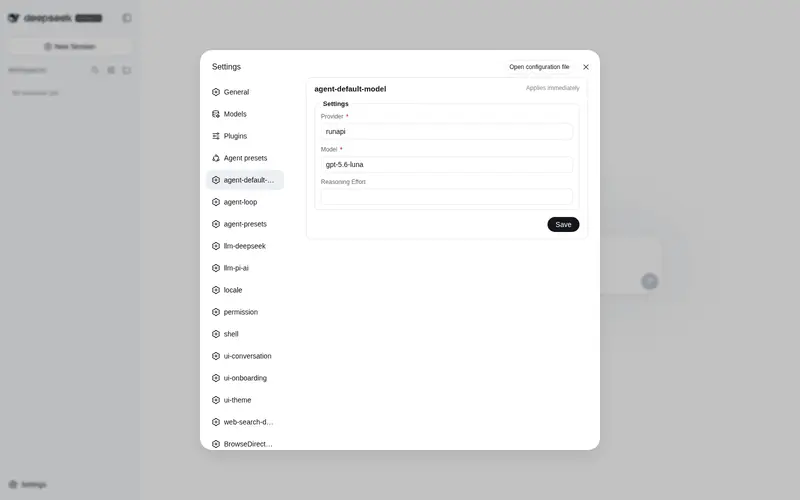
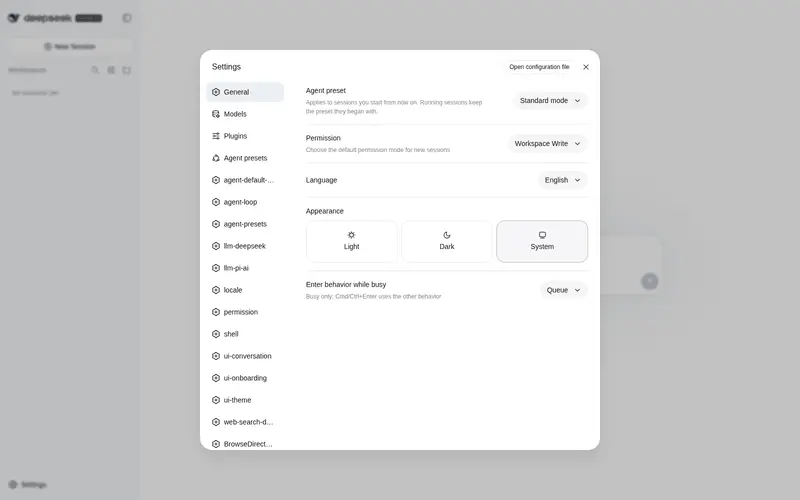
Settings extensions for DSH.
Best for
- DSH Web administrators who want registered settings namespaces and schema-backed composition rows exposed through a unified settings interface.
- Deployments needing secret-redacted configuration editing, reset behavior, revision-conflict handling, and live invalidation refreshes.
Not ideal for
- Profiles that do not already provide the required cordis-fabric and cordis-fabric-api 0.1.0 runtime pair.
- Deployments that do not want broad automatic composition editing, or need generic editing of native Zod schemas that lack schemastery toJSON() output.
README
@deepseek-ai/dsh-ex-setting
| English | 中文 |
The automatic DSH Web settings bundle. It combines the host-side configuration crawler with its browser settings navigation in one external package: the host enumerates registered settings namespaces and schema-bearing composition rows, while the client projects them into first-level settings sections and editors.
Repository shape
package.json              # host/client package and dsh.bundle/dsh.client manifests
cordis.patch.yml          # profile layer that mounts the crawler
src/index.ts              # host crawler plugin (service provide + Fabric handler binding)
src/routes.ts             # crawler-owned webserver composition route
src/nav-scroll.ts         # browser bundle rewrite contract (serveBrowserTransform)
src/invariant.ts          # crawler invariant companion
src/client/               # browser settings page (store, section, crawler wire)
lib/                      # generated host/client artifacts
docs/                     # detailed host and client protocol references
tests/host/               # crawler, route, invariant, loader, and Fabric composition tests
tests/client/             # browser store and section tests
patches/                  # host patch contract (empty: zero out-of-package changes)
scripts/                  # verify:self-contained, host patch extraction/applier
.agents/skills/           # dsh-plugin-* contributor workflow
The two runtime faces share one package identity so the release/profile installation has one root artifact. The browser face is exported as @deepseek-ai/dsh-ex-setting/client and is selected by the package’s dsh.client manifest.
The profile must already provide the cordis-fabric and cordis-fabric-api 0.1.0 runtime pair. They are required peer dependencies of this plugin, not dependencies or bundledDependencies, so the release tarball never carries a second Fabric copy. This repository’s pnpm-workspace.yaml enables strictPeerDependencies, so local installs and checks fail when either peer is unavailable. Install the Fabric release bundle in the consuming profile first; a package’s workspace setting is not copied into that profile’s pnpm configuration. The profile must still include that Fabric bundle because its fabric-dsh launcher installs the load-time hooks and bootstrap row.
Bundle behavior
Installing the bundle adds the web-config-crawler row. That is the deployment-level decision to expose all registered settings namespaces and schema-carrying composition rows through the Web configuration plane. A profile can disable it:
- id: web-config-crawler
  disabled: true
The crawler redacts secrets, applies path-addressed edits with schema resolution, persists complete rows into the personal overlay, and removes rows to restore lower bundle layers. The browser page keeps settings namespaces and composition rows source-distinct and renders schema fields, secret controls, reset, revision conflicts, restart notices, and live invalidation refreshes.
External zero-change design
This bundle ships with zero out-of-package host changes. Three mechanisms make that possible:
-
Fabric exposure widening — the crawler is Fabric-required: its
cordis.patch.ymlrow carries the staticweb-config-crawler/exposed-namespacesstub under the row’s own config and ships disabled, and thefabric-dshlauncher enables Fabric-required rows at launch. A plaindshboot therefore skips this bundle entirely (the app runs, the crawler stays unloaded), while a fabric-dsh boot loads it with the hooks installed and the gateway’s privateexposedNamespaces()decision rewritten at load time; the crawler binds the matchingafterhandler when it mounts, and therequiredstub makes a boot where the transform bound nothing fail loud (seedocs/web-config-crawler.md). -
Crawler-owned composition route — the browser half reads and edits composition rows through the crawler’s own webserver route (
/dsh-config/crawler/composition,src/routes.ts) instead of a gateway RPC domain, so the write path adds nothing toapiproxyorconnection. -
Served browser rewrite — the crawler serves the
ui-settings-generalclient bundle throughserveBrowserTransform, rewritingSettingsRootto publishweb-config-crawler/nav-scroll; the browser half registers the matchingbeforehandler that injects the dialog navigation scroll styles (seedocs/ui-settings-plugins.md).
The settings/composition wire protocol, API proxy handlers, slot host, and browser shell are supplied by the DSH version selected by the profile.
Development
The host packages (@deepseek-ai/dsh-*, @deepseek-ai/cordis) install from the npm registry: every runtime import declares them as peer + dev dependencies at the ^0.1.0-rc.0 series, and development imports resolve from this repository’s own node_modules — no sibling checkout is required. The required Fabric peers are also present as pinned GitHub Release tarballs in devDependencies for local typechecking and tests; they are not included in the release package. The devDependencies also enumerate the peer closure of the test-only host tree (the apiproxy composition test imports the real gateway).
pnpm install
pnpm run typecheck
pnpm test
pnpm run build
pnpm run verify:self-contained
The release artifact is built from src/ before packing, so profile installation consumes ready-made lib/ output and does not run an install-time prepare hook. A checkout is developed with the commands above and then packaged for the plugin channel.
CI
Two GitHub Actions workflows ship with the repository:
-
.github/workflows/ci.yml— every push tomainand every pull request: frozen-lockfile install,verify:self-contained, typecheck, tests, and build. -
.github/workflows/release.yml— every push tomain: verifies, typechecks, tests, builds, packs the ready-made tarball (pnpm pack), and publishes it to a GitHub Release taggedv<version>frompackage.json. Bumpversionto cut a new release; re-pushing the same version refreshes that release’s artifact.
Model Experience
This bundle adds no model-visible prompt text or tools. It exposes configuration only through the loopback Web settings surface; the owning DSH settings, composition, session, and permission services retain logging, redaction, and authorization semantics.
Known Limitations and Deferred Work
- Native Zod composition Config schemas remain file-configurable but are not rendered by the generic editor, which requires schemastery
toJSON(). - The crawler is intentionally broad; deployments that do not want automatic composition editing should disable the row and keep the gateway allowlist posture.
Frequently Asked QuestionsFAQ
Use the verified command dsh plugin --profile default add github:omdsh-dev/ex-setting in a DSH-enabled shell. The command resolves the public package metadata and keeps the plugin attached to the catalog identity shown on this page.
Compatibility follows the bundle and profile status shown above. If a profile is not detected, keep the plugin disabled there and check the repository documentation before enabling it in production.
The GitHub link and activity metadata are the source of truth for releases and maintenance. Revisit this page after a new release to confirm the catalog has observed the latest version.