omdsh-dev/sandbox-micro
microsandbox支持
Listed
3
Security
Bundle verified
Preview
What it does
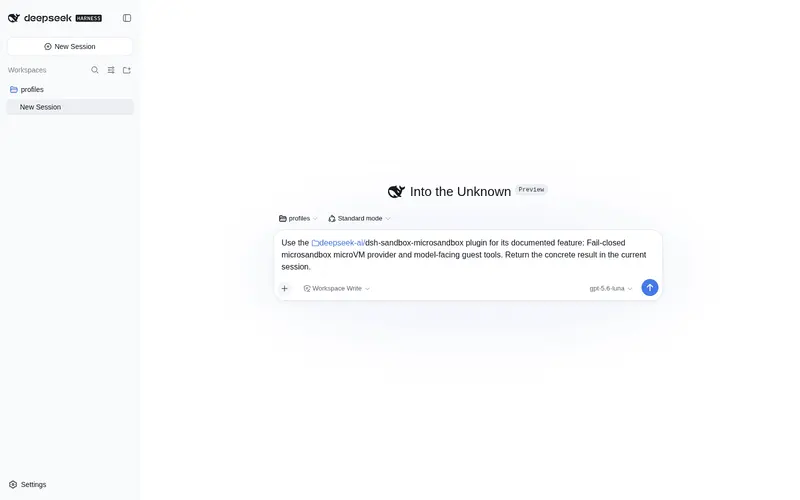
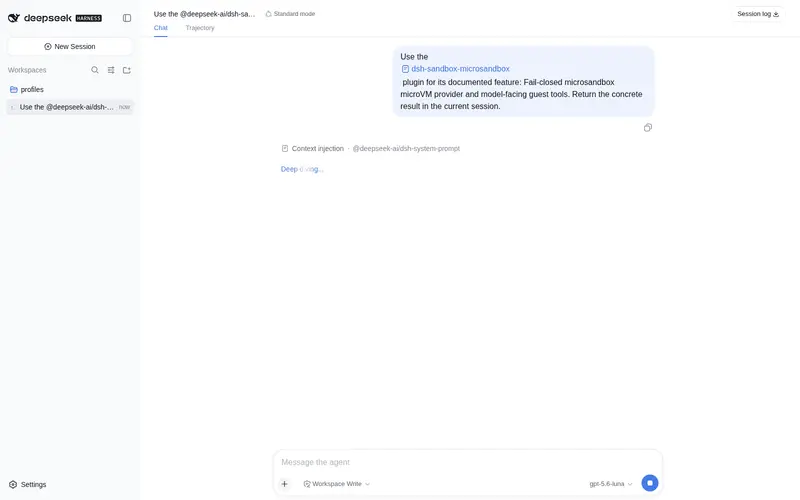
Support for the microsandbox backend.
Best for
- DSH deployments that need fail-closed command execution and guest filesystem operations inside microsandbox microVMs.
- Profiles that want provider activation and model-facing microsandbox tools controlled as separate explicit opt-ins.
Not ideal for
- Linux hosts without usable /dev/kvm, and unsupported or functionally unqualified platforms.
- Workflows requiring secrets, network-policy, snapshot, or image/volume lifecycle tools, which are not exposed as model tools here.
README
@deepseek-ai/dsh-sandbox-microsandbox
| English | 中文 |
A DSH profile bundle for the fail-closed microsandbox microVM capability. The root package contains the ctx.microsandbox provider and exports the model-facing tools as @deepseek-ai/dsh-sandbox-microsandbox/tool.
Repository shape
package.json              # provider/tool package and dsh.bundle manifest
cordis.patch.yml          # dormant provider and tool rows
src/                      # provider, runtime, resolver, and tool subpath
lib/                      # generated install artifacts
legacy/                   # source-compatible host integration patch for older DSH snapshots
docs/                     # detailed provider/tool references
tests/provider/            # provider, resolver, SDK, and host tests
tests/tool/                # model-tool and renderer tests
The single root artifact keeps Git/profile installation self-contained while preserving two Cordis entry points:
- id: microsandbox
  name: '@deepseek-ai/dsh-sandbox-microsandbox'

- id: tool-microsandbox
  name: '@deepseek-ai/dsh-sandbox-microsandbox/tool'
Both rows are disabled by the bundle. To enable the capability, a profile must explicitly enable the provider with config.enabled: true and enable the tool row separately. This prevents installation from starting a microVM capability or exposing model-facing tools implicitly.
Capability boundary
ctx.microsandbox is an environment-coherent microVM service, not a dsh-sandbox same-world provider. It uses the pinned microsandbox@0.6.7 SDK, package-owned msb resolution, bounded functional qualification, and fail-closed platform checks. It never degrades to unconfined host execution.
The tool entry exposes:
microsandbox_exec  exact argv execution with captured output
microsandbox_fs    guest file read, write, and directory listing
The old host integration patch remains under legacy/ for DSH snapshots that do not yet provide the provider/tool catalog and composition seams. A new bundle layer does not modify DSH host source.
Development
A full typecheck expects sibling checkouts:
~/git/deepseek-harness
~/git/sandbox-micro
pnpm install
pnpm run typecheck
pnpm test
pnpm run build
The prepare script builds provider, invariant, and tool entries directly from src/, so a Git install does not require sibling project references. pnpm 10 may require the profile to allow the package’s prepare script; only approve a pinned, trusted checkout.
Model Experience
The provider adds no prompt text. The tool subpath adds microsandbox_exec and microsandbox_fs to the authoritative tools service; their output preserves guest exit codes, captured streams, runner failures, timeout/abort classification, and guest file content.
Known Limitations and Deferred Work
- Linux requires
/dev/kvm; unsupported or unqualified hosts remain unavailable. - macOS Apple Silicon real-host acceptance is not included in the first release posture.
- Secrets, network policy, snapshots, and image/volume lifecycle tools remain provider-only or fail closed.
- The external SDK and platform binaries are pinned to
0.6.7and require their corresponding registry packages.
Frequently Asked QuestionsFAQ
Use the verified command dsh plugin --profile default add github:omdsh-dev/sandbox-micro in a DSH-enabled shell. The command resolves the public package metadata and keeps the plugin attached to the catalog identity shown on this page.
Compatibility follows the bundle and profile status shown above. If a profile is not detected, keep the plugin disabled there and check the repository documentation before enabling it in production.
The GitHub link and activity metadata are the source of truth for releases and maintenance. Revisit this page after a new release to confirm the catalog has observed the latest version.