pengxuding/dsh-plugin-judge
DSH 插件价值裁判:装前审核(源码静态扫描 + LLM 裁判)、装后审计与模型切换复核提醒 · Plugin value auditor for DeepSeek Harness.
Listed
0
Security
Bundle verified
Preview
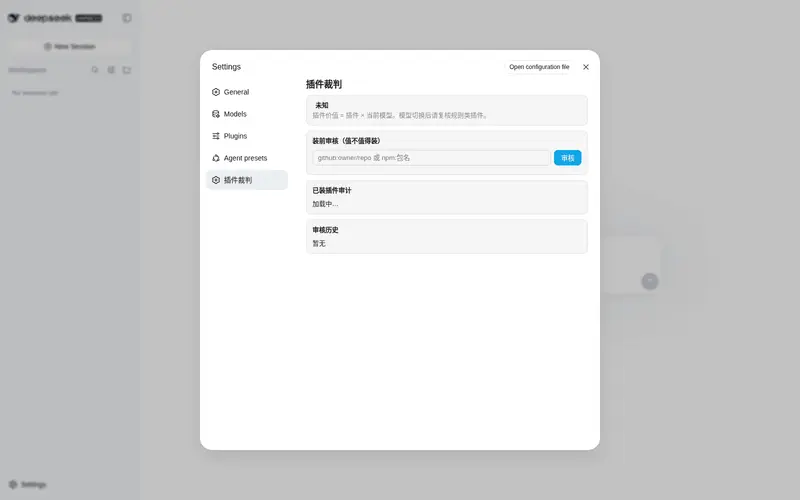
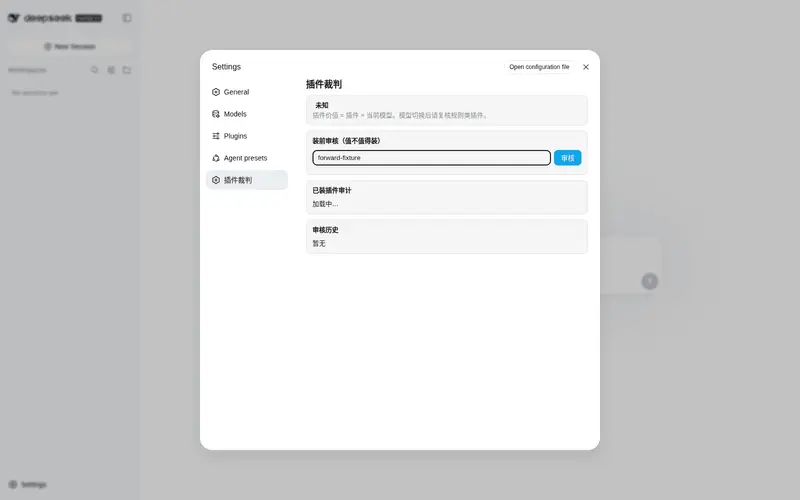
What it does
Plugin value auditor: pre-install review (source scan + LLM judge) and post-install audit of installed bundles, with model-switch re-audit reminders.
Best for
- DSH users comparing whether a candidate plugin adds capabilities or constrains their current model before installation.
- Administrators who want an inventory and post-install audit of installed bundles.
- Teams that switch models and need reminders to revisit model-dependent plugin verdicts.
Not ideal for
- Security review or malware detection; its verdicts are explicitly advisory and not a security audit.
- Users who require fully deterministic conclusions, because fine-grained verdicts can involve an LLM judge.
- Environments where candidate source fetching or running third-party plugin code is prohibited; the plugin does not make installation safe.
README
dsh-plugin-judge · Plugin Value Auditor for DeepSeek Harness
Judge whether a DeepSeek Harness plugin is worth using: pre-install review, post-install audit, and re-audit reminders when the model changes.
The problem this plugin solves
Plugins fall into two natures:
- Capability plugins give the model new abilities (new tools, skills, MCP servers, services, commands) — like giving the model “an extra hand”.
-
Constraint plugins impose rules and guardrails on the model (injecting
system prompt sections, personas, AGENTS.md rules, intercepting
agent/pre-step/tools/pre-execute,restrict/guardon tools, orcomplete: truewholesale prompt replacement) — like putting the model “in a cage”.
Constraint plugins carry a hidden cost: the model will follow the rules faithfully (compliance looks great), but it performs worse on the task you actually care about — rules crowd the context and suppress the model’s own judgment, putting a low ceiling over a capable model. Worse, as models get upgraded, many “patch rules for the old model” turn from patches into ceilings, and the plugin becomes obsolete or even harmful.
So a plugin’s value is not a property of the plugin alone — it is a binary relation of “plugin × current model”. That is exactly what this plugin evaluates.
Features
| Feature | When | How |
|---|---|---|
| Pre-install review | Before installing |
/plugin-audit <github:owner/repo or npm:pkg> command, the judge_plugin tool, or the settings-page input. Fetches the plugin source → static scan + LLM judge → a “worth installing?” verdict |
| Post-install audit | Already installed | Enumerates installed bundles from the profile → scans and classifies each (capability / constraint / cosmetic / hybrid) → constraint-risk score → settings-page report panel |
| Model-switch reminders | When the model changes | Watches the default model → flags plugins whose verdict depended on the old model → overlay popup reminder to re-audit |
How it judges (two layers combined)
- Rule heuristics (free, deterministic): scans the plugin source and its injected content for signals, weights them into a 0–100 constraint-risk score, and classifies the plugin as capability / constraint / cosmetic / hybrid.
- LLM judge (fine-grained, on demand): hands the scan result, the injected content summary, and the current model’s identity to a model and asks whether these rules help or suppress this specific model, returning a verdict with reasons.
Usage
# Install (requires an existing web profile)
dsh plugin --profile web add dsh-plugin-judge

# Or install from source
dsh plugin --profile web add <path-to-this-repo>
After installing and restarting the harness:
- Type
/plugin-audit github:some/repoin chat for a pre-install review; - Or let the model call the
judge_plugintool directly; - The settings panel gains a Plugin Judge page: scan reports for every installed plugin, a pre-install review input, and audit history;
- After a model switch, if any plugins need re-auditing, a floating reminder pops up on the page.
Design
Data flow
Installed plugins: profile manifest (~/.dsh/profiles/<profile>/package.json → dsh.profile.bundles)
                   + each package's package.json / lib source (read locally via node:fs)
Candidate plugins: package.json + entry source fetched from npm registry / jsDelivr / GitHub raw (Node fetch)
Heuristic scan:   capability signals (+) vs constraint signals (−), weighted → class + risk score
LLM judge:        llm.stream (generative verdict, carrying the current model identity) → verdict + reasons
Model watch:      agentDefaultModel.currentSelection() polling (fallback: agent/request waterfall observation)
Persistence:      ~/.dsh/plugin-judge/audits.json (audit history + model fingerprint)
Bridge:           Host ctx.connection.rpc.handle('/plugin-judge', …) ← Client rpc.call polling
Reminders:        Host produces pending-reminders → Client polls → shell.overlay popup
Reports:          Client settings.section "Plugin Judge" page + judge_plugin tool card
Signal table (heuristics)
Capability signals: tools.register / defineTool / skills / MCP /
webServer.register / registerFetchProvider / commands.register /
provide( …
Constraint signals: systemPrompt.section / ctx.systemPrompt / persona /
writing AGENTS.md / agent/pre-step / tools/pre-execute / tools/execute
waterfall listeners / restrict( / guard( / complete: true wholesale
replacement / strong-directive density (must, never, always, MUST, NEVER,
必须、不得、禁止) / fixed-template instructions (strictly follow, exact
format, 严格按照、按以下格式) …
Layout
judgePlugin/
├── package.json          # dsh.bundle.patch + dsh.client.inject + exports (Node >= 18)
├── cordis.patch.yml      # insert: plugin-judge
├── lib/
│   └── index.js          # Host half: inventory / source fetching / heuristic scan / LLM judge /
│                         # model watch & reminders / tool & command / connection RPC bridge / persistence
└── client/
    └── client.js         # Client half (__ModuleLoader__ format, no build step):
                          # settings.section report panel + shell.overlay model-switch reminder popup
Disclaimer
Verdicts are advisory opinions produced by heuristics plus a model judge — not a security audit. Installing any plugin runs third-party code on your machine with your own permissions; read the source before you install.
Frequently Asked QuestionsFAQ
Use the verified command dsh plugin --profile default add github:pengxuding/dsh-plugin-judge in a DSH-enabled shell. The command resolves the public package metadata and keeps the plugin attached to the catalog identity shown on this page.
Compatibility follows the bundle and profile status shown above. If a profile is not detected, keep the plugin disabled there and check the repository documentation before enabling it in production.
The GitHub link and activity metadata are the source of truth for releases and maintenance. Revisit this page after a new release to confirm the catalog has observed the latest version.