rj-jiangyichen/dsh-rules
Claude Code rules.md-style rule prompts: activate rule markdown files by glob-matching the files an agent reads or edits, with prompt injection and ordering support.
Listed
1
Dev
Bundle verified
Preview
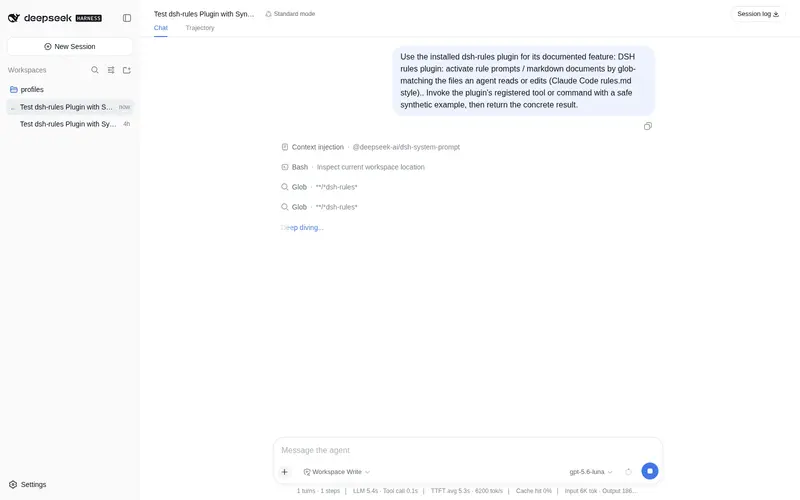
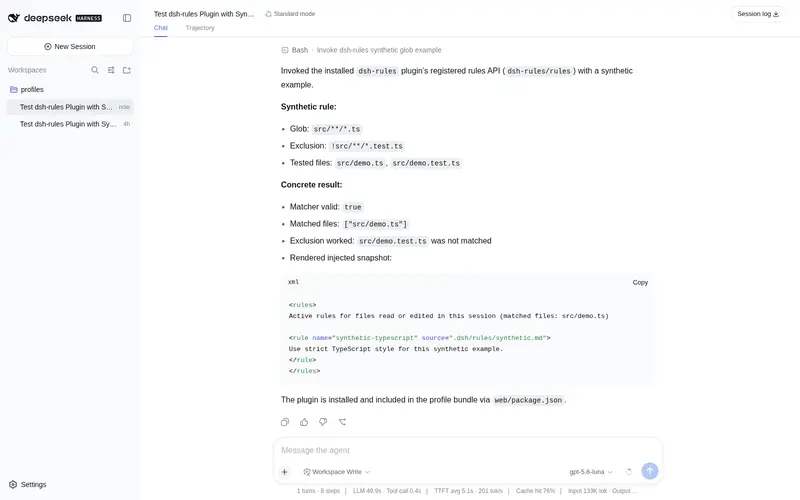
What it does
Claude Code rules.md-style rule prompts: activate rule markdown files by glob-matching the files an agent reads or edits, with prompt injection and ordering support.
Best for
- Repositories with path-specific coding, testing, or review instructions that should activate only when matching files are touched.
- Teams migrating Claude Code-style rule files or `# Path:` sections in `CLAUDE.md` or `AGENTS.md`.
- Multi-session or subagent workflows that need ordered, budget-bounded rule snapshots recorded in the session log.
Not ideal for
- Projects without path-specific instructions, where global prompts or existing repository guidance are sufficient.
- Rules intended to activate from files outside the project root; those reads never trigger matching.
- Rule sets whose complete content must always exceed the configured byte budget; lower-priority rules may be dropped and the final rule truncated.
README
dsh-rules


| English | 中文 |
Glob-activated rule prompts for DeepSeek Harness (DSH) — a Claude Code rules.md / # Path:-style mechanism. Each rule declares glob patterns; when the agent reads or edits a matching file, the rule activates and its content (any prompt or markdown document) is injected into the conversation as a superseding <rules> snapshot.
Works in every DSH deployment: desktop / web / tui / headless / custom profiles — nothing about this plugin is desktop-specific.
Contents
- Features
- How it works
- Installation
- Rule format
- Configuration
- Discoverability
- Limitations
- Development
- License
Features
-
Glob activation — rules activate per file the agent touches:
**,*,?,{a,b},[abc], and!negation (picomatch). -
Claude Code compatible — plain rule files (
.dsh/rules/*.md) and# Path:sections insideCLAUDE.md/AGENTS.md. - Visible & durable — active rules are injected as a user message the UI shows and the session log persists; each snapshot supersedes earlier ones, so the model always sees the current set.
- Budget-bounded — byte-budget rendering (32 KB default): low-priority rules are dropped first, then the last rule is truncated; content is escaped so it can never break out of the framing tags.
- Resume-friendly — on session resume the last snapshot and its matched files are restored from the log, preventing duplicate injection.
-
Per-session tracking — every agent/session tracks its own touched files (subagents included); global rules (no
path:) are always active.
How it works
workspace
  .dsh/rules/*.md    ← rule definitions (frontmatter declares globs)
  ~/.dsh/rules/*.md  ← user-level rules (optional)
  CLAUDE.md          ← optional: # Path: sections (Claude Code compatible)

agent reads/edits a file (fs/observed) → record per-session touched path
  ↓ every step (agent/pre-step)
match touched paths against globs → collect active rules → render a <rules> snapshot into the conversation
-
Injection point: an
agent/pre-stepwaterfall listener appends a<rules>-framed user message; a new message is only appended when the snapshot text changes. -
Discovery & caching: rule sources are re-probed per step with version caching (
fs.stat().version, ormtimeMs:sizeon the Node fallback) — edits to rule files take effect on the next step. -
Reads: prefer the harness
fsservice (containment-aware); fall back to Node’s filesystem when nofsservice is mounted.
Installation
Any DSH deployment (generic)
Published on the npm registry — dsh plugin installs and activates the plugin in one step:
# Adjust the profile name: desktop / web / tui / headless
dsh plugin --profile desktop add dsh-rules
The package declares dsh.bundle.patch, so the reconcile pass of dsh plugin add appends dsh-rules to the profile’s dsh.profile.bundles layer list automatically — no manual cordis.patch.yml edits are needed. Restart DSH (restart the desktop app; restart the web/headless process) and the plugin loads with the next Cordis composition.
Updates: dsh plugin --profile desktop update dsh-rules (or remove + add).
Installing from a local checkout (development):
# From the repo root — activates the bundle automatically, same as the registry install
dsh plugin --profile desktop add .
⚠️ pnpm splits
addarguments on spaces, so a repository path containing spaces must be installed through a no-space junction (see below).
DSH Desktop (Windows) one-click script
# 1. Clone this repository, then from the repo root:
node scripts\install-desktop.mjs

# 2. Restart DSH Desktop — the plugin loads with the next Cordis composition
The script creates a no-space junction to the repo and runs the desktop app’s own dsh plugin add through it (pnpm splits add arguments on spaces, so a repository path containing spaces must go through the junction):
# 0) Create a no-space junction to the repository (needed when the path contains spaces)
mklink /J "C:\code_repos\dsh-rules" "C:\code_repos\dsh rules plugin"

# 1) Install via the desktop's own dsh command (through the junction path)
& "C:\Program Files\DSH Desktop\DSH Desktop.exe" --expose-internals `
  "C:\Program Files\DSH Desktop\resources\app.asar.unpacked\lib\desktop-cli.js" `
  plugin --profile desktop add "C:\code_repos\dsh-rules"
Per-profile configuration (optional): the plugin loads with its code defaults; to customize, override the entry’s config in <profile>/cordis.patch.yml:
- id: dsh-rules
  name: dsh-rules
  config:
    includeClaudeSections: true
    projectRootMarkers: [".git", ".dsh"]
Uninstall: node scripts\install-desktop.mjs --uninstall (or dsh plugin --profile desktop remove dsh-rules), then restart the app. Installing/uninstalling never touches the DSH installation directory (resources\app.asar.unpacked) — only profile configuration, fully reversible.
Rule format
Source A: rule files (.dsh/rules/*.md and ~/.dsh/rules/*.md)
---
path:
  - "src/**/*.ts"
  - "!src/**/*.test.ts"
---
Rule body (markdown, injected verbatim when active — any prompt content works)
| Frontmatter field | Description |
|---|---|
path |
String or list of globs, relative to the project root, / separators; ! prefixes mark exclusion patterns. Absent or empty = always-active global rule (active for any session in the workspace). |
name |
Optional; rule identity (used for same-name deduplication). Defaults to the file name without .md. |
Source B: # Path: sections (requires includeClaudeSections: true)
Parses # Path: <globs…> headings out of AGENTS.md / CLAUDE.md (including .local.md variants and ~/.dsh/AGENTS.md):
# Project notes (content before the first heading is handled by the built-in agent-instructions baseline, not by this plugin)

# Path: src/**/*.ts, scripts/**
This section activates only when a file under src/**/*.ts or scripts/ is touched
- Each
# Path:heading starts a rule that runs until the next heading (or end of file). - Globs may be comma- or space-separated.
- Content before the first
# Path:heading is intentionally not injected by this plugin — DSH’s built-inagent-instructionsalready injects the full AGENTS.md/CLAUDE.md baseline.
Precedence & deduplication
Project rules (rank 100) > user rules (rank 200) > # Path: sections (rank 300). Same-name rules keep the highest-priority entry; rendering order is (rank, name) — deterministic across steps.
Configuration
| Option | Default | Description |
|---|---|---|
dshHome |
$DSH_HOME / ~/.dsh
|
Root for user rules and ~/.dsh/AGENTS.md
|
projectRootMarkers |
[".git"] |
Marker files/dirs used to find the project root by walking up |
ruleDirNames |
[".dsh/rules"] |
Rule directories inside the project (relative to the project root, multiple allowed) |
includeUserRules |
true |
Enable ~/.dsh/rules/*.md
|
includeClaudeSections |
false |
Parse # Path: sections |
instructionFileCandidates |
["AGENTS.md", "CLAUDE.md"] |
Candidate file names for # Path: sections |
localInstructionFileCandidates |
["AGENTS.local.md", "CLAUDE.local.md"] |
Per-directory candidate file names |
maxBytes |
32768 |
Per-injection render budget (UTF-8 bytes); <= 0 disables the plugin |
maxSourceBytes |
1048576 |
Per-rule source size cap; larger files are skipped |
maxTouchedPaths |
512 |
Touched-path cap per session (FIFO eviction) |
Discoverability
This plugin is discoverable through the GitHub dsh-plugin topic — the channel recommended by the DeepSeek Harness README (“Community and support”: Add the dsh-plugin topic to your plugin repository for discoverability). Community plugin lists and marketplaces (e.g. awesome-dsh-plugin, dsh-plugin-marketplace) scan that topic to pick up new plugins; the tag can be viewed/edited in the repository’s About section.
Limitations
- Only files inside the project root can activate rules; reads outside the root never trigger (avoids
../false positives). - The touched-path set is in-memory: after resuming a session, rules re-activate as the agent re-reads files (the previously matched list is restored from the log).
- Deployments with
includeRuntimeContext: falseare unaffected — this plugin injects its own message and does not depend on the runtime-context snapshot. - Rules are injected as “superseding snapshot” messages; the session log retains historical snapshots, but each snapshot is the complete current set and the model follows the latest one.
Development
pnpm install
pnpm test        # node --test: parsing / glob matching / precedence / budget / determinism / fs fallback
Layout:
-
lib/index.js— plugin entry (name/Config/apply):fs/observedtouch tracking,agent/pre-stepinjection,agent/disposedcleanup. -
lib/rules.js— pure logic: frontmatter and# Path:parsing, glob compilation/matching, precedence merging, budget rendering. -
lib/fs.js— versioned discovery/reads: harnessfsservice first, Node fallback. -
test/rules.test.mjs— unit tests. -
examples/.dsh/rules/— sample rules (copy into your project to get started). -
fixtures/demo-project/— a ready-made project for trying the plugin out.
License
Frequently Asked QuestionsFAQ
Use the verified command dsh plugin --profile default add github:rj-jiangyichen/dsh-rules in a DSH-enabled shell. The command resolves the public package metadata and keeps the plugin attached to the catalog identity shown on this page.
Compatibility follows the bundle and profile status shown above. If a profile is not detected, keep the plugin disabled there and check the repository documentation before enabling it in production.
The GitHub link and activity metadata are the source of truth for releases and maintenance. Revisit this page after a new release to confirm the catalog has observed the latest version.