ruby1304/dsh-vision-subagent
Vision for DeepSeek Harness agents — paste images in the Web composer, delegate reads to Kimi/MiniMax vision routes on isolated contexts; zero image bytes in the main session
Listed
0
Vision
Bundle verified
Preview
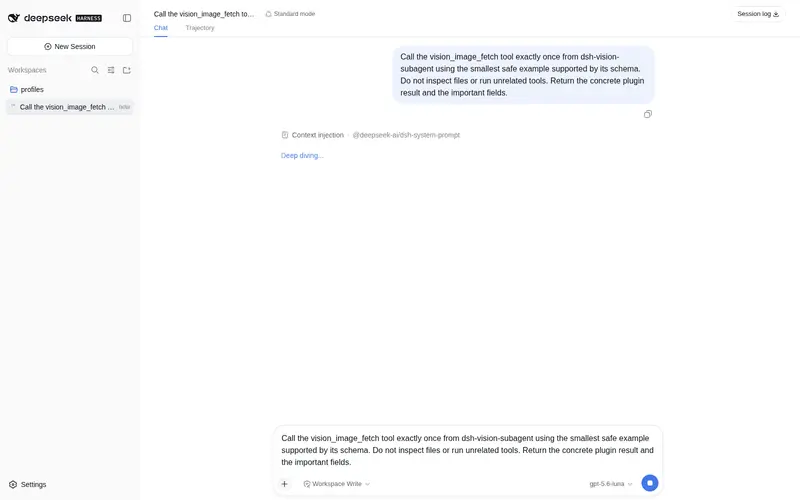
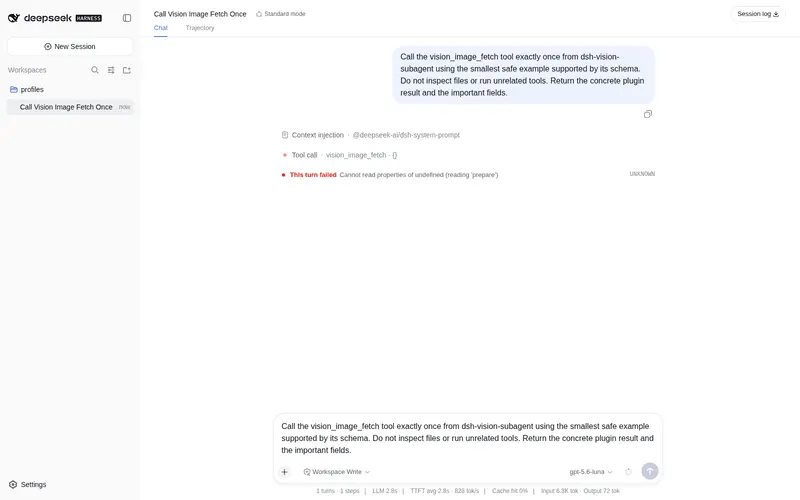
What it does
Vision for any DSH route: paste images in the Web composer with intent-aware auto-analysis, delegate workspace image reads to a Kimi/MiniMax vision subagent, and materialize pasted originals for editing.
Best for
- Text-only DSH routes that need visual understanding through a separately configured vision model.
- Web workflows where users paste or drop screenshots and want analysis focused by their draft message.
- Agents that need to inspect workspace images while keeping image bytes and vision-model context out of the main session.
- Image-editing workflows that may later materialize an original pasted image into the workspace.
Not ideal for
- Deployments without both a configured vision provider and model; the plugin is dormant until both are set.
- Workflows requiring remote image URLs; the documented version supports local paths only.
- Tasks needing more than four images per call or images above the default 10 MiB per-image limit without reconfiguration.
- Users who require provider and model selection from a settings panel; that UI remains on the roadmap.
README
dsh-vision-subagent

Eyes for text-only DeepSeek Harness agents: delegate image reading to a one-shot subagent running on a separately configured vision route (MiniMax / Kimi / any OpenAI-compatible provider). Image bytes and the vision model’s intermediate context never enter the main session — only the final text answer comes back.
Why a subagent
- Context isolation: large screenshots and multi-image comparisons never occupy the main model’s window
- Multi-turn visual reasoning: the child can call read_image on more workspace files before answering
- Cost & route separation: vision calls bill on the MiniMax/Kimi route; the main model only reasons
Quick start
sh
dsh plugin --profile web add /path/to/dsh-vision-subagent
Then edit ~/.dsh/profiles/web/cordis.patch.yml:
`yaml
- insert:
- id: vision-subagent name: ‘dsh-vision-subagent’ config: provider: kimi-coding # or minimax-cn / a hand-declared route model: k3 # or MiniMax-M3 / MiniMax-VL-01 `
Restart dsh web, open a new session, and ask: “Look at ~/Desktop/error.png — what is the error?” The model calls vision_agent(images=[...], question=...) on its own.
Screenshots
| Paste & ask | Analyzing | Clean bubble | Lightbox |
|---|---|---|---|
 |
 |
 |
 |
Paste images into the composer (Codex-style)
The Web composer accepts pasted/dropped images natively. On send, the client plugin uploads them to the host endpoint, which:
- validates the session and stores the images as durable attachments (bounded by deployment limits)
- runs ONE vision-route analysis on an isolated context (image bytes never enter the main session), guided by your draft message — the analysis focuses on what your words target (error text for a debugging ask, outfit details for a styling ask) instead of describing everything generically
- sends only the analysis text along with your message — the main model answers immediately, no tool call needed
In the chat history your bubble shows only your own words plus thumbnails; the analysis lives in the lightbox that opens when you click a thumbnail, never duplicated inline. Need the original bytes later (image editing, pixel-level inspection)? The durable message links let the model call vision_image_fetch to materialize the full-fidelity file into the workspace’s .dsh-vision/ directory.
On failure (timeout, route error) the message is not sent and the composer draft is preserved. This channel complements the vision_agent tool: pasted images take the automatic path, while workspace files are read by the model calling the tool itself.
MiniMax / Kimi vision models
| Provider | baseURL | Vision models | Key env |
|---|---|---|---|
| Kimi (Moonshot) | https://api.moonshot.cn/v1 | k3 / kimi-k3 / moonshot-v1-8k-vision-preview | MOONSHOT_API_KEY |
| MiniMax | https://api.minimaxi.com/v1 | MiniMax-VL-01 | MINIMAX_API_KEY |
| MiniMax CN | (built-in llm-pi-ai minimax-cn route) | MiniMax-M3 | MINIMAX_CN_API_KEY |
If a route already exists in Settings/Models (e.g. kimi-coding, minimax-cn), the plugin config only names provider + model — the key stays in the route’s credential reference. The plugin itself never touches secrets.
Configuration
| Field | Default | Meaning |
|---|---|---|
| enabled | true | Master switch |
| provider / model | ’’ (dormant) | Vision route; must be set together |
| subagentProvider | spawn | ctx.subagents provider |
| maxDepth | 1 | Absolute delegation-depth cap for the spawned child; 1 lets the vision child run but forbids further delegation (0 would reject the child itself — a top-level agent’s child is depth 1) |
| maxImages | 4 | Images per call |
| maxImageBytes | 10 MiB | Per-image byte cap |
| maxPromptChars | 8000 | Question length cap |
| maxOutputChars | 32000 | Returned text truncation |
| allowRemoteUrls | false | Reserved (v0.1 supports local paths only) |
| allowOutsideWorkspace | false | Workspace containment bypass |
| extraAllowedRoots | [] | Extra allowed image roots |
| guidance | ’’ | Extra instructions appended to the child prompt |
Security model
- Keys live only in the vision route’s credential reference (env); the plugin accepts no plaintext secrets
- Local images default to the session workspace; symlinks are rejected; reads are byte-capped
- The child runs with maxDepth: 1 (runs, but cannot delegate further) and instructions forbid file modification and shell use
-
vision_image_fetchwrites only under the session workspace’s.dsh-vision/with self-generated content-hashed filenames; no caller-controlled path segment reaches the disk
Architecture
` Main model (text-only) └─ vision_agent(images, question) ──┐ │ 1. admission: ext / containment / symlink / byte cap │ 2. ctx.attachments.saveImage → durable content-addressed refs │ 3. ctx.subagents.start(‘spawn’, { agentOptions: {provider, model} }) ▼ One-shot subagent (MiniMax/Kimi vision route, own context) └─ final text ──► main session (only this message enters main context) `
The plugin consumes harness services structurally (duck-typed) and is rc-version tolerant. Runtime dependencies: @deepseek-ai/dsh-tools (defineTool) and @deepseek-ai/schemastery (config schema) only.
Roadmap
- Web paste bridge: composer images auto-trigger vision analysis (v0.2)
- Context-aware paste analysis: your draft message steers the vision focus; bubble stays clean (v0.3)
-
vision_image_fetch: materialize pasted originals into.dsh-vision/for editing (v0.3) - Settings panel for provider/model selection
- Remote image URL support (bounded fetch)
- Embedded SKILL.md steering when to delegate
Development
sh
npm install && npm run typecheck && npm test && npm run build
Before publishing, align @deepseek-ai/* versions in dependencies/devDependencies with the target harness rc (runtime deps currently rc.6, peer range >=rc.5 <0.1.0 — compatible with a local rc.5 checkout).
License
MIT
Frequently Asked QuestionsFAQ
Use the verified command dsh plugin --profile default add github:ruby1304/dsh-vision-subagent in a DSH-enabled shell. The command resolves the public package metadata and keeps the plugin attached to the catalog identity shown on this page.
Compatibility follows the bundle and profile status shown above. If a profile is not detected, keep the plugin disabled there and check the repository documentation before enabling it in production.
The GitHub link and activity metadata are the source of truth for releases and maintenance. Revisit this page after a new release to confirm the catalog has observed the latest version.