Sev7een/ds-api-usage
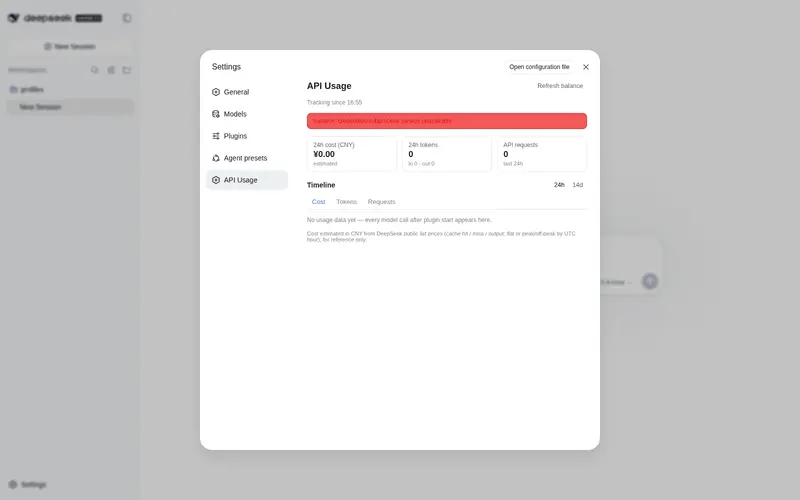
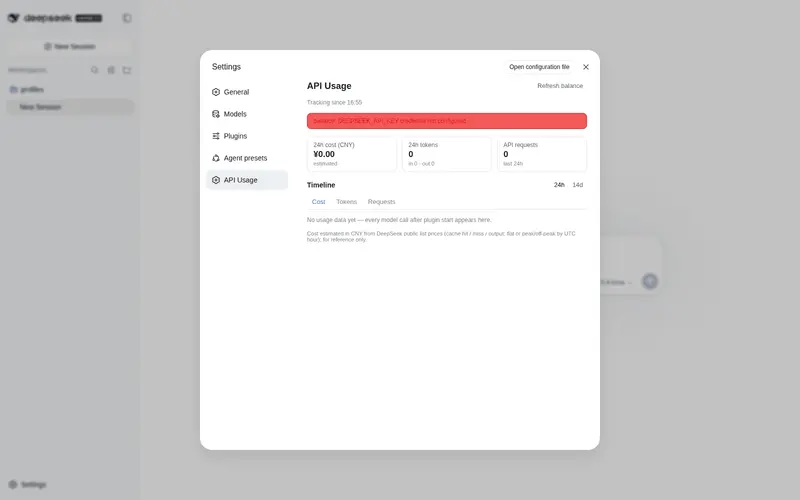
DeepSeek API balance and 24-hour usage dashboard in Settings, with estimated spend, token counts, request counts, and an hourly timeline.
Listed
6
Usage
Bundle verified
Preview
What it does
DeepSeek API balance and 24-hour usage dashboard in Settings, with estimated spend, token counts, request counts, and an hourly timeline.
Best for
- DeepSeek API users who want balance and recent usage metrics inside Settings.
- Teams monitoring hourly or 14-day token, request, and estimated-cost trends.
Not ideal for
- Workflows using providers other than DeepSeek, since the balance endpoint and pricing model are DeepSeek-specific.
- Billing reconciliation that requires exact charges, because displayed spend is estimated from public prices.
README
DHS API Usage — DeepSeek Harness plugin
| English | 简体中文 | Português (Brasil) |
After installation, open Settings → API Usage in DeepSeek Harness to view your DeepSeek API usage. The page shows your account balance, estimated spend, token counts, and API request count over the last 24 hours (14 days in the daily view), rendered as a timeline bar chart similar to the official DeepSeek platform usage page.
Features
- 💰 Balance card — total balance with granted / topped-up split, labeled with the API-reported currency code (CNY or USD), plus an availability badge, fetched from the official
GET /user/balanceendpoint. - 📊 Metric cards — 24h estimated spend (CNY), token counts (input / output split), and API request count.
- 📈 Timeline chart — hourly bars over the last 24 hours, or daily bars over 14 days, toggled between cost, tokens, and request counts (hover for exact values).
- 🔄 Live refresh — balance refreshes every 60 s on the host; the page polls every 30 s and has a manual refresh button.
- 🔑 No extra key setup — reuses the deployment’s existing
DEEPSEEK_API_KEYcredential through the harnesscredentialsservice.
Architecture
┌─────────────────────────────── Host (Node.js) ───────────────────────────────┐
│ src/index.js                                                                 │
│  • ctx.on('llm/stream', ...)  ← waterfall: folds every real model call's     │
│      provider-reported TokenUsage (input/output/cache-hit/cache-miss,        │
│      already disjoint, matching DeepSeek billing vocabulary)                 │
│      into in-memory hourly + daily buckets                                   │
│  • fetchBalance()             ← credentials.resolve('DEEPSEEK_API_KEY')      │
│      → subprocess curl → https://api.deepseek.com/user/balance               │
│      (web.fetch cannot send an Authorization header, hence curl)             │
│  • webServer.register('/ds-api-usage/snapshot')  ← JSON endpoint for client  │
└──────────────────────────────────────────────────────────────────────────────┘
                              │ fetch('/ds-api-usage/snapshot')
                              ▼
┌────────────────────────────── Client (browser) ─────────────────────────────┐
│ client/bundle.js (web bundle; client/index.js = dynamic-plugin source)      │
│  • slots.inject('settings.section')  → new settings page (localized label)   │
│  • balance card + 3 metric cards + timeline bar chart                       │
│      (cost / tokens / requests; 24h or 14d)                                 │
│  • auto-refresh every 30 s (native setInterval in the static bundle)        │
└──────────────────────────────────────────────────────────────────────────────┘
Data notes
-
Token counts are real — they come from the
usagechunk of every streaming model call (StreamChunkwithtype: 'usage',TokenUsage), the same provider-reported numbers the harness itself uses for session stats. -
Cost is an estimate — CNY is computed from DeepSeek’s public list prices (模型 & 价格) in the generated
PRICINGtable (src/index.js), applied per model:- cache hit input →
hitprice - cache miss input →
missprice - output →
outputprice - cache write is not billed separately by DeepSeek and is excluded.
- since 2026-08-16 DeepSeek bills peak / off-peak: models with
peak/offPeakrates are priced by the request’s UTC hour (windows inpeakHoursUtc; 01:00–04:00 and 06:00–10:00 UTC); the rest use theirflatrate.
- cache hit input →
-
Persisted aggregation — hourly buckets keep 48 h, daily keep 14 d, persisted to
$DSH_HOME/storages/ds-api-usage.json(writes debounced to at most one per 60 s, flushed on plugin shutdown, fail-safe: a read/write error never breaks accounting). The 14-day view therefore survives web-app restarts; delete the file to reset. The harness separately keeps its own durable per-session token projection.
Installation
Via dsh plugin add (recommended, from GitHub or npm)
Install directly from this GitHub repository:
dsh plugin --profile web add github:Sev7een/ds-api-usage
or, once published to npm:
dsh plugin --profile web add dsh-plugin-ds-api-usage
dsh plugin forwards to pnpm in the profile directory and reconciles the
package into the profile’s bundle list (dsh.profile.bundles). The package’s
cordis.patch.yml (declared via dsh.bundle.patch in package.json) then
inserts the plugin row into the host composition, and the dsh.client
declaration makes the web shell load client/bundle.js as the settings page.
As a dynamic plugin (dev / session-scoped)
The original is a dynamic Cordis plugin, created per session with cordis_define / cordis_run (see the DeepSeek Harness docs). The code.host body is src/index.js minus the module.exports wrapper; the code.client body is client/index.js minus the wrapper.
Note: the dynamic form uses the sandbox-private
harness.handle/host.callchannel (client/index.js), while the static bundle form (client/bundle.js) talks to the host over the HTTP route/ds-api-usage/snapshot. Keep both in sync when changing the protocol.
As a composition plugin (persistent, manual)
Add a row to the host composition (cordis.patch.yml of your profile):
- insert:
    - id: ds-api-usage
      name: 'dsh-plugin-ds-api-usage'
or, without installing the package, by a relative path to this repository. The plugin is host-plane: it reads the host credentials, subprocess, timer, and webServer services and registers the client settings page in the root-scoped settings.section slot, so it should live in the host composition, not inside an agent preset.
Requirements
- DeepSeek Harness with the DeepSeek LLM adapter configured (
DEEPSEEK_API_KEYcredential resolvable via thecredentialsservice) -
curlavailable on the host for the balance endpoint - A browser client with the settings sidebar (for the UI)
Development
npm run check   # syntax-check both halves
npm test        # offline test suite: pricing parser (fixtures) + peak/off-peak rate logic
- Prices are auto-tracked:
.github/workflows/update-pricing.yml(daily cron + manual dispatch) re-parses the official pricing pages and opens a PR when the table changes;npm run update:pricingdoes the same locally (--applywrites the generated block insrc/index.js). Edit the table only through the script — the block between the__PRICING_BEGIN__/__PRICING_END__markers is generated. - The client localizes through the harness
localeservice (namespacesettings.ds-api-usage) and follows the harness’s active locale: dictionaries ship for the harness’szh/enids plus apt-BRentry for future harness support (keys missing in the active locale fall back tozh).
CI / GitHub Actions
The repository ships two workflows — no secrets or API keys are required, and the only prerequisite is GitHub Actions being enabled for the repository (default; check Settings → Actions → General → Allow all actions):
-
ci.yml— runs on every push and pull request:npm run check(syntax of both halves) andnpm test(offline test suite with page fixtures). -
update-pricing.yml— re-parses the official DeepSeek pricing pages every day (06:23 UTC cron) and on manual dispatch (Actions → update-pricing → Run workflow). When the table changes it opens a PR with the regenerated block (the workflow declarescontents: writeandpull-requests: writeon the defaultGITHUB_TOKEN— nothing to configure). If the docs page is restructured, the parser validation fails and the job fails loudly instead of opening a bad PR.
After the first push, run Actions → update-pricing → Run workflow once to validate the pipeline end-to-end (a no change result is the expected, green outcome when prices are current).
License
Frequently Asked QuestionsFAQ
Use the verified command dsh plugin --profile default add github:Sev7een/ds-api-usage in a DSH-enabled shell. The command resolves the public package metadata and keeps the plugin attached to the catalog identity shown on this page.
Compatibility follows the bundle and profile status shown above. If a profile is not detected, keep the plugin disabled there and check the repository documentation before enabling it in production.
The GitHub link and activity metadata are the source of truth for releases and maintenance. Revisit this page after a new release to confirm the catalog has observed the latest version.