Sev7een/dsh-plugin-automations
Scheduled tasks plugin for DeepSeek Harness Web Profile
Listed
2
Workflow
Bundle verified
Preview
What it does
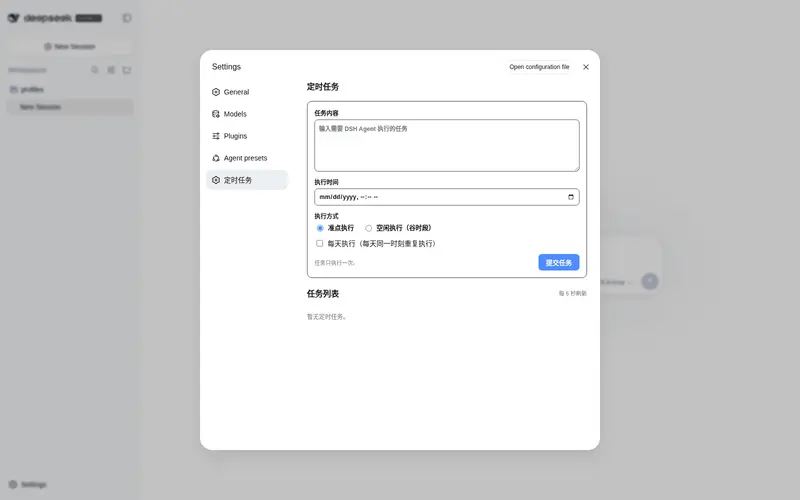
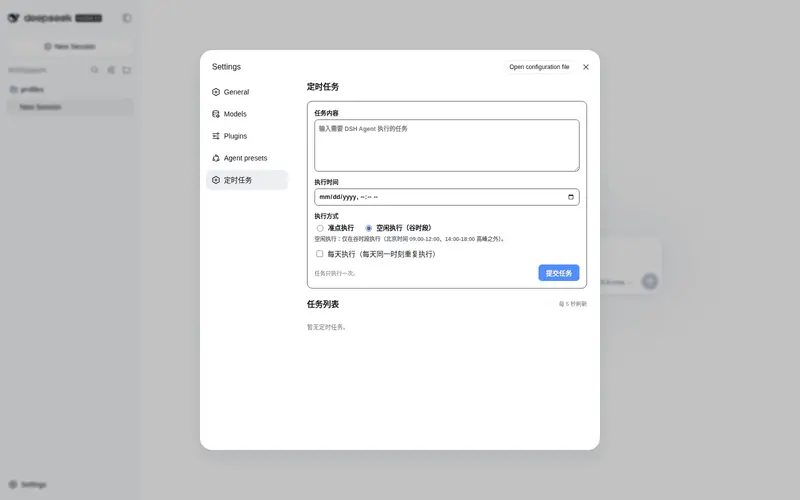
Settings-based scheduled tasks that run on time or during DeepSeek off-peak hours, with one-time and daily schedules backed by durable task state.
Best for
- Users scheduling one-time or daily agent tasks from the DSH Settings page.
- Cost-sensitive workflows that can defer work to DeepSeek off-peak hours.
Not ideal for
- Task management requiring edit, delete, pause, cancel, retry, or pagination, which the MVP does not provide.
- Jobs expected to run longer than the fixed 30-minute execution timeout.
README
| English | 简体中文 |
dsh-plugin-automations
为 DeepSeek Harness Web Profile 提供定时任务:支持准点执行、只在 DeepSeek 谷时段执行的“空闲执行”,以及每天重复执行。
Scheduled tasks for the DeepSeek Harness Web Profile: run on time, run only during DeepSeek off-peak (valley) hours, or repeat daily.
Features
- Settings-page form and task list with 5-second polling.
- Two execution modes: on time and when idle (valley hours).
- Two repeat modes: once and daily.
-
when_idleruns outside Beijing peak hours (09:00-12:00and14:00-18:00) and automatically defers to the next valley window. - Daily tasks keep the same local wall-clock time across month and daylight-saving transitions.
- Durable task state through
ctx.storageDomain. - One serialized scheduler pump persists
runningbefore launching the runner. - Each run uses an isolated Session with the default Agent preset, model, and Host workspace root.
- Fixed 30-minute execution timeout and explicit
host_interruptedrecovery. - Strict JSON API validation, request-size limits, same-origin checks, and a custom mutation header.
- Automated messages use
{ kind: 'plugin', plugin: 'dsh-plugin-automations' }and never impersonate direct human input.
The full behavioral contract is documented in SDD.zh-CN.md.
Installation
dsh plugin add (recommended)
Install into the Web profile and restart DSH after installation.
From GitHub
dsh plugin --profile web add github:Sev7een/dsh-plugin-automations
From npm
Once the package is published to npm:
dsh plugin --profile web add dsh-plugin-automations
If you run DSH through npx, use the equivalent command:
npx @deepseek-ai/dsh plugin --profile web add github:Sev7een/dsh-plugin-automations
Verify the composed profile and restart the Web app:
dsh --profile web --dump-config
dsh web
Then open Settings → 定时任务 (Scheduled Tasks).
Local checkout (development)
git clone https://github.com/Sev7een/dsh-plugin-automations.git
dsh plugin --profile web add ./dsh-plugin-automations
Remove
dsh plugin --profile web remove dsh-plugin-automations
Usage
Execution modes
| Mode | Behavior |
|---|---|
on_time |
Creates an isolated DSH Session and starts as soon as the task is due. |
when_idle |
Runs only outside Beijing peak hours; a task due during peak hours waits for the next valley window. |
Repeat modes
| Repeat | Behavior |
|---|---|
once |
Reaches a terminal state and does not run again. |
daily |
Rolls to the same local wall-clock time on the next calendar day. |
HTTP API
-
POST /dsh-scheduled-tasks/api/v1/tasksContent-Type: application/jsonX-DSH-Scheduled-Tasks: 1- Body:
{ prompt, scheduledAt, timeZone, mode, repeat }
GET /dsh-scheduled-tasks/api/v1/tasks
curl -X POST http://127.0.0.1:3080/dsh-scheduled-tasks/api/v1/tasks \
  -H 'Content-Type: application/json' \
  -H 'X-DSH-Scheduled-Tasks: 1' \
  -d '{
    "prompt": "check project tests",
    "scheduledAt": "2026-08-15T01:00:00+08:00",
    "timeZone": "Asia/Shanghai",
    "mode": "when_idle",
    "repeat": "daily"
  }'
The MVP has no edit, delete, pause, cancel, retry, or pagination endpoints.
Development
npm install --legacy-peer-deps
npm run check
npm test
npm run build
npm pack --dry-run
--legacy-peer-deps is currently needed for local development because the published @deepseek-ai/dsh-storage-domain package still carries an older peer range than the current DSH Web bundle.
License
MIT
Frequently Asked QuestionsFAQ
Use the verified command dsh plugin --profile default add github:Sev7een/dsh-plugin-automations in a DSH-enabled shell. The command resolves the public package metadata and keeps the plugin attached to the catalog identity shown on this page.
Compatibility follows the bundle and profile status shown above. If a profile is not detected, keep the plugin disabled there and check the repository documentation before enabling it in production.
The GitHub link and activity metadata are the source of truth for releases and maintenance. Revisit this page after a new release to confirm the catalog has observed the latest version.