Smalldy/godot-bridge
DSH (DeepSeek Harness) plugin that launches and drives a running Godot 4.x game through its in-game TCP interaction server — replaces the godot-mcp MCP server with native agent tools.
Listed
10
Tools
Bundle verified
Preview
What it does
DSH↔Godot engine runtime bridge: launch and drive a running Godot 4.x game through its in-game TCP interaction server — 16 tools (runtime control via ~130 game commands, scene/UI inspection, GDScript eval, input simulation, screenshots, headless static ops, project editing, export, script validation, engine-path setup), replaces godot-mcp.
Best for
- Godot 4.x developers who want DSH agents to launch, inspect, test, and control a running game.
- Teams replacing godot-mcp while retaining its in-game newline-delimited JSON interaction server and command workflows.
- Godot automation that combines runtime scene/UI inspection, input simulation, screenshots, headless project edits, validation, and export.
Not ideal for
- Projects outside Godot 4.x, since the bridge targets that engine and protocol.
- Projects without the `McpInteractionServer` autoload listening on `127.0.0.1:9090`; runtime commands depend on it.
- Setups that expose only a version-manager shim instead of the real Godot executable, because process lifecycle tracking can become incorrect.
README
| English | 中文 |
godot-bridge

Native DeepSeek Harness (DSH) plugin that launches and drives a running Godot 4.x game through its in-game TCP interaction server — replacing the godot-mcp MCP server with first-class agent tools.
No MCP protocol, no Python server, no editor addon. The game side is untouched: McpInteractionServer (the mcp_interaction_server.gd autoload) already listens on 127.0.0.1:9090 and speaks newline-delimited JSON — godot-bridge speaks the same protocol natively from inside the DSH host.
Tools
| Tool | Replaces (godot-mcp) | Purpose |
|---|---|---|
godot_run_project |
run_project |
Launch the project in debug mode (godot -d --path …), wait for port 9090 |
godot_stop_project |
stop_project |
Terminate the game process (tree-scoped kill) |
godot_get_debug_output |
get_debug_output |
Incremental stdout/stderr of the launched process |
godot_command |
all game_* (~130) |
Send any interaction-server command: get_scene_tree, get_ui_elements, eval, get/set_property, call_method, click, key_press, screenshot, raycast, serialize_state, ui_*, … |
godot_screenshot |
game_screenshot |
Viewport capture as base64 PNG |
godot_ping |
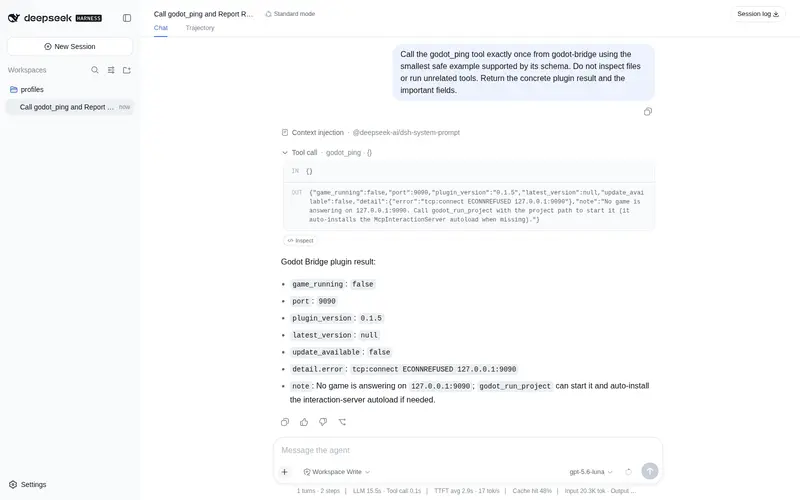
— | Probe whether the game answers on 9090 (also reports installed/latest plugin version) |
godot_set_engine_path |
— | Persist the Godot engine executable path into settings (the model asks the user for it, then saves it here; hot-reloaded) |
godot_headless_op |
read_scene, modify_scene_node, remove_scene_node, attach_script, create_resource, save_scene, create_scene, add_node, get_uid, manage_scene_signals, … |
Headless static operations (godot --headless --script godot_operations.gd): 16 ops, no running game needed |
godot_validate_script |
validate_script |
Headless GDScript compile-check via validate_script.gd → {valid, errors}
|
godot_set_project_setting |
modify_project_settings, set_main_scene, manage_layers, manage_plugins, manage_translations
|
Set a typed key in any project.godot section (PackedStringArray(...) / Vector2i(...) / bool / …) |
godot_manage_autoloads |
manage_autoloads |
List / add / remove autoload singletons (Name="*res://…") |
godot_manage_input_map |
manage_input_map |
List / add / remove input actions — correct Godot 4 keycodes (fixes godot-mcp’s Godot 3 baseline bug) |
godot_manage_export_presets |
manage_export_presets |
List / add / remove export presets (export_presets.cfg) |
godot_create_script |
create_script |
GDScript template (extends / class_name / method stubs / source) |
godot_create_project |
create_project / create_csharp_script
|
Project scaffold, optional Godot .NET .csproj
|
godot_export_project |
export_project |
Headless export (--export-release / --export-debug <preset> <output>) |
The remaining godot-mcp tools were implemented in the MCP server’s own Node process: pure file/editor operations are covered by DSH’s native file tools, while a handful carry Godot-specific write logic (manage_input_map, manage_export_presets, modify_project_settings, project/script templates) that a generic edit replaces only with format knowledge — see COVERAGE.md for the full breakdown.
How it works
DSH session
  └─ godot-bridge (Host plugin)
       ├─ godot_run_project ──────► subprocess.spawn(Godot -d --path <project>)
       ├─ godot_get_debug_output ─► collect-mode output (incremental offsets)
       └─ godot_command / godot_screenshot / godot_ping
            └─ subprocess.spawn(node -e <bridge> <command> <paramsJson>)
                 └─ TCP 127.0.0.1:9090 ◄── in-game McpInteractionServer autoload
- The in-game protocol (
{command, params, id}+ newline) is identical to godot-mcp, so the game side and any existing workflows keep working. - Each command spawns a one-shot
node -ebridge that connects, sends one line, prints the first response line, and exits. The game server is single-connection/single-command (_busy), so short-lived connections are a perfect fit. - Spawning uses the harness’s raw
subprocessservice (not the sandboxed shell executor), so Godot can write itsuser://files without the DSH file sandbox killing it (see Pitfalls).
Requirements
- DeepSeek Harness (a session with a host runtime)
- A Godot 4.x project with the
McpInteractionServerautoload registered. If your project does not have it yet, copyplugin/mcp_interaction_server.gdto the project root and register it as an autoload namedMcpInteractionServer(godot-mcp projects already have this).godot_run_projectalso auto-installs it when missing (copies the vendored file intoautoload/and registers it inproject.godot), so no manual setup is needed — and non-Godot projects are completely unaffected. -
nodeon PATH - Godot executable — resolved in this order: the
godot_pathtool argument → thegodotPathsetting (the Web plugin-config page, or thegodot-bridge:section ofsettings.yaml) → thegodotcommand on PATH. Nothing to configure whengodotis on PATH; otherwise set your engine path in settings (the plugin author does not preset it — Godot is a portable exe that can live anywhere). Use the real exe full path, never a version-manager shim (see Pitfalls).
Install
Recommended — one command (requires the dsh CLI):
dsh plugin --profile web add github:Smalldy/godot-bridge
dsh plugin is a pnpm forwarder: it installs the package into the profile’s node_modules and — because the package declares dsh.bundle (its cordis.patch.yml inserts the tool-godot-bridge row) — appends it to the profile’s dsh.profile.bundles layer list. The web profile is the standard one the Web app already boots from, so this simply adds the tools to standard mode — no new profile is created. After a restart, the sixteen godot_* tools are available in every session on that profile. Listed in the awesome-dsh-plugin community registry (topic: dsh-plugin).
The same command installs a local checkout or tarball (dsh plugin --profile web add ./path/to/godot-bridge).
The plugin is a standard DSH bundle module: it imports
defineToolfrom@deepseek-ai/dsh-toolsand registers viactx.tools.register. It must be installed through the bundle mechanism above — the harness heals the shared@deepseek-ai/*dependency layer inside the profile’snode_modules, which is what makes the import resolve. Do not copy the file into a user agent preset (~/.dsh/.agent-presets/...); Node cannot resolve@deepseek-ai/dsh-toolsfrom that location.
Uninstall
dsh plugin --profile web remove godot-bridge
Removes the package and its godot-bridge bundle layer from the profile — after a restart the sixteen godot_* tools are gone from sessions on that profile. The standard web profile itself is untouched (this never creates or removes a profile). Stop any running game first with godot_stop_project; the plugin’s unload cleanup also terminates a Godot child it started. Reinstall any time with the add command above.
Update notices
On load the plugin does a best-effort version check: it fetches the repo’s main-branch package.json (raw.githubusercontent.com, 5s timeout, silent on failure/offline) and compares it with the installed version. When a newer version exists it registers a system-prompt section, so the model surfaces “godot-bridge update available: installed X, latest Y” in every session until the plugin is updated (dsh plugin --profile web update godot-bridge, then restart DSH). godot_ping additionally reports plugin_version / latest_version / update_available for on-demand checks.
To publish an update: bump version in package.json (the release marker) and push — an unchanged version triggers no notice. Forks: set repository in package.json and the check follows the fork automatically.
Known limitations: the notice is a system-prompt section, so presets whose persona is complete/suppressing (e.g. 极简模式 / minimal) do not show it; the check needs network access at boot.
Usage
godot_run_project            # start the game (default: current workspace)
godot_ping                   # confirm 9090 answers
godot_command get_scene_tree # inspect the scene graph
godot_command get_ui_elements
godot_command eval {code: "return get_tree().current_scene.name"}
godot_command click {x: 576, y: 300}
godot_screenshot             # view the game
godot_get_debug_output       # read the boot log
godot_stop_project           # done
Godot executable resolution: per-tool godot_path argument → the godotPath setting (the Web plugin-config page, or the godot-bridge: section of settings.yaml) → the godot command on PATH. Nothing to configure when godot is on PATH; otherwise set the engine path in settings and point at the real exe, never a shim.
Pitfalls (learned the hard way)
-
DSH file sandbox vs Godot
user://: launching Godot through the sandboxed shell executor (pwsh/bash tool) propagates a restricted token and Godot crashes at startup (Failed to open 'user://logs/…', signal 11). godot-bridge spawns via the rawsubprocessservice, which is not file-confined — this is why it works. -
node -eargv: withnode -e <script> <cmd> <json>, extra args land atprocess.argv[1]/[2](not[2]/[3]). -
eval in debug mode: a compile error in
evalcode pauses the game at the debugger (same as godot-mcp). Use dynamic access (p.get("global_position")) to dodge static typing, andgodot_stop_project+godot_run_projectto recover. - Real exe, not a version-manager shim: a shim exits immediately and orphans the real Godot; process management misjudges it as dead.
Project layout
plugin/godot-bridge.mjs           # the plugin (standard DSH module, named exports name/inject/apply)
plugin/mcp_interaction_server.gd  # vendored from godot-mcp (MIT) — in-game TCP server autoload
plugin/godot_operations.gd        # vendored from godot-mcp (MIT) — headless ops script
plugin/validate_script.gd         # vendored from godot-mcp (MIT) — GDScript compile-check
package.json                      # dsh.bundle manifest (for `dsh plugin add`)
cordis.patch.yml                  # bundle patch layer (inserts the tool row)
install.md / install.zh-CN.md     # detailed install & maintenance
ARCHITECTURE.md / ARCHITECTURE.zh-CN.md  # how it replaces godot-mcp + protocol details
COVERAGE.md / COVERAGE.zh-CN.md   # full tool-by-tool comparison vs godot-mcp
CHANGELOG.md / CHANGELOG.zh-CN.md  # release history
mcp_interaction_server.gd, godot_operations.gd and validate_script.gd are vendored from godot-mcp (MIT). The plugin locates the headless scripts relative to the module (import.meta.url); pass an explicit ops_script / validate_script argument to override.
License
MIT
Frequently Asked QuestionsFAQ
Use the verified command dsh plugin --profile default add github:Smalldy/godot-bridge in a DSH-enabled shell. The command resolves the public package metadata and keeps the plugin attached to the catalog identity shown on this page.
Compatibility follows the bundle and profile status shown above. If a profile is not detected, keep the plugin disabled there and check the repository documentation before enabling it in production.
The GitHub link and activity metadata are the source of truth for releases and maintenance. Revisit this page after a new release to confirm the catalog has observed the latest version.