WhitePlusMS/dsh-git-graph
Read-only Git Graph view for the DeepSeek Harness web interface. Inspect commit topology, branches, tags, remotes, HEAD, and working-tree status in a dedicated view beside Chat and Trajectory.
Listed
2
Git
Bundle verified
Preview
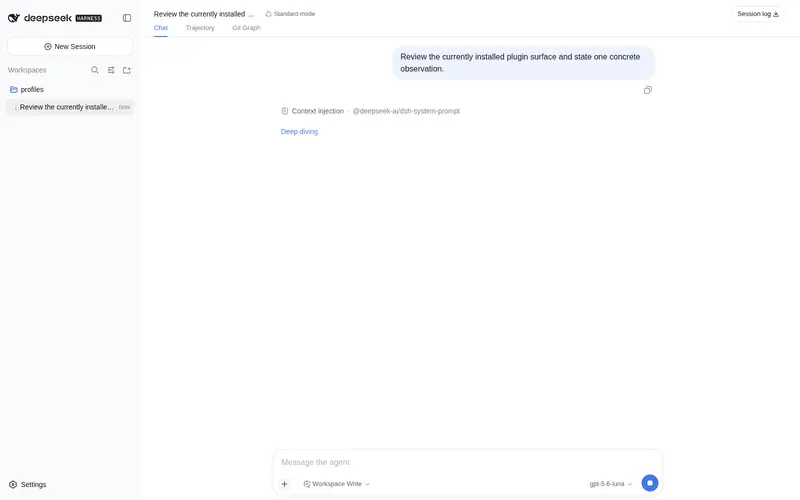
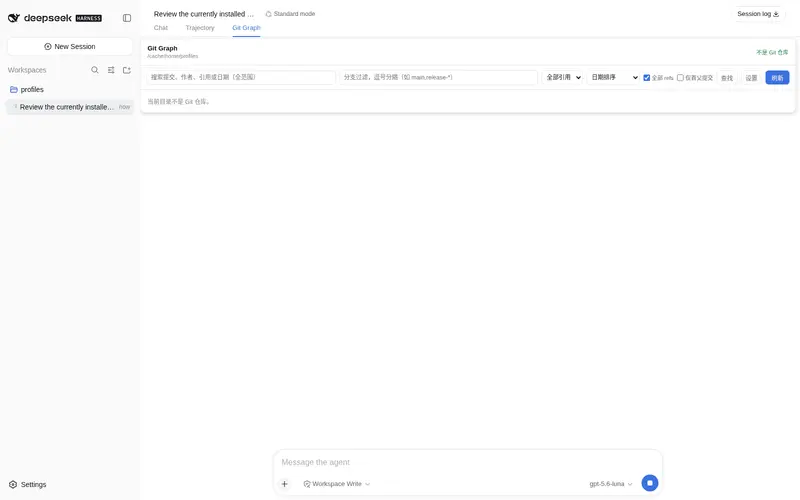
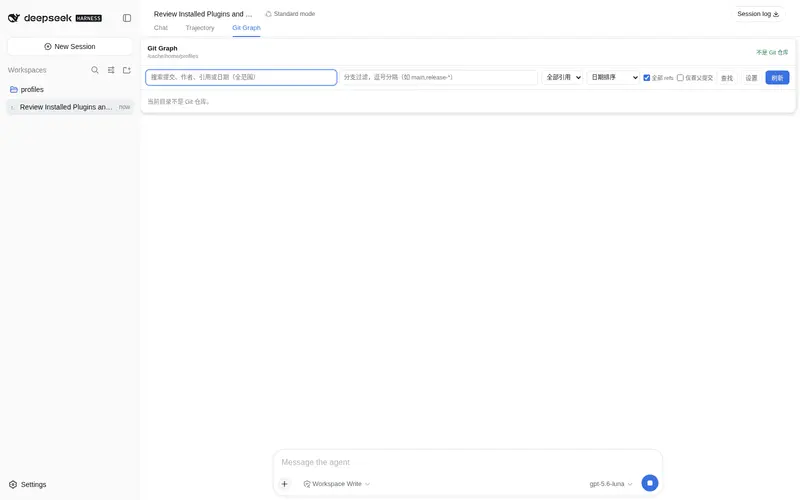
What it does
Dedicated read-only Git Graph view beside Chat and Trajectory: commit topology, local/remote/tag refs, HEAD and working-tree status, search, filtering, first-parent mode, refresh, and load more.
Best for
- Developers who want to inspect commit topology, branches, remotes, tags, HEAD, and working-tree state without leaving DSH.
- Code-review and debugging workflows that need commit details, changed-file trees, line diffs, or comparisons between two commits.
- Large-history investigations that benefit from commit search, branch globs, reference filters, sort modes, and first-parent navigation.
Not ideal for
- Workflows that need Git mutations such as commit, merge, rebase, push, pull, fetch, tagging, stashing, or reset; the current release is read-only.
- Repositories requiring more than 500 commits in one loaded result set.
- Directories that are not Git repositories or repositories with no commits, where the view can only show an empty state.
README
dsh-git-graph
Git Graph for the DeepSeek Harness web interface. Open a dedicated Git Graph view beside Chat and Trajectory to inspect the current workspace’s Git history; refreshing the graph does not create a conversation message or write to the trajectory.

Features
- A dedicated
Git Graphentry beside Chat and Trajectory. - Commit topology with branch, merge, and parent relationships.
- Local branch, remote branch, tag, and HEAD reference labels.
- The clean or dirty working-tree state in the graph header.
- Full-range search across commit hashes, subjects, authors, email addresses, and reference names.
- Branch-name glob filters (e.g.
main,release-*), reference-kind filtering, and an option to include all refs. - Date, author-date, and topological commit ordering, plus a first-parent mode for the mainline history.
- Selecting a commit expands its details inline below the commit’s row: hash, author, committer, date, parents, signature status, and references, with a layout aligned to vscode-git-graph.
- File changes in tree or list view: folder icons with compacted single-child folders, change-type colouring, and
(+added|−deleted)stats. - Click a file to view its line-by-line diff with old/new line numbers and add/remove highlighting.
- Expand the
Uncommitted Changesrow to inspect working-tree files and their per-file diffs. - Compare file changes between any two commits.
- A metadata strip listing the repository’s tags and stashes.
- An in-results find bar with case sensitivity, regex, and previous/next navigation.
- A display settings panel: date/author/hash columns, date format, and graph style, persisted per repository.
- Keyboard support:
↑/↓to move the selection,Ctrl+Fto find,Ctrl+Shift+Ffor settings. - Refresh the current repository without creating a conversation message or tool trace entry.
- Load more commits as needed, up to 500 commits.
- Display an empty state instead of an error when the current directory is not a Git repository or the repository has no commits yet.
The current release is read-only. It does not create, delete, rename, merge, rebase, push, pull, fetch, create tags, stash, or reset Git data.

Open Git Graph
After installing the plugin and restarting DSH Web, click Git Graph in the view switcher beside Chat and Trajectory.
The page reads the current session workspace. Refresh operations call the plugin’s Typert Remote directly; they are not rendered as conversation tool cards and do not append refresh events to the trajectory.
Git data and path handling
The Host reads Git data through fixed subprocess arguments without using a shell. It reads repository status, HEAD, and bounded commit history, and loads commit details, file contents, file diffs, working-tree changes, and commit comparisons on demand.
The model tool supports the following parameters:
git_graph({
  path?: string,          // Repository directory; defaults to the current session workspace
  max_commits?: number,   // 1..500, defaults to 100
  all?: boolean,          // Include all reachable refs, defaults to true
  first_parent?: boolean, // Follow only the first parent, defaults to false
  glob?: string[],        // Branch-name glob filters (OR); overrides --all when provided
  search?: string,        // Full-range search: hash, subject, author, email, ref name, date
  sort?: string           // Commit ordering: date, author-date, or topological; defaults to date
})
The provided path is used only as the Git subprocess working directory and is never interpolated into a shell command; file-read requests are validated to stay inside the repository. If the path is not a Git repository, the page displays an empty state instead of a repository error. A Git repository with no commits is handled the same way.
Install or update
Install version v0.0.2 from GitHub:
dsh plugin --profile web add https://github.com/WhitePlusMS/dsh-git-graph/archive/refs/tags/v0.0.2.tar.gz
Use the same command to update an existing installation. Restart dsh web after installation so the Host entry and browser client load the new version.
Uninstall
Remove the current package from the web profile:
dsh plugin --profile web remove dsh-git-graph
Development
pnpm install
pnpm run typecheck
pnpm test
pnpm run build
The build writes the standalone Host and browser artifacts to lib/. Profile installation uses these generated artifacts and does not require a Harness monorepo checkout.
Reference and inspiration
This project was created with reference to the following open-source project: vscode-git-graph. We would like to express our thanks to its authors and contributors.
License
MIT
Frequently Asked QuestionsFAQ
Use the verified command dsh plugin --profile default add github:WhitePlusMS/dsh-git-graph in a DSH-enabled shell. The command resolves the public package metadata and keeps the plugin attached to the catalog identity shown on this page.
Compatibility follows the bundle and profile status shown above. If a profile is not detected, keep the plugin disabled there and check the repository documentation before enabling it in production.
The GitHub link and activity metadata are the source of truth for releases and maintenance. Revisit this page after a new release to confirm the catalog has observed the latest version.