ZK-Andy/dsh-continual-evolve
Continual self-evolution plugin for DeepSeek Harness: versioned, auditable, rollback-safe harness state refined from session trajectories, with a benchmark-driven validation loop.
Listed
12
Dev
Bundle verified
Preview
What it does
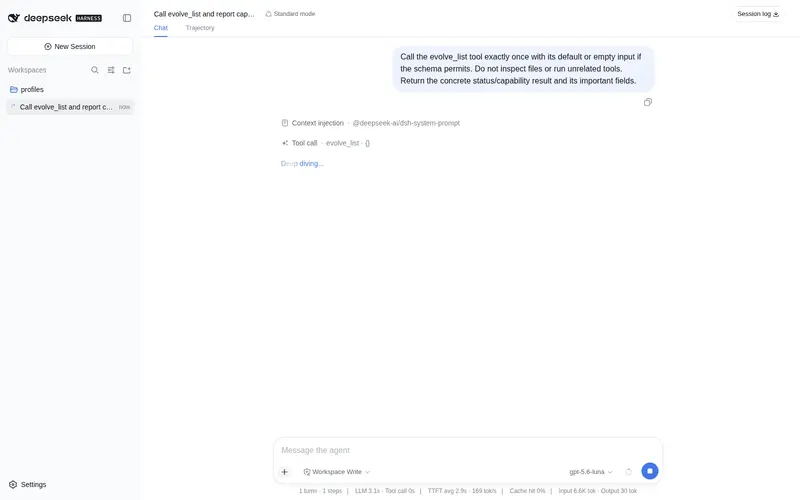
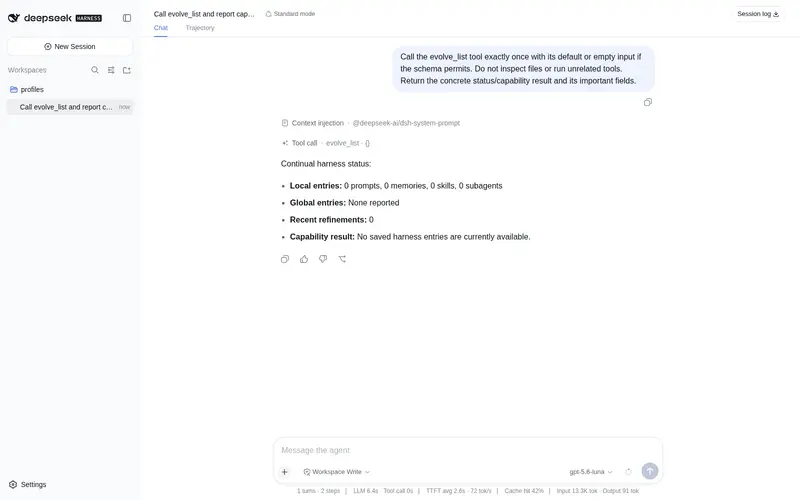
Continual self-evolution: versioned, auditable, rollback-safe harness state (prompts, memory, skills, subagent specs) refined from session trajectories, with review gates and hot-reloaded skills.
Best for
- Teams that want session lessons to become versioned, auditable harness state across prompts, memory, skills, and subagent specifications.
- Workflows that require review gates, human approval for global edits, and deterministic rollback.
- Agent-improvement programs that validate proposed changes with benchmarks and non-regression checks.
Not ideal for
- Simple, stateless sessions that do not need persistent self-improvement or cross-session memory.
- Environments that cannot meet the documented Node.js requirement of ^22.19 or >=24.
- Workflows seeking immediate autonomous global changes without review or approval gates.
README
dsh-continual-evolve
| 中文 | English |






Continual self-evolution for DeepSeek Harness: a versioned, auditable, rollback-safe layer of harness state — prompt notes, memories, skills, and subagent specs — refined from session trajectories.
Status: all phases complete; in long-term maintenance. Phases 1–3 shipped the full evolution loop: the pure-core engine, model tools and the
/evolvecommand, the automatic review gate (turn-interval + compaction checkpoints, human approval for global edits), real system-prompt injection (prompt notes + delegation specs, zero token cost when empty), and the benchmark-driven validation loop (code-owned scoring, non-regressive acceptance, rubric ACL). Since then the plugin keeps growing with usage-driven enhancements — the memory layer (ranked injection, trajectory citations, archive), per-installation rubric keys, plugin-owned file logging, the session wrap-up (/evolve wrapup), and the gate’s automatic local-fate dimension (local entries get a promoted or archived exit on the gate’s own cadence — consulted first, never written silently). See the Roadmap for the full shipped and candidate lists.
Background
This project started as a research question: can a harness improve itself, and what would a production-grade version look like? Three lines of evidence shaped the answer:
-
penguin-harness demonstrated the concept (benchmark → evaluate →
optimize → accept/rollback) but with zero code-level enforcement — every
guarantee was a prompt contract. Its report (
docs/research/) became the hardening checklist this project implements. -
prime-agent
/refineproved the engineering shape: versioned harness entries, atomic persistence, optimistic concurrency, inverse-op rollback. This package is an original implementation of that shape on the DSH plugin surface. - Academic work (Self-Harness, AHE, HarnessOpt-Bench) supplied the discipline: frozen evaluation runtime, code-owned aggregation, non-regressive acceptance.
The result: the model proposes, the code guarantees. Every mechanical safety property (schema validation, snapshots, versioning, audit trail, acceptance decisions) is enforced in code — never by asking the model to behave.
Why
Agents accumulate reusable experience in every session — repeated failures, durable facts, reusable procedures — and then forget it at the next turn or session. This plugin makes that experience first-class persistent state:
-
Versioned entries keyed by kind (
prompt/memory/skill/subagent), each with a recorded provenance and version -
Evidence trail: every refinement appends an event carrying
trigger / changes / evidence / outcome - Deterministic rollback: inverse edits are generated from applied results — no LLM re-guessing
- Code-enforced safety, not prompt discipline: schema validation, atomic writes, corrupt-file degrade, optimistic concurrency, immutable base system prompt
- Local (session) and global (cross-session) scopes with merge semantics
Design provenance
Inspired by three bodies of work (see docs/design.md):
-
prime-agent
/refine(MIT): the state model, atomic persistence, optimistic concurrency, per-edit validation, and inverse-op rollback this package implements — annotated reference source indocs/research/prime-agent-refinement.ts. The code here is an original implementation, written for the DSH plugin surface. -
penguin-harness (Apache-2.0): the benchmark-driven evolution loop — research report in
docs/research/penguin-harness-self-evolution.md; its prompt-only contracts are the anti-pattern this package hardens. - Academic: Self-Harness (arXiv 2606.09498), AHE (arXiv 2604.25850), HarnessOpt-Bench (arXiv 2608.06301).
Tech stack
| Layer | Choice |
|---|---|
| Language | TypeScript (strict, ES2024, ESM) |
| Runtime | Node ^22.19.0 \|\| >=24.0.0 (matches DSH) |
| Plugin seam |
@deepseek-ai/cordis (name / apply / inject entry) |
| Package manager | pnpm (DSH ecosystem standard) |
| Build |
tsc → lib/ (main lib/index.js, types lib/index.d.ts) |
| Tests | Vitest |
| Lint | oxlint (DSH official repo convention) |
| License | MIT |
Project layout
dsh-continual-evolve/
├── package.json          # exports / files / engines / scripts + dsh.bundle manifest
├── cordis.patch.yml      # bundle patch (dsh plugin add activates on install)
├── tsconfig.json / .oxlintrc.json / .editorconfig / .gitignore
├── LICENSE / README.md / README.zh.md
├── docs/
│   ├── design.md               # full design doc (incl. hardening matrix)
│   └── research/               # penguin-harness report + prime-agent reference source
├── src/
│   ├── index.ts          # cordis plugin entry (service mount + wiring)
│   ├── types.ts          # HarnessState / entry / edit / result types
│   ├── state.ts          # atomic persistence, corrupt degrade, merge, concurrency
│   ├── validate.ts       # code-enforced edit validation
│   ├── apply.ts          # per-edit apply pass with optimistic locking
│   ├── rollback.ts       # deterministic inverse-op rollback
│   ├── plan.ts           # proposal JSON parsing (truncation-aware)
│   ├── tool.ts           # evolve_* model-facing tools (5)
│   ├── command.ts        # /evolve command dispatcher + shared utilities
│   ├── goal-command.ts   # /evolve goal subcommand handler
│   ├── mount-command.ts  # /evolve mount + unmount subcommand handlers
│   ├── benchmark-command.ts # /evolve benchmark subcommand handler
│   ├── wrapup-command.ts # /evolve wrapup subcommand handler
│   ├── planner.ts        # ctx.llm planner
│   ├── llm-text.ts       # unified streaming-text helper (BlockAssembler + finish check)
│   ├── render.ts         # bounded prompt rendering
│   ├── inject.ts         # dynamic system-prompt section (prompt notes + delegation specs, ranked injection)
│   ├── source.ts         # trajectory citations (sessionId + event seqs of distilled entries)
│   ├── auto.ts           # auto-review gate (turn/compaction triggers + audit, global-aware view, local-fate phase)
│   ├── fate.ts           # gate local-fate dimension — auto promote/archive of local entries (consulted first, cooldown)
│   ├── notify.ts         # gate visibility — follow-up notice after an approved auto-refine
│   ├── goal.ts           # goal-driven evolution rounds (/evolve goal)
│   ├── review.ts         # gate LLM judgment (declines local duplicates of globally covered topics)
│   ├── approval.ts       # human approval for global edits
│   ├── skill.ts          # skill materialization ($DSH_HOME/skills/)
│   ├── skill-render.ts   # shared skill rendering (skillNameOf + renderSkillMarkdown, breaks circular dependency)
│   ├── skillquality.ts   # skill standard in the loop (skill-creator template reading + frontmatter code checks)
│   ├── mount.ts          # hot-mounted skill plugins (loader.create + boot restore)
│   ├── benchmark.ts      # benchmark store + CellScore types (with runtime evidence fields)
│   ├── rubric.ts         # rubric ACL (AES-256-GCM envelopes, auto-generated local key)
│   ├── logfile.ts        # plugin-owned file logging (JSONL exporter + rotation)
│   ├── score.ts          # code-owned aggregation + acceptance rule
│   ├── evaluate.ts       # two-stage evaluation runner (executor evidence → independent reviewer) + failure-cell protocol + runtime verification
│   ├── pool.ts           # bounded-concurrency worker pool for evaluation runs
│   ├── store.ts          # store layout + snapshots + result history
│   ├── service.ts        # evolution engine (onApplied hook)
│   ├── usage.ts          # entry injection usage tracking (durable counts, staleness detection)
│   ├── failures.ts       # failure-signature aggregation (gate + benchmark failures by class, /evolve failures)
│   └── wrapup.ts         # session wrap-up lifecycle (promote / split-promote → global, guarded archive; shared proposal builders; staleness signal)
└── test/                 # 32 files, 463 tests
Install
# from npm (installs and activates — ships its own bundle patch)
dsh plugin --profile web add dsh-continual-evolve

# or from source (first GitHub installs require approving the allowBuilds build step)
dsh plugin --profile web add github:ZK-Andy/dsh-continual-evolve
Swap web for your profile name (headless, or a custom profile).
In-session usage (after restart)
/evolve                  help + current local store
/evolve list [global]    list entries
/evolve history          applied refinements (ids for rollback)
/evolve rollback <id>    deterministically revert a refinement
/evolve plan [msg]       LLM planner against the current store
/evolve wrapup           assess this session's local entries: promote reusable ones to the
                         global store (approval required), archive session-specific ones
/evolve archive <id>     hide an entry from injection (data kept, restorable)
/evolve unarchive <id>   restore an archived entry
/evolve log [tail N] [session <id>]  show the recent plugin log (default 50 lines; optional per-session filter)
/evolve failures                  aggregated failure counts (review-gate + benchmark, by class — D1 observation layer)
/evolve export <path>    backup the local store to JSON
/evolve import <path>    restore a store from an export file
/evolve mount <skillId>  hot-mount a skill entry as a live cordis plugin (tool: skill_<name>)
/evolve mount list       list hot-mounted plugins (restored on boot)
/evolve unmount <id>     remove a hot-mounted plugin
/evolve goal             show the evolution goal (round-driven auto-review)
/evolve goal <objective> create/update the evolution goal — while active, the review gate runs EVERY round
/evolve goal done        complete the evolution goal
Model-facing tools: evolve_list, evolve_add, evolve_update, evolve_delete, evolve_rollback.
Memory layer
Beyond the persisted store itself, four features keep injected memory “understanding you” as entries grow (gap analysis vs. Mem0 / Letta / Zep / LangMem; no external services — everything is pure functions):
-
Ranked injection — when a kind holds more than the 6-entry cap, the
injected block no longer shows the fixed first six: entries are scored by
relevance to the agent’s most recent direct user messages (keyword/BM25
level: title hits weigh 2×) and then by recency (
updated_at, 30-day half-life), so the freshest and most relevant entries fill the cap. The empty-store zero-token behavior is unchanged. -
Trajectory citations — every newly created entry records
metadata.sourceSession+metadata.sourceSeqspointing at the direct user messages it was distilled from (DSH sessions are event-sourced with contiguous seqs, so the citation expands back into the durable session log). Listings showsrc=<sessionId>:<seqs>; old entries are not migrated and never error. -
Archive —
/evolve archive <id>hides an entry from injection (metadata.archivedAt, data kept, rollback-compatible) and/evolve unarchive <id>restores it. Archived entries are marked[archived]inevolve_listand skipped by injection; the overflow count excludes them. -
Session wrap-up — a session’s local entries otherwise become orphans when
it ends (later sessions never see them).
/evolve wrapupgives them an exit. Each entry is audited mechanically — global-coverage is judged by title similarity only (a bare id collision with a different title is intentionally NOT coverage; the actual matching global titles are shown to the assessor so it judges against real content) — then classified aspromote/archive/keep. Promotions move reusable entries into the global store through the human approval gate, keeping their trajectory citation and adding asourcedFromLocal=<session>:<id>back-link; the local copy is stampedpromotedToand retired from injection so it is never offered again. Split promotion (A-form): a mixed entry (durable facts + session snapshot) can be archived while carrying a cleanedpromotesub-object — only the durable part lands globally, the snapshot stays in the archive. A symmetric archive guard requires user confirmation before an archive that is NOT globally covered AND was distilled from real user messages hides that content from future sessions (over-archiving gets the same protection as over-writing); operational entries still archive silently. Everything stays snapshot/versioned/rollbackable. -
Gate local-fate (automatic wrap-up) — the same wrap-up machinery now
runs inside the auto-review gate on its own cadence (
fateIntervalTurns), so local entries get their exit while the session is still running instead of waiting for a manual/evolve wrapup. On each due gate run the audited candidates are classified by the assessor and partitioned by the same deterministic guards; the user is consulted FIRST before anything governed lands (one dialog covering promotes, split promotions and review-required archives — the consultSkillEdits pattern, with a decline cooldown). Covered or operational entries still archive silently, and at compaction the gate never opens a dialog: only silent archives apply, governed actions are deferred with an audit record pointing at/evolve wrapup. Every fate decision lands inreviews.jsonl(approved/declined/deferred/assessed/failed) and applied actions are visible via a follow-up notice. Apply writes are byte-identical to the wrap-up command (shared proposal builders). - Global-aware gate — the auto-review gate and planner judge the merged global + local state with every entry’s real scope labeled, so a topic already covered by a global entry is declined instead of being re-sedimented as a local duplicate.
Skill standard in the loop
The planner and the auto-review gate are raw ctx.llm calls — they do not
live in an agent session, so they cannot load skills through the skill
tool. To keep self-evolved skills on the quality bar, the plugin references
the skill-creator / skill-audit skills (user-level skills distilled
by the author from the official deepseek-harness 11 skills; template facts
verified against deepseek-harness 47f9438) at runtime — they stay the
single source of truth on disk, nothing is copied:
- Every planning call receives a
<skill_quality_standard>block: theskill-creator/references/template.mdfacts when those skills are installed (<dshHome>/skills/), or a builtin distilled guide otherwise (~1KB, low-frequency calls). The planner must ground skill proposals in a REAL trigger scenario from the trajectory, must not duplicate the official 11 skills or existing entries, and self-checks every proposed skill against the 7 structural features. - The gate judges skill-related trajectories against the skill-audit dimensions (frontmatter routing, structural features, paragraph skeleton, duplication) and declines proposals that would not meet the standard.
- The mechanical frontmatter rules of
validate-frontmatter.mjsare code-enforced at apply time: skill bodies must not open with a second---block (it would shadow the generated frontmatter), and resource references may not escape the skill directory. After materialization the rendered SKILL.md is re-checked and danglingreferences//scripts/links are logged as warnings. -
Two skill forms —
executableskills keep the python reference contract (hot-mountable as tools);guidanceskills are SKILL.md documents with no reference, the form for recurring multi-step workflows (session start/end routines, handoff procedures). Code enforces the split: a guidance skill must NOT carry a reference or arguments contract. - User-governed skill creation — the gate never writes a skill silently: when the planner proposes skill edits, the user is asked (固化/不固化) before they land; a rejected candidate is not offered again within a cooldown window. The rest of a proposal proceeds regardless, so memory/prompt distillation is never blocked by a skill decision.
Logging
Plugin-owned file logging: every cordis log message (from this plugin or any
other) is appended to <dshHome>/evolve/plugin.log as JSONL (0600, rotated to
plugin.log.1 past logMaxBytes). It works no matter how dsh web is
launched — no extra component to install, no startup-script dependency.
View the tail with /evolve log [tail N], or read the file directly:
tail -f ~/.dsh/evolve/plugin.log          # live
/evolve log 100                            # last 100 lines in the chat
For live output in a foreground terminal, the official
@deepseek-ai/cordis-plugin-logger-console plugin can be added to the
profile (optional; the file log remains the baseline that always exists).
Benchmark-driven validation (Phase 3)
/evolve benchmark new <title> [runs]                   create a benchmark (runs = repeats per case, default 1)
/evolve benchmark add-case <bid> <title> <statement> <rubric>
/evolve benchmark list                                 list benchmarks
/evolve benchmark reset <bid>                          clear the scoreboard (re-run reference)
/evolve benchmark status <bid>                         scoreboard + decisions
/evolve benchmark run <bid>                            evaluate current state → reference
/evolve benchmark run <bid> candidate <refinementId>   evaluate post-refinement state → decide
/evolve benchmark casecheck <bid>                      quality-gate check all cases
/evolve benchmark pilot <bid> <cid>                    single pilot run for calibration
/evolve benchmark freeze <bid> <cid>                   freeze a case as formal baseline
/evolve benchmark meta <bid> <cid> <field> <value>     set case metadata (capability/distinguisher/shortcuts)
The loop: freeze a reference score → evolve a candidate (/evolve plan) →
run the same case × run matrix against the post-refinement state → the
code-owned acceptance rule keeps the candidate only if the overall mean
strictly improves with no case regressing (Self-Harness style).
Evaluator/scorer separation (two-stage, gap A1) — each case × run unit is a PAIR of fresh subagents:
- the executor performs the task with its tools and records concrete evidence of what it did and found — it NEVER sees the rubric, so the agent under test cannot optimize toward or self-grade against the grading criteria;
- an independent reviewer grades that evidence strictly against the rubric (the only branch that receives the decrypted rubric), eliminating the “self-produced and self-scored” bias.
Each cell records the executor’s session id, so a score can be drilled back to the exact transcript that produced it (trace evidence pointer, gap A4).
Failure-cell protocol (gap A2) — a unit that cannot produce a score
(rubric decrypt error, executor/reviewer crash, protocol error) is recorded
as a failed cell, NEVER a zero: aggregation excludes failed cells from
every mean and counts them (/evolve benchmark status shows (N failed)),
and the acceptance rule rejects a round with more failed cells than
maxFailedCells (0 by default) instead of silently averaging a 0 into the
mean.
Aggregation and decisions live in src/score.ts. Rubric isolation is by
construction (the planner never sees rubric files, and the executor branch
never decrypts); a rejection is recorded in the scoreboard and the
refinement is rolled back automatically (autoRollbackOnReject, on by
default).
Ready-to-use seed cases are in examples/ — copy-paste the
statement and rubric to get started in under a minute.
Real recorded run (ACCEPT)
A live dsh web session, one case, one candidate — the first genuine
acceptance:
| Step | Command | Outcome |
|---|---|---|
| reference | /evolve benchmark run lint_convention |
90 — the evaluator agent actually grepped the harness store and reported “lint/ruff/eslint/mypy appear in zero entries” |
| candidate | /evolve plan 记住:写代码前必须先运行适用的 lint 检查 |
creates memory:convention_lint_before_code
|
| re-evaluate | /evolve benchmark run lint_convention candidate <id> |
100 — evaluator ran evolve_list, hit the memory, quoted it verbatim |
| decision | — |
overall: 90 → 100 · lint_knowledge: 90 → 100 · DECISION: ACCEPTED
|
The executor does not grade model common sense — it inspects the actual
harness state under test (grep, evolve_list) and records what it found;
the independent reviewer grades that record. A harness change measurably
moves the score. Earlier runs in the same session
produced honest REJECTED decisions (0 → 0 stub cases, and 100 → 100
where the baseline was already perfect).
Second recorded run (2026-08-19, gap-free baseline → 100) — a case whose topic was absent from the harness starts at 0, and a single distilled policy carries it all the way to a clean accept:
| Step | Command | Outcome |
|---|---|---|
| reference | /evolve benchmark run bootstrap2 |
0 — no performance-related entry exists, the executor honestly reports nothing found |
| candidate | /evolve plan 记住:写代码前必须先评估算法复杂度、性能优先、profile 再优化 |
creates local prompt performance-first-coding-policy
|
| re-evaluate | /evolve benchmark run bootstrap2 candidate <id> |
100 — evaluator runs evolve_list, hits the new policy, scores the full rubric |
| decision | — |
overall: 0 → 100 · DECISION: ACCEPTED (candidate caseHash matched the reference — no material drift) |
This run also exercised the whole measured pipeline end-to-end on the
current code: the two-stage executor/reviewer pair, runtime evidence
(provider/model/caseHash/sessionId/durationMs recorded on every
cell), and the failure-cell protocol (0 failures).
Configuration
| Key | Default | Meaning |
|---|---|---|
baseDir |
resolved DSH home | root for the evolve/ stores |
sectionOrder |
118 | system-prompt section order |
autoReview |
false |
enable the automatic review gate (costs a cheap model call per interval) |
reviewIntervalTurns |
6 | gate runs when this many turns passed since the last review |
maxReviewInputChars |
40000 | trajectory slice handed to the gate |
reviewBudgetTokens |
4096 | output budget for the gate call |
notifyOnAutoReview |
true |
after an approved gate run that applied edits, queue a visible follow-up notice in the session (persisted entries + rollback command) |
requireGlobalApproval |
true |
cross-session (global) edits ask the user for “批准” before applying |
skillsDir |
<dshHome>/skills |
root where skill entries materialize as SKILL.md bundles |
rubricKey |
auto-generated local key file (<dshHome>/evolve/rubric.key, 0600) → dev fallback |
passphrase for AES-256-GCM rubric encryption (benchmark rubrics never touch the disk in plaintext). When unset, the plugin generates a random per-installation key file on first use — every install gets its own key, no setup needed; DSH_EVOLVE_RUBRIC_KEY is the environment-variable override |
logToFile |
true |
write all cordis log messages to <dshHome>/evolve/plugin.log (JSONL, 0600) — plugin-owned logging works with any launch method, no extra component to install |
logLevel |
1 |
file log level: 0=error, 1=info, 2=warn, 3=debug |
logMaxBytes |
5 MiB | rotate the log to plugin.log.1 when it exceeds this size |
autoRollbackOnReject |
true |
after a benchmark decision rejects a candidate, roll the refinement back automatically (same engine path as /evolve rollback — deterministic, snapshotted, audited) |
localFate |
true |
gate local-fate dimension: the gate audits the session’s local entries on its own cadence and proposes promote/archive — consulted first, never written silently (only meaningful with autoReview) |
fateIntervalTurns |
follows reviewIntervalTurns
|
minimum turns between local-fate assessments on the turn-interval path (compaction is unconditional) |
goalBlockedWrapupTurns |
3 |
D3: after this many consecutive gate runs observing the goal phase blocked, run one local-fate assessment (0 disables) |
reviewModel |
(agent’s own) | optional model override for the review gate (cheaper model); format: "provider/model" or just "model"
|
Example (profile cordis.patch.yml):
- insert:
    - id: continual-evolve
      name: 'dsh-continual-evolve'
      config:
        autoReview: true
        reviewIntervalTurns: 6
Development
pnpm install        # install dev deps
pnpm dev            # tsc --watch
pnpm build          # tsc -> lib/
pnpm test           # vitest run
pnpm test:coverage  # vitest run --coverage (v8; thresholds enforced in CI)
pnpm lint           # oxlint src test (correctness category on)
Hit a wall? See docs/FAQ.md — real failure/fix records (service planes, schema DSL, structured output, gate counting, verifying prompt injection).
Where we still lag behind prime-agent /refine and penguin-harness — and what to build next: docs/gap-analysis.md (P0+P1+P2+P3 shipped: evaluator/scorer separation, failure-cell protocol, runtime provenance verification + material-drift detection, usage statistics, auto-decay, case lifecycle + quality gate, entry directory view, review model separation, blast-radius annotations, duration tracking, evolve_complete events, seed benchmark; D1 observation layer + D3 goal-blocked trigger shipped; remaining: cross-process sync on demand + D1/D2 full engineering pending experiment data).
Roadmap
Shipped
-
Phases 1–3 (done): pure-core engine (state model, validation, apply, rollback, proposal parsing) →
evolve_*tools +/evolvecommand +ctx.llmplanner → auto-refine review gate (turn-interval + compaction checkpoints, visible follow-up notices), global-scope human approval, executable skills, real system-prompt injection (prompt notes + delegation specs, inherited by subagents), benchmark-driven validation loop (code-owned scoreboard, non-regressive acceptance, rubric isolation by construction), hot-mounted skill plugins, goal-driven evolution rounds. -
2026-08 maintenance wave (done):
-
memory layer — ranked injection (relevance + recency scoring fills the per-kind cap), trajectory citations (
metadata.sourceSession+sourceSeqs, shown assrc=session:seqs), archive/unarchive (/evolve archive <id>, injection skips archived entries), global-aware gate (declines local duplicates of globally covered topics) -
per-installation rubric key — auto-generated local key file (
<dshHome>/evolve/rubric.key, 0600); no more publicly known dev key -
plugin-owned file logging — every cordis log message lands in
<dshHome>/evolve/plugin.log(JSONL, 0600, rotated), viewable via/evolve log; works with any launch method, no extra component to install -
trajectory-grounded planning —
/evolve plan(and every planner call, including the gate’s refine step) now reads the session trajectory: the caller’s recent direct user messages are extracted from the session log and fed to the planner as a<session_trajectory>block, so proposals are grounded in what the user actually said (explicittrajectoryoverrides; empty trajectory is omitted at zero cost) -
gate-proposed archiving — stale entries are a first-class refine target: the planner can emit
action: "archive"(kind + id only), which stampsmetadata.archivedAtthrough the normal apply path — snapshot, version bump, audit event, and a deterministic rollback inverse that restores the pre-archive state. Archive hides from injection but never deletes; re-archiving an archived entry is rejected, and the base system prompt stays immutable -
automatic rollback on benchmark rejection — the acceptance loop is closed: when the code-owned decision rejects a candidate, the refinement is reverted automatically through the same engine path as
/evolve rollback(deterministic inverse edits, snapshotted and audited; configurable viaautoRollbackOnReject, on by default). Failures report the manual fallback instead of throwing -
per-session log filtering —
/evolve log [tail N] [session <id>]keeps only the lines mentioning a given session id (exact token match, drawn from the rendered message and raw args); gate records now carry the session id in their log line -
skill standard in the loop — the planner and gate now author and judge skill entries against the skill-creator/skill-audit standard (author-distilled from the official deepseek-harness 11 skills): every plan call injects the
template.mdfacts (builtin distilled guide as fallback) as<skill_quality_standard>; apply code-enforces the frontmatter mechanics (no shadowing---, no escaping resource refs); materialized SKILL.md files are re-checked and dangling resource references are logged; - guidance skills + user-governed creation — a second skill form (SKILL.md documents without a python reference) lets recurring workflows be proposed as skills; the gate offers every auto-created skill to the user (固化/不固化) before it lands, with a rejection cooldown — skills grow under governance, never silently
-
memory layer — ranked injection (relevance + recency scoring fills the per-kind cap), trajectory citations (
-
2026-08-17 wrap-up wave (done):
-
/evolve wrapup— a session’s local entries get a real exit at session end: mechanical audit (local candidates + global-coverage detection; coverage judges title similarity only — a bare id collision with a different title is deliberately NOT coverage, and the real matching global titles are shown to the assessor) → LLM classification (promote/archive/keep+ A-form split promotion: archive a mixed entry while promoting a cleaned durable sub-object) → deterministic guards re-checked at apply time (promote can never write a global duplicate; the symmetric archive guard requires user confirmation before an uncovered, user-sourced archive hides content; splits that duplicate a global topic drop to plain archive) → one human approval gate for every global create -
gate local-fate dimension — the wrap-up machinery now runs inside the auto-review gate on its own cadence (
fateIntervalTurns, compaction unconditional): local entries are audited, classified and partitioned while the session is still running; governed actions are consulted first (one dialog, decline cooldown), covered/operational entries archive silently, compaction applies only silent archives and defers governed actions with an audit record; every decision lands inreviews.jsonland applied actions get a follow-up notice. Apply writes are shared with the wrap-up command (byte-identical proposals)
-
-
2026-08-19 research-wave precursors (done):
-
goal-blocked wrap-up (D3) — a goal stuck in
blockedforgoalBlockedWrapupTurnsconsecutive gate runs (default 3) triggers one local-fate assessment, so the blocked encounter is distilled before the session moves on; the streak resets on any non-blocked run and after each assessment, and declined proposals follow the normal fate cooldown (never nagged). Disable withgoalBlockedWrapupTurns: 0 -
failure-signature aggregation (D1 observation layer) —
/evolve failurescounts every failed review-gate record and benchmark failed cell by deterministic failure class (rubric-decrypt/executor/reviewer/material-drift/gate/max-tokens/ …), the data layer a future failure-signature Refiner would route on -
bootstrap-update experiment scaffold (D2) —
docs/experiment-bootstrap.mddesigns a ≤3-round controlled experiment (fixed reference → evolve harness → candidate) to test whether a refined harness accelerates the next run;scripts/benchmark-trend.shextracts the per-run trend table (overall / totalDurationMs / failed / case-hash consistency) from scoreboards
-
goal-blocked wrap-up (D3) — a goal stuck in
-
2026-08-17 gap P0 (done):
- evaluator/scorer separation — benchmark evaluation is now two-stage (gap A1): the executor performs the task and records concrete evidence without ever seeing the rubric; an independent reviewer grades that evidence against the rubric (the only branch that decrypts it). The assessed agent can no longer optimize toward or self-grade against the criteria.
-
failure-cell protocol — cells carry
status: ok|failed(gap A2): failed units are excluded from every mean and counted, and the acceptance rule rejects rounds with failures beyondmaxFailedCells(0 default) instead of averaging a zero into the mean. Scoreboard status/run surfaces failed counts and per-cell reasons. - trace evidence pointer — each cell records the executor’s session id (gap A4), so a score drills back to the exact transcript that earned it
-
2026-08-18 gap P1 (done):
-
runtime evidence verification (A3) — cells now record actual
provider,model, andcaseHash(SHA-256 prefix of statement + rubric) written by the host, not the model; material changes between reference and candidate runs are detected and re-mark the affected candidate cells as failed (version_changed semantics,score.flagMaterialDrift), so a drifted round can never be accepted -
entry usage statistics (B1) — injection counts are durably tracked per entry in
<baseDir>/evolve/usage.json;evolve_listshows usage counts;zeroUsageEntries()surfaces never-injected local entries as archive candidates -
automatic staleness detection (B2) — entries with zero injection usage AND old recency are flagged
stalein wrap-up candidates; the LLM assessor is instructed to prefer “archive” for stale entries
-
runtime evidence verification (A3) — cells now record actual
-
2026-08-18 gap P2 (done):
-
case lifecycle + quality gate (A5) — cases follow a
draft → calibrating → frozenstate machine;casecheckruns mechanical quality validation (capability contract, distinguisher, shortcuts);pilotperforms a single-run calibration;freezelocks a case as a formal baseline (requires quality gate pass);metasets case metadata fields - entry directory view (B3) — the injection block now includes a lightweight directory of ALL non-archived entries (id + title, one line each) when entries exceed the curated cap, giving the model a zero-cost overview
-
review model separation (C1) —
reviewModelconfig option lets the review gate use a cheaper model than the main agent -
blast-radius annotations (C2) — every edit now carries a
blastRadiusfield (general/project/session); the planner is instructed to annotate it and the parser validates values -
duration tracking (C3) — each evaluation cell records
durationMs(wall-clock time); aggregate totals and decision reports show timing comparison
-
case lifecycle + quality gate (A5) — cases follow a
-
2026-08-18 code refactoring (done):
-
circular dependency break (P1-1) — extracted
skill-render.tsto decoupleskill.ts ↔ skillquality.ts -
LLM call deduplication (P1-2) — extracted
llm-text.tswith sharedstreamText()(~107 lines removed from review/planner/wrapup) -
config type derivation (P2-1) —
EvolveConfignow derived from schemastery schema viaSchemastery.TypeT(eliminated 20-line handwritten interface) -
command.ts split (P2-2) — 860-line god file split into
goal-command.ts,mount-command.ts,benchmark-command.ts,wrapup-command.ts -
P3 cleanups —
questionServiceOf()cast dedup (4 sites), dead exports removed, contradictory comments fixed
-
circular dependency break (P1-1) — extracted
The upcoming/candidates list is empty for now — future work is driven by real usage.
License
MIT. Independent project — not affiliated with DeepSeek.
Frequently Asked QuestionsFAQ
Use the verified command dsh plugin --profile default add github:ZK-Andy/dsh-continual-evolve in a DSH-enabled shell. The command resolves the public package metadata and keeps the plugin attached to the catalog identity shown on this page.
Compatibility follows the bundle and profile status shown above. If a profile is not detected, keep the plugin disabled there and check the repository documentation before enabling it in production.
The GitHub link and activity metadata are the source of truth for releases and maintenance. Revisit this page after a new release to confirm the catalog has observed the latest version.