BruceLanLan/dsh-tier-router
双档模型路由:强档负责规划/咨询/评审、弱档负责实现;含计划模式自动路由、高危操作守卫、失败自动升级与子代理分层。
已收录
2
Model
Bundle 已验证
预览
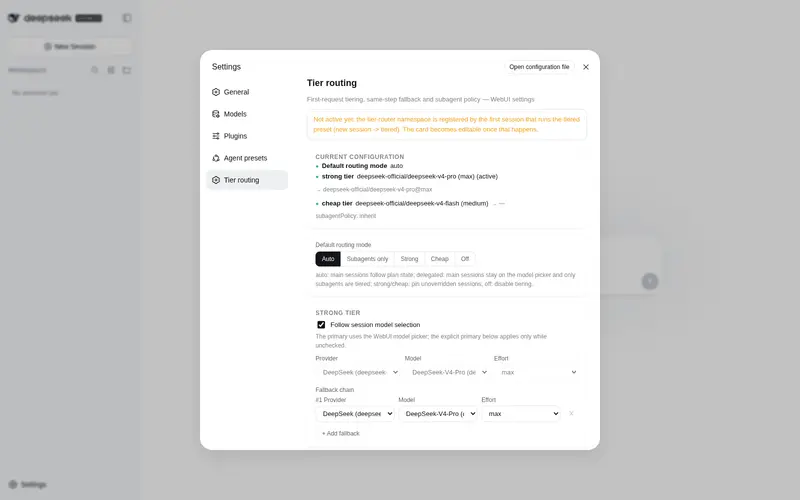
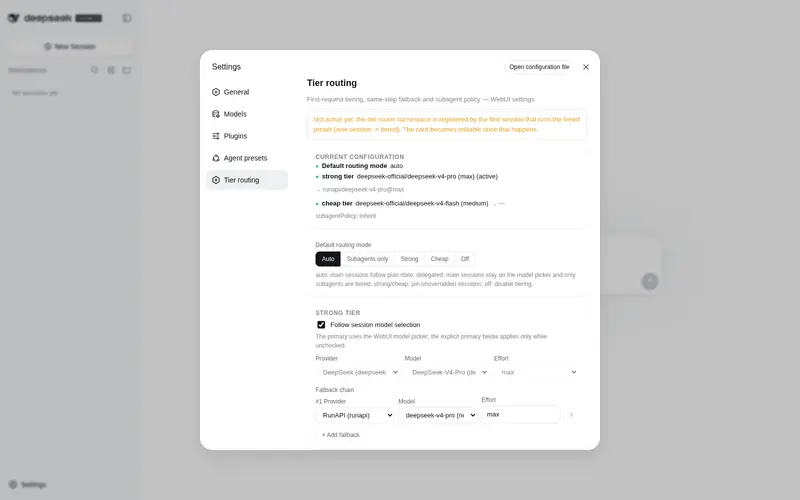
功能介绍
双档模型路由:强档负责规划/咨询/评审、弱档负责实现;含计划模式自动路由、高危操作守卫、失败自动升级与子代理分层。
适合
- 希望强档模型负责规划、咨询和评审,同时由较低成本模型处理常规实现的团队。
- 需要在规划与执行阶段之间自动切换档位的计划模式工作流。
- 需要在重复失败后临时升级,或在高影响操作前强制升级的会话。
- 需要为新建 worker 配置模型档位的多代理工作流。
不适合
- 只有单一模型、无法形成档位差异的部署。
- 要求档位切换影响当前正在构建步骤的流程;切换从下一步生效。
- 需要按会话分别设置子代理策略的场景;文档中的子代理策略为进程级。
- 要求内置子代理使用独立于父会话档位的流程;内置子代理会继承父级路由。
README
dsh-tier-router — Tiered model routing for DeepSeek Harness


Routes model steps by task difficulty: a strong tier (deepseek-v4-pro by default)
handles planning / architecture / review, while a cheap tier (deepseek-v4-flash by
default) handles day-to-day implementation. Inspired by Claude Code’s /advisor
(consult a stronger model for hard decisions) and opusplan (strong model in plan mode,
cheap model for execution), implemented on DeepSeek Harness through its official seams,
with an escalation gate, failure auto-escalation, and subagent tiering on top.
English · 中文
How it works
flowchart LR
    subgraph main["Main session (header-driven)"]
      U["User message"] --> IN["agent/inbox/inserted"]
      IN -->|"auto mode"| HW["write session request/header"]
      PM["plan/mode flip"] --> HW
      HW --> API["api-proxy selection layer"]
      API --> STEP["each step's model = header tier"]
    end
    subgraph child["Subagents (agent/request swap)"]
      W["tier_worker dispatch"] -->|"agentOptions injection"| C["subagent"]
      C --> AR["agent/request waterfall"]
      AR -->|"swap provider/model per tier"| STEP2["subagent steps"]
    end
    G["tools/pre-execute guard"] -.->|"cheap tier + high-impact pattern"| DENY["deny + escalation hint"]
    E["agent/error failures"] -.->|"within window"| ESC["temporary strong tier (TTL)"]
sequenceDiagram
    participant U as User
    participant S as Session (main agent)
    participant A as Strong v4-pro
    participant C as Cheap v4-flash
    U->>S: /tier plan (enter plan mode)
    S->>S: write header -> strong
    S->>A: planning / architecture / design
    U->>S: approve plan, leave plan mode
    S->>S: write header -> cheap
    S->>C: routine implementation
    S->>A: tier_advisor (hard decisions) / tier_review (final review)
    Note over S,C: high-impact actions (rm -rf / credential files) are denied by the guard until the strong tier is selected
Features
-
Automatic tiered routing (auto mode, opusplan-style): steps run on the strong tier
while plan mode is active and on the cheap tier during execution. Main sessions are
routed by writing the session
request/header(the official seam the api-proxy selection layer reads, as community plugins likedsh-model-routerdo); subagents are switched per step at theagent/requestwaterfall. -
Per-session scoping:
/tier strong|cheap|auto|offaffects only the current session; other sessions in the process keep their own tier (global defaultauto). Sessions that should not be managed can opt out with a single/tier off. -
On-demand advice (advisor-style): the
/advisor <question>command and thetier_advisortool hand one decision question plus gathered evidence to the strong tier and return advice / evidence / risks / acceptance criteria; implementation stays on the current tier. -
Review phase: the
tier_reviewtool and/tier review <focus>ask the strong tier to review a change set and return anAPPROVE / NEEDS-CHANGES / BLOCKEDverdict with issues ranked by severity. -
Failure auto-escalation: repeated step errors within a window (default 2 errors /
60s) temporarily escalate the session to the strong tier (default 180s), expiring via
TTL; sessions in
offmode never escalate. -
Configurable tiers (durable):
/tier set <strong|cheap> <provider> <model> [effort]or thetier_configuretool can point either tier at any registered provider/model (defaults:deepseek-official/deepseek-v4-pro(max)anddeepseek-official/deepseek-v4-flash(high)). Configuration persists in thetier-routersettings namespace and survives restarts (passsessionOnly: truefor a transient change). -
High-impact escalation gate (deterministic guard): while the cheap tier executes,
tools/pre-executedenies high-impact tool calls and requires switching to the strong tier first — no reliance on model self-discipline. Guard rules (pure logic inlib/pure.js, unit-tested):- every
rm -rfspelling: combined flags (-rf), split flags (-r -f), case variants (-R), long flags (--recursive --force), runner prefixes (sudo rm -rf,busybox rm); - destructive commands:
mkfs,dd if=,sudo,shutdown/reboot/halt,git push --force/-f,git clean -f*,find ... -delete/find ... -exec rm,python -cwithshutil.rmtree/os.remove,curl|sh,wget|sh,chmodon.ssh,chown; - sensitive paths:
.env(whitelist for.env.example/.template),credentials/secretswith common extensions,.ssh/, private keys such asid_rsa(case-insensitive),.pem,.key; - prose never false-positives:
echo rm -rf,grep sudodo not trigger (command-position anchored).
- every
-
Subagent tiering:
tier_workerdispatches bounded task packets to a fresh subagent on a chosen tier (agentOptionsmodel injection), withoutputSchema(structured results),toolFilter(restrict worker tools),maxDepth(delegation-depth cap),persona(per-child persona) andbackground(run via the jobs service);/tier subagent <inherit|cheap|strong>records the policy used to classify subagent execution (the guard); a child’s model route is fixed at creation —tier_workerpasses provider/model/effort directly, built-insubagent/subagent_forkchildren inherit the parent’s route. -
Escalation rules injected into the system prompt: ambiguity unresolved,
architecture / security / data integrity, two failed attempts, high-risk completion —
the model is guided to call
tier_advisor/tier_reviewat decision points.
Installation
Plane note.
dsh-tier-routercontributes agent-plane surfaces — tools, slash commands, a prompt section, and step-routing listeners — so it must be composed in the agent preset your sessions use, not as a host bundle row. Installing the package alone (or shipping a host insert) activates nothing.
# 1. Link the package into your profile (dev: clone this repo and add the path;
#    once published: dsh plugin --profile web add dsh-tier-router)
git clone https://github.com/BruceLanLan/dsh-tier-router.git
cd dsh-tier-router
dsh plugin --profile web add .

# 2. Install the ready-made agent preset (standard + the tier-routing row) into
#    the user preset root (${DSH_HOME:-$HOME/.dsh}/.agent-presets/):
cp -R agent-presets/tiered "${DSH_HOME:-$HOME/.dsh}/.agent-presets/"

# 3. Make it the default for new sessions (add to the profile's cordis.patch.yml):
#      - id: agent-presets
#        name: '@deepseek-ai/dsh-agent-presets'
#        config:
#          default: tiered
#    (or select "tiered" per session in the preset picker instead)

# 4. Restart DSH (kill the process LISTENing on the web port first), then open a
#    NEW session (existing sessions keep the preset they were created with) and
#    verify with /tier status.
Uninstall: remove the tier-routing row from the preset (or delete the preset
directory), and dsh plugin --profile web remove dsh-tier-router to drop the
package link.
Installation is verified in practice: the package resolves from the profile
store, the shipped agent-presets/tiered preset (a standard copy plus the
- id: tier-routing / name: dsh-tier-router row) passes
agentPresets.standingKeyFor mount validation, module loading is smoke-tested,
and npm pack ships a clean tarball (lib + patch + preset + README/LICENSE).
Post-install acceptance checklist
-
Restart DSH: kill the process LISTENing on the web port first
(
lsof -tiTCP:<port> -sTCP:LISTEN | xargs kill -9), then start it again. - Open a NEW session — existing sessions keep the preset they were created with (this is by design).
- Run
/tier status— it must report:-
config persisted: yes (tier-router settings namespace), - both tiers with their provider/model/effort,
- a non-empty
diag:line with live counters.
-
- The
tier_status,tier_route,tier_configure,tier_advisor,tier_review, andtier_workertools must be callable in that session. - While executing on the cheap tier, a high-impact command (e.g.
rm -rf,sudo …) must be denied by the guard with an escalation hint. -
/tier set strong <provider> <model> [effort]must replySaved to tier-router settings.and survive a restart.
If /tier status is unavailable, the row is missing from the session’s preset
(see Installation) or the session predates the preset switch.
Usage
Slash commands (typed in the composer; they affect only the current session)
/advisor <question>                          # one strong-tier consultation
/tier status                                # routing state, escalation state, diagnostics
/tier strong | cheap                        # force one tier for this session (optionally persist as session default)
/tier auto                                  # restore auto for this session (plan -> strong, execution -> cheap)
/tier off                                   # disable routing for this session, restore its default model (other sessions unaffected)
/tier plan                                  # auto + enter plan mode, apply the strong header immediately
/tier models                                # list registered providers and their models
/tier set <strong|cheap> <provider> <model> [effort]
/tier subagent <inherit|cheap|strong>       # policy used to classify subagent execution (guard)
/tier review <focus>                        # strong-tier review
Sample output (/tier status):
Tiered model routing
  mode: global=auto, this session=auto (per-session via /tier strong|cheap|auto|off; escalate: 2 errors / 60s window -> 180s strong)
  strong: deepseek-official/deepseek-v4-pro (max)
  cheap:  deepseek-official/deepseek-v4-flash (high)
  subagents: inherit
  diag: requestSteps=42 guardChecks=31 guardDenies=3 headerWrites=4 errorsSeen=0 escalations=0
  session default: deepseek-official/deepseek-v4-pro (max)
  providers: deepseek-official, opencode-go, minimax
Model tools (called by the model when needed)
| Tool | Purpose |
|---|---|
tier_advisor |
Strong-tier consultation: one question + evidence -> advice / risks / acceptance criteria |
tier_review |
Strong-tier review: change set + validation results -> verdict with ranked issues |
tier_route |
Set this session’s tier (strong/cheap/auto/off, optionally persisted) |
tier_configure |
Reconfigure either tier’s provider/model/effort and the subagent policy |
tier_worker |
Dispatch a bounded task packet to a subagent on a chosen tier; supports outputSchema / toolFilter / maxDepth / persona |
tier_status |
Read-only diagnostics: global & session tiers, escalation state, listener counters, effective tier |
Configuration
Runtime configuration (no restart needed):
/tier set strong deepseek-official deepseek-v4-pro max
/tier set cheap deepseek-official deepseek-v4-flash high
/tier set and tier_configure persist the tier configuration in the tier-router
settings namespace (survives restarts; pass sessionOnly: true for a transient change).
tier_route strong|cheap scopes to the current session and does NOT persist by default;
pass persist: true to also write the session default model (agent-default-model).
Failure auto-escalation parameters (threshold / window / TTL) are currently built-in
constants; configurable in a later version.
Tests
npm test        # node:test — 20 cases: guard positive/negative matrix, tier decision precedence, per-session overrides
npm run check   # syntax check for lib/index.js and lib/pure.js
Verified in live multi-round sessions (dynamic-plugin form):
| Area | Result |
|---|---|
| Main-session per-step routing (durable log evidence) | ✅ request/header events show the pro -> flash switch |
| Guard matrix (auto/strong/off) | ✅ auto denies / strong allows / off allows + restores default / auto-restored denies |
| Guard hardening (split flags, runner prefixes, prose, .env whitelist, case) | ✅ 7/7 live probes |
| Tools, positive paths | ✅ advisor/review hit the strong tier; route modes; configure; worker on both spawn and fork providers |
| Worker options | ✅ outputSchema structured result, toolFilter restriction, maxDepth rejection, invalid filter error |
| Tools, negative paths | ✅ invalid provider rejected, invalid subagent provider error |
| Subagent tiering | ✅ cheap tier on flash, strong tier on pro (child logs + return values) |
| Failure-escalation event path | ✅ agent/error fires, counters increment, off mode correctly skips |
| Lifecycle | ✅ stop removes guard & tools; re-run restores everything and the guard works |
| Persistence | ✅ agent-default-model written |
| Cross-turn listener survival | ✅ diagnostic counters keep incrementing across turns |
FAQ
Q: Why was another session’s model switched automatically?
Early versions were process-global. Since v0.3.0 /tier commands scope to the current
session only; other sessions default to auto independently. A session that should not
be managed runs /tier off to opt out.
Q: The tier switch did not take effect immediately? Tier switches are written to the session header before the step is built, so they apply from the next step (one-step delay).
Q: How do I use subscription-channel models (OpenCode Go / MiniMax)?
Run /tier models to confirm the provider is registered and its models are configured,
then /tier set cheap opencode-go deepseek-v4-flash. pi-ai-style providers must declare
baseURL / api / models in settings.yaml, otherwise every model id is rejected.
Q: A high-impact action was blocked. What now?
The guard’s message tells you: switch to the strong tier first (tier_route strong or
/tier strong) and re-issue — the block exists precisely to keep the cheap tier from
running destructive actions directly.
Q: /tier does not appear after installing the bundle?
The package is an agent-plane plugin: it must be a row in the agent preset your
session uses (see Installation). A host bundle row alone activates nothing —
agent-plane services (tools, commands, systemPrompt) are only reachable
from the preset scope, and this package ships no host insert by design. After
adding the row, restart dsh web and verify with /tier status. (The
dynamic-plugin form is a process-local temporary instance and disappears on
restart.)
Known limitations
- Tier switches take effect from the next step (the header is written before the step builds).
- The subagent policy (
/tier subagent) is process-wide and classifies child execution for the guard. A worker’s tier is fixed at creation (tier_workeragentOptions); built-insubagent/subagent_forkchildren inherit the parent’s model route. - The full live “fail -> self-heal” sequence for failure auto-escalation has been verified at the event path and unit-logic level; trigger it live per the FAQ if desired.
License
MIT
常见问题常见问题
在启用了 DSH 的终端中执行已验证命令 dsh plugin --profile default add github:BruceLanLan/dsh-tier-router。命令会解析公开 package 元数据,并保持插件与本页展示的目录身份一致。
兼容性以页面上展示的 bundle 与 profile 状态为准。如果某个 profile 尚未检测到,请先保持禁用,并在生产启用前阅读仓库文档。
GitHub 链接和 activity 元数据是 release 与维护状态的来源。新版本发布后重新查看本页,确认目录已经观察到最新版本。