GodD6366/dsh-sub2api
Connect your sub2api gateway to DeepSeek Harness: OpenAI-compatible multi-provider routes (OpenAI / Claude / Grok / Gemini) behind one base URL, with per-key model discovery, usage lookup, and a settings page.
已收录
0
Model
Bundle 已验证
预览
功能介绍
将 sub2api 网关接入 DeepSeek Harness:用一个 base URL 统一管理 OpenAI / Claude / Grok / Gemini 等多供应商路由,支持按 key 发现模型、用量查询与全局视觉/图像生成工具。
适合
- 已经运行 sub2api 网关,希望在一套 DSH 配置中接入 OpenAI、Claude、Grok 和 Gemini 路由的团队。
- 需要按 sub2api 分组发现各 key 可用模型并从网关查看用量的多 key 环境。
- 需要专用全局图像分析、生成工具或可选自动视觉包装的纯文本模型工作流。
不适合
- 没有 sub2api 网关,或没有绑定到相应分组的供应商 key 的用户。
- 无法提供所需 pi-ai 适配器的环境;协议序列化、流式传输和用量统计依赖该适配器。
- 在 models.dev 缺少数据时仍要求模型能力元数据绝对准确的工作流,因为此时图像支持可能根据模型 ID 推断。
README
dsh-sub2api
Connect your sub2api gateway to DeepSeek Harness as model providers.
Sub2API is an AI API gateway that turns subscription quota into OpenAI-compatible endpoints. In its model, each API key is bound to a group, and the group decides the platform (OpenAI / Claude / Grok / Gemini) and the models that key can serve. The four provider routes (sub2api-openai, sub2api-claude, sub2api-grok, sub2api-gemini) are served by the harness’s own pi-ai adapter (dsh-llm-pi-ai): this plugin translates its llm-sub2api: settings into llm-pi-ai: provider profiles (all sharing one bare-host base URL, no /v1), and protocol serialization, streaming, and usage accounting all live in pi-ai. The same gateway serves OpenAI, Claude, Grok, and Gemini models side by side, and the harness routes each request to the key whose group owns the requested model.
Features
-
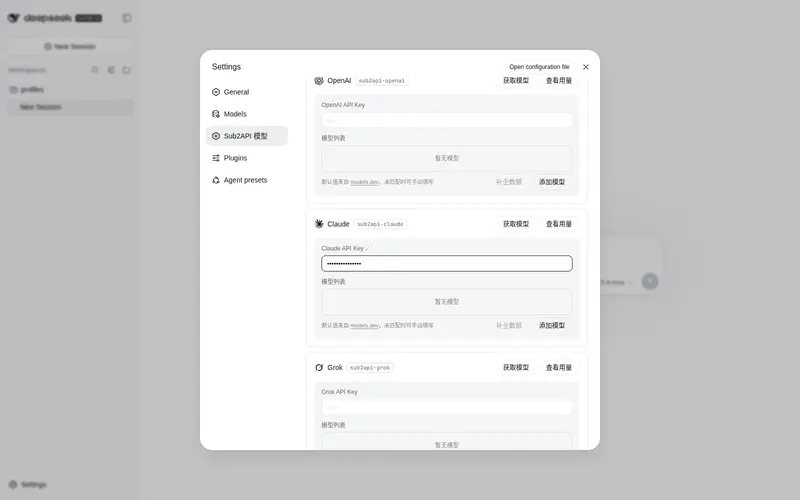
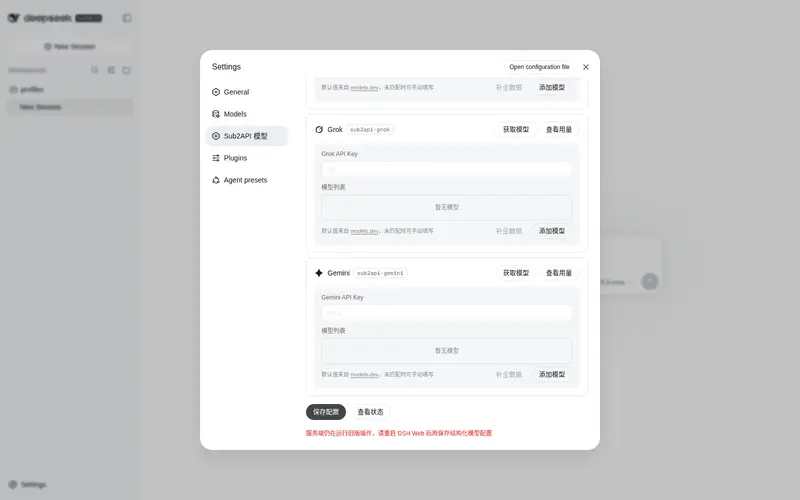
One base URL, four provider routes:
sub2api-openai,sub2api-claude,sub2api-grok,sub2api-gemini— each configured with its own key, registered as a live LLM provider the moment the key is set. -
Streaming chat (backed by pi-ai): SSE streaming, tool calls, reasoning deltas, and token usage are mapped to the harness protocol by
dsh-llm-pi-ai, which natively handles wire-format details like top-levelfunction_callitems in the Responses API. -
Model discovery: one-click “fetch models” calls
GET {baseURL}/modelswith the key, so each route’s catalog matches exactly what the sub2api group serves. -
Reasoning effort (thinking mode):
reasoning_effortis passed straight through to the gateway and adjustable right in the chat model selector; the settings page’s per-model “reasoning strength” column fills each model’s real levels from models.devreasoning_options(e.g.gpt-5.6-sol→ none/low/medium/high/xhigh/max,deepseek-v4-flash→ low/high/max), with editable levels and an explicit opt-out. -
Usage lookup: “view usage” calls
GET {baseURL}/usageand summarizes quota, balance, rate limits, and subscription windows. -
Standards-based config: base URL and model catalogs live in the
llm-sub2api:settings section ($DSH_HOME/settings.yaml, written by the web Models page); keys go through the harness credential store. -
Global vision / image tools:
analyze_imageandgenerate_imagestay available even when the current chat model cannot see or create images. They call a dedicated vision or image model configured on the settings page, and return a description or a workspace file path rather than injecting image blocks into a text-only session. -
Auto Vision wrapper: image capability for text-only models. Every registered text-only provider route gets a same-name twin (
<route>-vision, shown as “… + 自动识图”) — our ownsub2api-*routes and external providers (officialdeepseek-official,llm-pi-ai, routes added by other plugins). Twin models carry a-visionid/name suffix (e.g.deepseek-v4-flash-vision) so the picker shows at a glance which models accept images; the suffix is stripped again when the call is delegated back to the base route. The twin’s catalog declaresinputModalities: ['text', 'image']so the harness attachment admission passes, and the twin’s stream rewrites image blocks into vision-model transcriptions (via the configuredtools.analyzemodel, cached per attachment) before delegating the text-only turn to the original route’s adapter. DeepSeek stays the brain; the vision model is only the eyes. Twins followllm/adapters-updatedand skip names already taken by other plugins. Disable withautoVision: false. - Provider icons from lobehub/lobe-icons, embedded as SVG in the settings page.
Install
dsh plugin --profile web add @godd6366/dsh-sub2api
or, from this repository:
dsh plugin --profile web add .
Configure
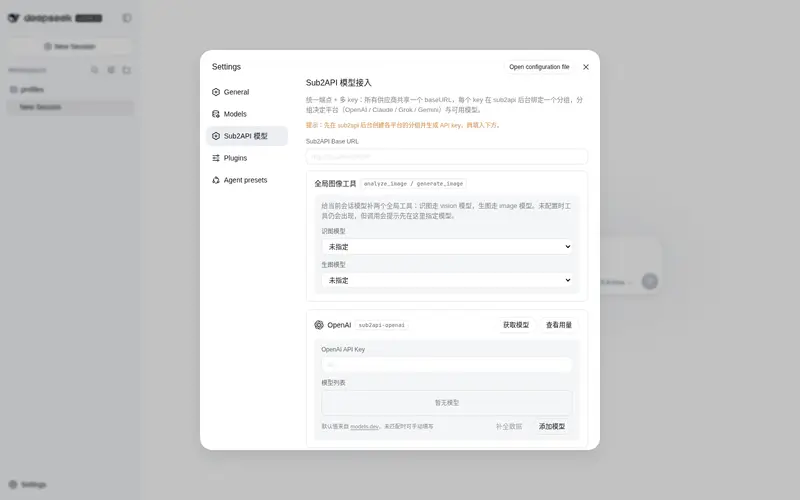
Open Settings → Sub2API 模型 (or edit $DSH_HOME/settings.yaml directly):
llm-sub2api:
  baseURL: http://localhost:8080
  providers:
    openai:
      apiKeyEnv: SUB2API_OPENAI_API_KEY
      models:
        - id: gpt-4o
    claude:
      apiKeyEnv: SUB2API_CLAUDE_API_KEY
    grok:
      apiKeyEnv: SUB2API_GROK_API_KEY
    gemini:
      apiKeyEnv: SUB2API_GEMINI_API_KEY
  tools:
    analyze:
      provider: openai
      model: gpt-4o
    generate:
      provider: openai
      model: gpt-image-1
Store each key through the credentials service (the web Models page writes it, or export SUB2API_OPENAI_API_KEY=… etc.). A route activates only when its platform has a key; clear the key to drop the route again.
Wire protocol (automatic per group)
The gateway serves each platform group upstream through its NATIVE protocol, and pi-ai picks the endpoint automatically from the key’s group — no configuration needed. Configure the bare host (no /v1): OpenAI-style endpoints get /v1 appended automatically, and the Anthropic SDK appends /v1/messages itself:
| Group | Protocol used | Endpoint |
|---|---|---|
| openai | openai-responses |
POST {baseURL}/v1/responses |
| claude | anthropic-messages |
POST {baseURL}/v1/messages |
| grok / gemini | openai-completions |
POST {baseURL}/v1/chat/completions |
Speaking the native protocol means the gateway never has to convert chat/completions — that conversion is what drops/misaligns tool-call names and ids for parallel calls (unknown tool "", missing required property …). To force a different endpoint for a group whose gateway does not serve it natively, declare api on the provider in $DSH_HOME/settings.yaml (advanced; no settings-page control):
llm-sub2api:
  baseURL: http://localhost:8080
  providers:
    openai:
      apiKeyEnv: SUB2API_OPENAI_API_KEY
      api: openai-completions   # optional: openai-completions / openai-responses / anthropic-messages
      models:
        - id: gpt-4o
api accepts openai-completions (/v1/chat/completions), openai-responses (/v1/responses), or anthropic-messages (/v1/messages); omitted means the automatic group default above.
Relationship to dsh-llm-pi-ai
This plugin no longer implements the LLM protocol layer itself: the four sub2api-* routes are served by dsh-llm-pi-ai (shipped dormant with dsh-base) through llm-pi-ai: settings profiles. On every llm-sub2api: change (and at boot) the plugin translates the bare-host base URL, per-group models, and key references into hand-declared profiles and writes them to llm-pi-ai:, so routes register/drop live. The settings page, model discovery (GET /v1/models), usage lookup (GET /v1/usage), the vision/image tools, and the Auto Vision twins remain this plugin’s own.
Dependency (pi-ai multi-turn crash; attribution: dsh-llm-pi-ai violates pi-ai’s contract): pi-ai’s
AssistantMessage.usageis a required field that its prefix-token estimation dereferences, but the harness’s owndsh-llm-pi-airebuilds assistant history withoutusage(the harnessMessagetype records none), so multi-turn conversations throwCannot read properties of undefined (reading 'totalTokens'). The root fix belongs in dsh-llm-pi-ai (attach a zeroUsage); this plugin applies a defensive guard at boot (assistant.usage !== undefinedbefore counting prefix tokens) to@earendil-works/pi-ai/dist/utils/estimate.jsinside the dsh install — idempotent, re-applied automatically after a dsh upgrade, so a fresh install works out of the box; on a read-only install runnode scripts/patch-pi-ai.mjsmanually.Auto Vision twins and replay: the twin delegates history to the base route with the base provider id, so pi-ai stamps its replay state with that provider while the harness records the message under the twin route — replaying it would fail pi-ai’s
provider does not match assistant sourcecheck (INVALID_REPLAY_STATE). The twin therefore stripsreplayStatefrom assistant history before delegating (pi-ai then treats it as foreign); twin conversations intentionally skip provider-native replay.
Image input & reasoning effort (auto-filled)
Attaching an image to the session model requires that model to declare the image input modality — otherwise the harness refuses before sending (“model does not support images”). Both fields are auto-filled from models.dev — no manual selection (the model details panel shows the derived values read-only):
-
Image input: derived from models.dev
attachment/modalities.inputwhen present (e.g. gpt-5.6-luna → text+image, deepseek-v4-flash → text); otherwise guessed from the model id (gpt-*,claude-*,gemini-*,grok-*,glm-*, … default to text+image). Pin a model to text-only withinput: [text]in$DSH_HOME/settings.yaml. -
Reasoning effort: derived from models.dev
reasoning_optionswhen present (e.g. deepseek-v4-flash → high/max); otherwise the default low/medium/high, and models withreasoning: falseare marked unsupported.
When the model accepts images, the request carries the image in the group’s native protocol: openai → Responses input_image, claude → Messages image (base64), grok/gemini → chat-completions image_url.
Pick the dedicated vision / image models under Settings → Sub2API 模型 → 全局图像工具. Those two tools stay global: a text-only chat model can still call analyze_image (local file or URL) and generate_image (writes into the session workspace). Generation first tries POST {baseURL}/images/generations, then falls back to chat completions when the gateway has no images endpoint.
Development
npm install
npm run build     # tsdown → lib/ + client wrapper
npm run typecheck
License
MIT
常见问题常见问题
在启用了 DSH 的终端中执行已验证命令 dsh plugin --profile default add github:GodD6366/dsh-sub2api。命令会解析公开 package 元数据,并保持插件与本页展示的目录身份一致。
兼容性以页面上展示的 bundle 与 profile 状态为准。如果某个 profile 尚未检测到,请先保持禁用,并在生产启用前阅读仓库文档。
GitHub 链接和 activity 元数据是 release 与维护状态的来源。新版本发布后重新查看本页,确认目录已经观察到最新版本。