Letter2025/dsh-tool-search
Tool search & slimming for DeepSeek Harness: Hermes-style progressive disclosure — search, describe, and call long-tail tools on demand
已收录
4
Tools
Bundle 已验证
预览
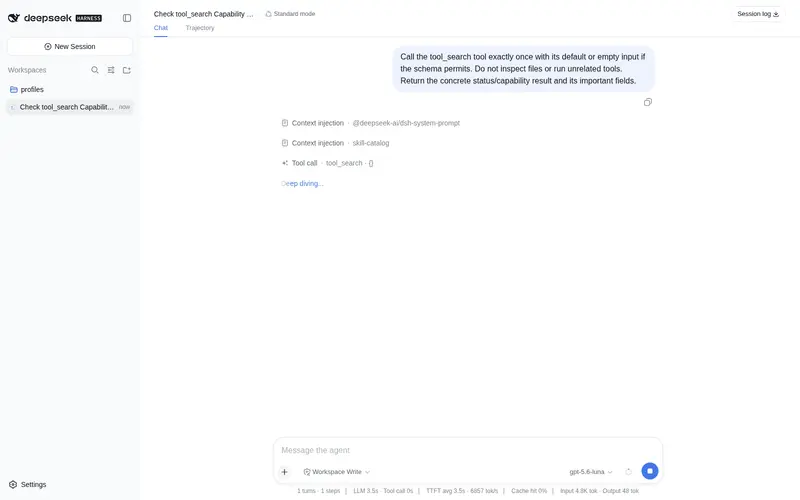
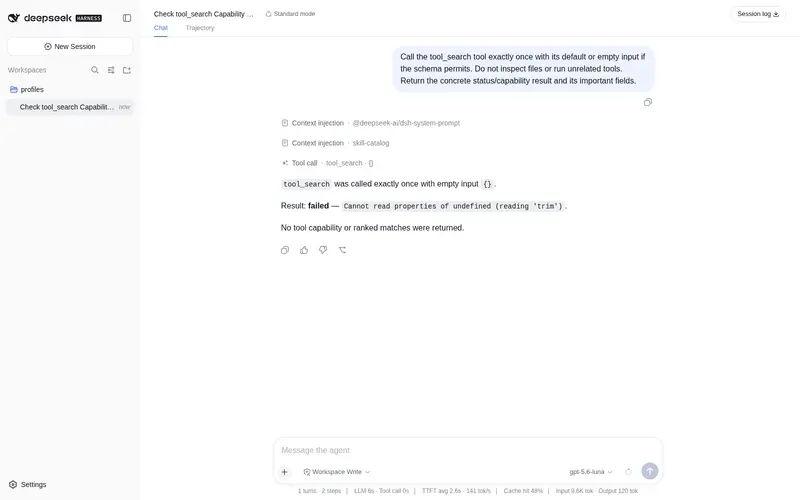
功能介绍
Hermes 风格工具搜索与瘦身:渐进式披露,语义搜索/查看/调用长尾工具,核心工具保持直通。
适合
- 拥有大量 MCP 或插件工具、且很大一部分上下文被低频工具 schema 占用的 DSH 环境。
- 希望核心工具保持直通,同时让 agent 按需搜索、查看和调用长尾工具的工作流。
- 愿意划分工具分组并配置 rerank 端点以获得更强语义检索的团队。
不适合
- 工具目录较小、所有 schema 已能轻松放入上下文的场景;插件会停留在第 0 层或价值有限。
- 要求模型每一轮都直接看到全部工具 schema 的工作流。
- 必须稳定进行语义排序、但无法配置所支持的 OpenAI 兼容 rerank 端点的部署;此时搜索只能依赖关键词回退。
README
dsh-tool-search
| English | 中文 |

Tool search & slimming for DeepSeek Harness (DSH): Hermes-style progressive disclosure. When your tool catalog gets large (many MCP servers or plugin tools), every tool’s JSON schema is injected into the model context on every turn — wasting tokens on tools the task never uses. This plugin collapses the long tail behind three bridge tools and lets the model discover and load them on demand through a configured rerank model.
- Core tools stay eager — file/shell/essential tools are always directly visible.
-
Bridge tools —
tool_search,tool_describe,tool_callreplace the deferred schemas. - Tiered disclosure — the visible listing shrinks automatically as the catalog grows.
-
Conversational setup — the bundled
tool-slimmer-setupskill groups your tools by talking to you, and guides configuring the rerank model. -
User or project config — groups/matcher live in
~/.dsh/dsh-tool-search.json(global) or<workspace>/.dsh/dsh-tool-search.json(per project), your choice.
Install
dsh plugin --profile web add dsh-tool-search
How it works
Inspired by Hermes Agent’s Tool Search. On every turn, the plugin’s system-prompt/assemble listener computes the tier and replaces the model-visible tools:
| Tier | Condition | Model sees |
|---|---|---|
| 0 | Small catalog / nothing deferrable | Every tool, bridge absent |
| 1 | Grouped manifest fits the budget | Bridge + ## group name/description listing |
| 2 | Only names fit | Bridge + names-only listing |
| 3 | Even names overflow | Bridge + one line per group (name: count) |
Budget = min(thresholdPct% × contextWindow, listingMaxTokens), recomputed every turn. The manifest rides a runtime context, so it survives complete-prompt composition.
Dynamic injection: searching, describing, or calling a deferred tool warms it into the session’s visible set (LRU-bounded by maxWarmTools), so its full schema is injected into the context for later turns — the model pulls tools into context on demand instead of keeping everything.
When tool_call runs, the plugin executes the real tool by name through ctx.tools.execute, so approvals, guards, and session events all reference the underlying tool — never the bridge. tool_search ranks with the configured rerank matcher and falls back to keyword matching (exact name > name tokens > description tokens) when no matcher is configured or the rerank call fails.
Setup (conversational)
Ask your agent:
帮我配置 dsh-tool-search 的工具分组
The tool-slimmer-setup skill will read the catalog, propose groups, confirm with you, ask whether the config should be global or per-project, and guide you through configuring the rerank matcher (required for tool_search and preload).
Configuration
Static tuning lives in your profile cordis.patch.yml (restart to change):
- id: tool-search
  config:
    enabled: auto        # auto | on | off
    thresholdPct: 5      # listing budget as % of context window
    listingMaxTokens: 4000
    configScope: auto    # user | project | auto (project file wins when present)
    core: [todo_write]   # extra always-eager tools
    maxWarmTools: 8      # LRU cap for dynamically injected tools
Tool groups, the matcher, and preload live in the runtime file (~/.dsh/dsh-tool-search.json for user scope):
{
  "version": 1,
  "scope": "user",
  "groups": [
    { "name": "git", "tools": ["git_status", "git_diff"] },
    { "name": "mcp-github", "prefixes": ["mcp_github_"] }
  ],
  "matcher": {
    "endpoint": "https://dashscope.aliyuncs.com/compatible-mode/v1/rerank",
    "apiKey": "sk-...",
    "model": "qwen3-reranker",
    "topN": 20
  },
  "preload": { "enabled": false, "topK": 5 },
  "core": ["read_file", "write_file"]
}
-
groups: exact tool names and/or name prefixes; a tool belongs to the first matching group. -
matcher: an OpenAI-compatible/v1/rerankendpoint — the only matcher type.tool_searchreturns setup guidance until one is configured. -
preload: optional; when enabled (with a matcher), the session’s first turn semantically preloads the top-K matching tools into the eager set. - The file is watched by mtime and hot-reloads; changes take effect on the next turn.
Bridge tools
| Tool | Purpose |
|---|---|
tool_search(query, limit?) |
Search the deferred catalog (rerank, keyword fallback) and return ranked {name, description, group} matches; matches are injected into the visible context |
tool_describe(name) |
Load the full schema of one deferred tool; the tool is injected into the visible context |
tool_call(name, arguments) |
Invoke a deferred tool by real name; approvals/guards/events use the real tool; the tool is injected into the visible context |
Design notes & pitfalls
- Slimming only rewrites the model-visible surface (
system-prompt/assemble); the registry stays complete, so deferred tools remain executable. - The bridge, the two setup tools, and
skillare always eager and never defer themselves. - Keyword matching is only a fallback: rerank is the primary ranking; without a matcher or on rerank failure, search degrades to keyword matching (exact name > name tokens > description tokens) and never errors.
- See DESIGN.md for the full architecture.
Links
License
MIT
常见问题常见问题
在启用了 DSH 的终端中执行已验证命令 dsh plugin --profile default add github:Letter2025/dsh-tool-search。命令会解析公开 package 元数据,并保持插件与本页展示的目录身份一致。
兼容性以页面上展示的 bundle 与 profile 状态为准。如果某个 profile 尚未检测到,请先保持禁用,并在生产启用前阅读仓库文档。
GitHub 链接和 activity 元数据是 release 与维护状态的来源。新版本发布后重新查看本页,确认目录已经观察到最新版本。