Viger1/dsh-review
Packaged multi-agent adversarial code review for DeepSeek Harness — parallel finders, then a verifier per finding, so only confirmed defects survive.
已收录
0
Git
Bundle 已验证
预览
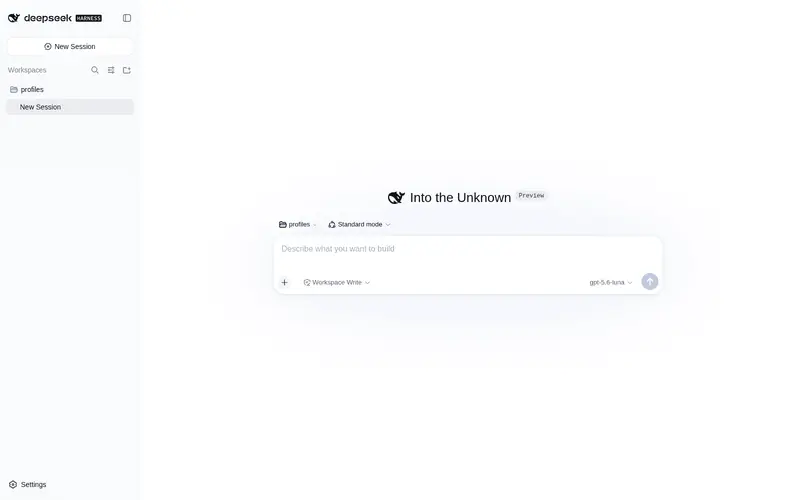
功能介绍
对抗式代码审查:多个 finder 并行地从不同视角(正确性、生命周期、契约、安全)审查改动,随后每条发现都交给独立验证者去推翻它,只要有一票推翻就丢弃。
适合
- 适合发布前审查较大改动,并分别检查正确性、生命周期、API 契约和安全性。
- 适合希望每条候选缺陷在报告前都经过独立反驳验证的团队。
- 适合值得投入多个 Agent 和数分钟进行证据化审查的高风险改动。
不适合
- 不适合日常逐提交检查,因为完整审查可能调用两位数数量的 Agent,并持续数分钟。
- 不适合缺少组合式子代理提供器或 Node 22.19 以上运行环境的场景。
- 不适合要求其已被证明优于普通模型审查的团队;目前没有受控基线对比结果。
README
dsh-review
Packaged multi-agent adversarial code review for DeepSeek Harness.
| English | 中文 |
Status: M0 — the review tool works end to end.
The problem
dsh ships the primitives for multi-agent work — subagents, workflows, ralph loops — but nothing that packages them into a review you can trust. Run naive parallel reviewers over a diff and you get a wall of plausible-sounding findings, most of them wrong; triaging them costs more than the review saved. “AI code review produces too many false positives” is the reason people stop using it.
The method
Two stages, and the second is the one that matters:
- Find — several reviewers in parallel, each with a distinct lens (correctness, lifecycle/concurrency, API-contract conformance, security), each reporting findings with a concrete failure scenario rather than a style opinion.
- Verify adversarially — every finding gets its own verifier whose job is to refute it: read the real code, reproduce if possible, and default to “not real” when the evidence is ambiguous. Only survivors are reported.
Measured on this repo’s two sibling plugins (dsh-preview, dsh-pilot): 73 agents, 49 confirmed findings, 14 refuted. Two of the confirmed ones were only established because a verifier wrote a script and reproduced the failure — including a defect where the agent silently clicked the wrong same-named button on shadow-DOM pages.
Install
dsh plugin --profile web add dsh-review
Requires a composed subagent provider (the stock spawn provider in dsh-base is the default) and Node ^22.19 || >=24.
Use
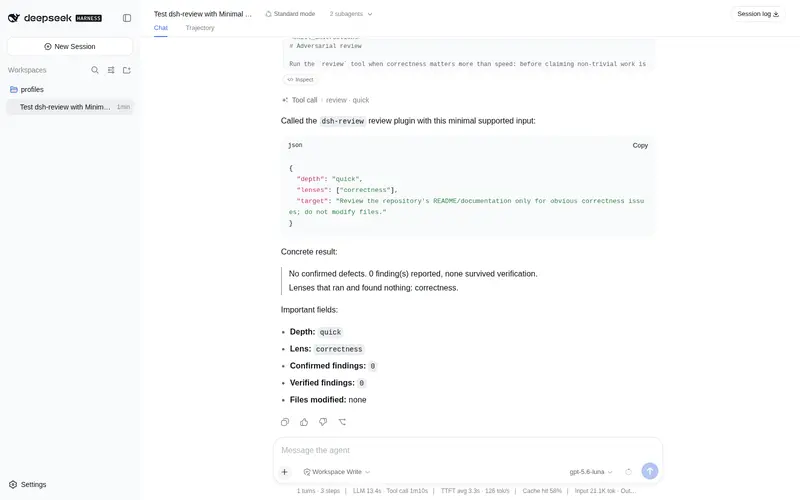
One tool, review. It is the most expensive thing in a session — every lens is an agent and every finding costs another — so it is a pre-release audit, not a per-commit check. A full run on a real change took minutes and a double-digit number of agents in our own use; budget for that, and use depth: quick when you want a cheap look at a small change.
Describe the target the way you would brief a colleague who has the repository but not the context:
Review the uncommitted changes in src/policy.ts and src/index.ts (run git diff).
They add an origin gate that must follow the session's approval stance: a session
with approval policy 'never' passes silently, an 'ask' session is prompted once
per origin, and a grant must never leak to another session.
The tool returns confirmed findings — file, line, what is wrong, the failure scenario, and a suggested fix — plus the titles of findings that were refuted, so you can see what the verification stage filtered out rather than wondering what it missed.
review { target: "...", depth: "quick" }
quick caps the run at two lenses, four verified findings, and one verifier — roughly a third of the cost. Verification runs at both depths: a cheaper review looks at less rather than trusting more, because reporting an unverified claim is the failure this plugin exists to avoid.
The bundled adversarial-review skill teaches the agent when a review is worth its cost and how to act on the two categories differently.
What this has not been measured against
The evidence here is that the method finds real defects — 49 confirmed across the sibling plugins, several reproduced by a verifier writing a script. What has not been measured is whether it beats simply asking the model to review the same diff: no A/B, no false-positive rate against a baseline. Treat the refutation stage as a design argument backed by observed refusals (14 findings dropped), not as a proven improvement over the obvious alternative.
Configuration
- id: review
  name: dsh-review
  config:
    subagentProvider: spawn   # which composed provider runs the children
    lenses: []                # [] runs every built-in lens
    verifiersPerFinding: 1    # raise for a stricter panel; all must confirm
    maxFindings: 12           # verification budget, worst severities first
    maxConcurrentChildren: 8  # cap on children running at once
    maxDepth: 2               # delegation-depth cap for review children
    registerSkill: true
Lenses: correctness, lifecycle, contract, security. Each is one child agent, and each finding costs verifiersPerFinding more — a review is the most expensive tool in a session, which is why the skill tells the model to use it deliberately.
Design notes
- Silence is reported, not implied. A lens that ran and found nothing is listed as such, separately from one that failed — otherwise a caller cannot tell coverage from absence, which the plugin’s own first quick run made obvious.
- Failures are contained per child. A finder that dies costs its lens and is reported as a coverage gap; a verifier that dies refutes its finding, because a claim nobody verified is exactly what this plugin exists not to print.
-
Verification is unanimous. With
verifiersPerFinding > 1, one refutation is enough to drop a finding — the asymmetry is deliberate. - The budget cuts the least severe. Findings are verified worst-first, and anything cut is reported as dropped rather than silently omitted.
- Fan-out is bounded. Every child start passes through one limiter, so a large budget queues instead of firing hundreds of agents at once — an overload would otherwise arrive disguised as a review that refuted everything.
Dogfooding
dsh-review reviewed its own source and found three defects, which are fixed and pinned by tests: a zero dedupeThreshold merged every finding in a file (distinct defects silently discarded as duplicates), the verifier fan-out had no concurrency bound, and maxDepth was the one numeric config never validated at load. It also refuted two findings, one of which was a genuine false positive about a value the entry point already validates.
Family
| Plugin | What it gives your agent |
|---|---|
| dsh-preview | 👁 Eyes — verify what it builds: open, read, screenshot, self-check |
| dsh-pilot | ✋ Hands — operate any page by accessibility refs, with a native permission model |
| dsh-review (this repo) | 🔍 Judgement — find defects, then try to refute each one before reporting it |
| dsh-design | 🎨 Taste — constrain the choices, then measure whether the result kept them |
License
MIT © Viger1
常见问题常见问题
在启用了 DSH 的终端中执行已验证命令 dsh plugin --profile default add github:Viger1/dsh-review。命令会解析公开 package 元数据,并保持插件与本页展示的目录身份一致。
兼容性以页面上展示的 bundle 与 profile 状态为准。如果某个 profile 尚未检测到,请先保持禁用,并在生产启用前阅读仓库文档。
GitHub 链接和 activity 元数据是 release 与维护状态的来源。新版本发布后重新查看本页,确认目录已经观察到最新版本。