KinGao294/dsh-skin
Skin switcher + custom wallpaper for DeepSeek Harness (dsh): curated --dsw-alias-* palettes, translucent wallpaper with opacity/blur controls, persisted per browser (like Codex themes) — 换皮肤 / 自定义背景插件
Listed
19
Theme
Bundle verified
Preview
What it does
Codex-style skin switcher plus a custom wallpaper layer with opacity and blur controls.
Best for
- Users who want curated Codex-style palettes for the DSH interface.
- Users who want a local image or remote media wallpaper with adjustable opacity, blur, and fit.
- People who want appearance preferences to persist independently in each browser.
Not ideal for
- Teams needing centrally managed or account-synchronized appearance settings; preferences are stored in browser localStorage.
- Users who need local wallpaper files larger than the documented 2 MB limit.
- Workflows that only need functional DSH changes and gain little from visual customization.
README
dsh-skin
Skin switcher + custom wallpaper + 奶龙桌宠(desktop pet with sticker pack) for DeepSeek Harness — a “change the skin” feature in the spirit of Codex themes. It registers a curated catalog of palettes into DSH’s built-in theme runtime and adds three rows to Settings → General (below the built-in Appearance row):
- 皮肤 / Skins — pick one of 7 curated palettes (or 默认 / Default to follow the built-in appearance).
- 背景图片 / Wallpaper — local image, or paste an image/video URL; opacity, blur, and fit (cover / contain / stretch / tile).
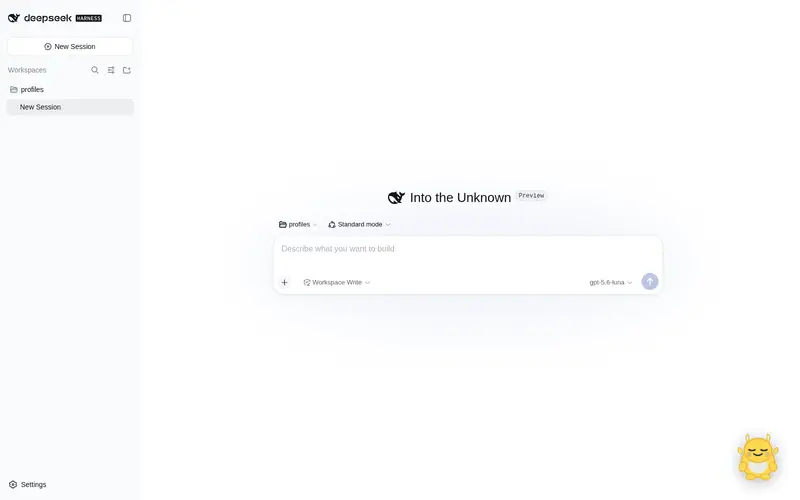
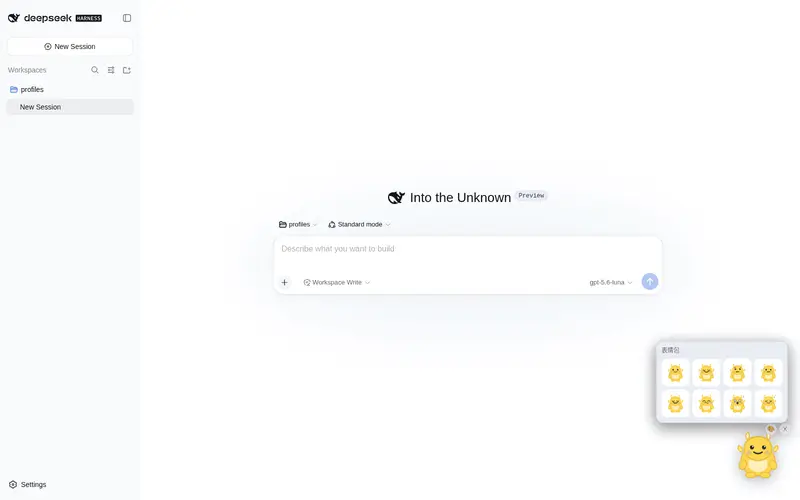
- 奶龙桌宠 / Pet — a floating, draggable yellow-dragon desktop pet with an 8-mood sticker pack (表情包). It follows the agent’s running state (idle → thinking → working → done → sleeping), blinks while idle, falls asleep when idle too long, can be dragged anywhere (position remembered), and shows a 🎨 sticker panel where you can pick any mood manually. Toggle it, resize it, or reset its position from the settings row.
Both choices persist across reloads (localStorage). A saved third-party skin is re-applied once on boot (DSH only persists system/light/dark itself).
How it works
DSH’s theme system is token-based: the web shell ships --dsw-* design tokens,
and ThemeRuntime lets third-party plugins register themes that override the
alias layer (--dsw-alias-*) per color scheme. This package is a regular
dual-face plugin:
-
Host half (
lib/index.js) — adsh.bundlepatch layer that inserts one loader entry (skin); a no-opapply, exactly like the shipped ui-* packages. -
Browser half (
lib/client.js) — adsh.clientbundle (served at/plugins/dsh-skin/client.js) that:- registers 7 curated skins via
ctx.theme.register(...); - restores the saved skin id and applies it with
ctx.theme.setTheme(...); - renders the wallpaper as a fixed backdrop layer (
z-index: -1) and stacks a token override (ctx.theme.overrideTokens) that makes the main canvas (--dsw-alias-bg-base) and sidebar (--dsw-specific-sidebar-fill) translucent, so the image shows through while inner surfaces (cards, inputs, bubbles) stay opaque and readable; - keeps the slot stores in sync with
theme/change(and re-shades the wallpaper when the active skin or light/dark scheme changes); - mounts both rows into
settings.general.item; - mounts the desktop pet (a fixed, draggable element with inline-SVG
stickers) and watches the agent’s running state through
ctx.get("sessions").list()to switch moods.
- registers 7 curated skins via
Each skin sets its colorScheme (light/dark), which drives
body[data-ds-dark-theme], plus alias-token overrides applied as inline custom
properties on <body> by ui-layout’s ThemePresenter.
Skins
| id | scheme | vibe |
|---|---|---|
skin-ocean |
dark | DeepSeek-blue deep sea |
skin-graphite |
dark | neutral monochrome |
skin-forest |
dark | green calm |
skin-sunset |
dark | warm purple |
skin-midnight |
dark | pure black OLED |
skin-paper |
light | warm paper |
skin-sakura |
light | pink accents |
Ids are namespaced (skin-*) so they do not collide with official @deepseek-ai/dsh-client-ui-console themes (sakura, graphite). Saved unprefixed ids are migrated on read.
Picking 默认 / Default reverts to the built-in appearance (follow system) and clears the stored skin.
Wallpaper
In Settings → General → 背景图片 / Wallpaper:- 选择图片 / Choose image — pick a local image (≤ 2MB, stored as a data URL, kept in this browser only). Local video files are not uploaded; paste a URL instead.
- 网址 / URL — paste http(s) / data image or video (mp4/webm/ogv/mov). blob is rejected (dies on reload). No extra media server.
- 显示方式 / Fit — cover / contain / stretch / tile.
- 界面遮罩 / UI wash and 模糊 / Blur sliders (rAF-coalesced; no crash). Higher wash = more solid UI.
- 移除 / Remove clears it.
The wallpaper lives on a z-index: -1 fixed layer, so it is only visible
through the translucent main canvas and sidebar; message surfaces keep their
solid backgrounds for readability. It also follows your active skin’s tint
(switching skins re-shades the translucent surfaces).
奶龙桌宠 / Pet
In Settings → General → 奶龙桌宠 / Pet you can show/hide the pet, resize it (64–180 px) and reset its position. Behavior:
-
Status moods — the dragon follows the agent:
thinkingwhen a turn starts,workingwhile it runs,done(with sparkles) when it finishes, then back toidle. Left idle too long it falls asleep (sleeping, Zzz). - Sticker pack (表情包) — hover the pet and open 🎨: 8 moods to pick (idle / happy / thinking / working / done / sad / surprised / sleeping). Clicking the pet also cycles to a random sticker for a few seconds.
-
Draggable — drag it anywhere; the position is remembered
(
dsh-skin:pet-pos). Reset it from the settings row. -
Zero assets — every sticker is inline SVG (original hand-drawn art in a
Nai-Long style, not the licensed character), so the bundle stays dependency-
free and crisp at any size.
preview.htmlin the repo shows the full pack.
Persistence
Choices are stored in localStorage (dsh-skin:skin, dsh-skin:wallpaper,
dsh-skin:wallpaper-opacity, dsh-skin:wallpaper-blur, dsh-skin:wallpaper-fit,
dsh-skin:pet-enabled, dsh-skin:pet-size, dsh-skin:pet-pos).
DSH’s Host settings wire only exposes an allowlisted set of namespaces to
browser clients (WEB_SETTINGS_NAMESPACES in dsh-host-apiproxy), so a
third-party namespace would answer settings-not-exposed; the product itself
keeps remote browser preferences process-local, and localStorage matches that
boundary for a visual preference while surviving reloads on the same origin.
Install
From anywhere, add the package to the web profile:
dsh plugin --profile web add -w /path/to/dsh-skin
The
-wflag is required: every profile ships apnpm-workspace.yaml, so pnpm 9 treats the profile directory as a workspace root and refuses a bareaddwithERR_PNPM_ADDING_TO_ROOT.
This runs pnpm in ~/.dsh/profiles/web, installs the package, and appends it
to dsh.profile.bundles (its patch layer inserts the skin loader entry).
The running web server must be restarted to pick up the new bundle layer:
# stop the running instance, then:
dsh web
Open Settings → General to use the skins, wallpaper and pet.
Publishing (npm)
DSH (rc.6) has no separate plugin marketplace — the plugin distribution
channel is the npm registry. A package that declares dsh.bundle (host patch
layer) and dsh.client (browser bundle) is exactly what dsh plugin
--profile <name> add <package> installs, so publishing this package to npm is
what “上架” means today:
- Pick a unique name (scoped names are safer, e.g.
@yourscope/dsh-skin) and fill inauthor,repository,keywords, and a CHANGELOG. - Make sure
filesshipslib/index.js,lib/client.js,lib/types,cordis.patch.yml(already configured). - Publish to the official npm registry (this machine’s default registry is
a mirror — publishing to a mirror does not reach npmjs):
npm publish --registry https://registry.npmjs.org - Users install with:
dsh plugin --profile web add -w @yourscope/dsh-skinthen restart
dsh web.
Known platform boundaries to document for users: browser-side preferences are
stored in localStorage (third-party settings namespaces are not exposed over
the wire yet), and the client bundle may only require module-table entities
(platform seeds + registered client bundles).
Development
The client bundle is written directly in the __ModuleLoader__ bundle format
(the same shape tsdown emits for the shipped ui-* packages), so no build step
is required. lib/client.js may require only module-table entities: platform
seed words (react, react/jsx-runtime, …) and registered client bundles
(@deepseek-ai/dsh-client-runtime/client, @deepseek-ai/dsh-client-ui-theme/client,
…). After editing, restart the web server (bundle content is re-hashed and
served with a new rev; loader entries are rescanned at boot).
Frequently Asked QuestionsFAQ
Use the verified command dsh plugin --profile default add github:KinGao294/dsh-skin in a DSH-enabled shell. The command resolves the public package metadata and keeps the plugin attached to the catalog identity shown on this page.
Compatibility follows the bundle and profile status shown above. If a profile is not detected, keep the plugin disabled there and check the repository documentation before enabling it in production.
The GitHub link and activity metadata are the source of truth for releases and maintenance. Revisit this page after a new release to confirm the catalog has observed the latest version.