nanpaidashi/dsh-honcho-sync
DSH plugin: auto-sync conversation turns to Honcho memory service
Listed
3
Memory
Bundle verified
Preview
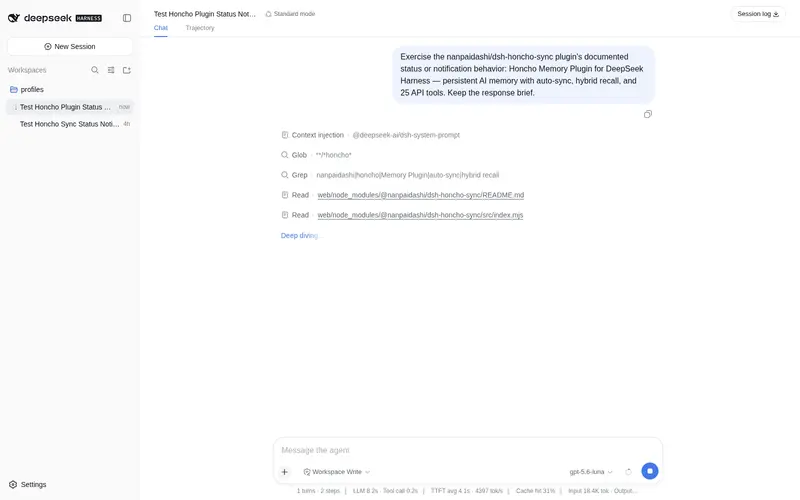
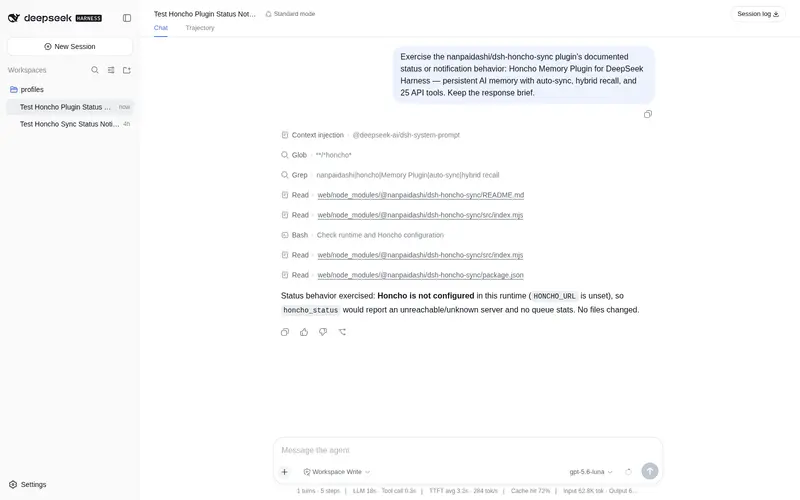
What it does
Honcho memory bridge: auto-syncs every conversation turn to a self-hosted Honcho service, with recall/search/remember/context/status tools, context injection on session start, and a visual settings panel.
Best for
- Users who want persistent memory and semantic recall across DSH sessions.
- Self-hosters who already operate a Honcho v3 service on a NAS, server, or cloud host.
- Workflows that benefit from automatic turn synchronization and relevant memory injection at session start.
- Advanced Honcho users who need search, peer, session, conclusion, queue, and status operations exposed as tools.
Not ideal for
- Users without a reachable self-hosted Honcho v3 instance or the required workspace configuration.
- Environments below Node.js 18 or DSH setups that do not use the Web profile.
- Workflows that should not synchronize conversation content to a separate memory service, even when self-hosted.
- Immediate recall of newly synced derived conclusions; background processing may take time before results appear.
README
@nanpaidashi/dsh-honcho-sync
Honcho Memory Plugin for DeepSeek Harness — give your AI persistent, cross-session memory backed by a self-hosted Honcho v3 service.
| 中文 | English |
What it does
- Auto-sync: Every conversation turn is automatically synced to Honcho (with debounce). Sync cursors persist across restarts.
- Hybrid recall: Semantic search across both raw messages AND reasoned conclusions (explicit/deductive/inductive) in parallel.
- Memory injection: On session start, relevant peer cards, representations, and semantic recall results are injected into the system prompt.
- 25 tools: Full Honcho v3 API surface exposed as DSH tools — search, profile, session management, peer management, conclusions, dreaming, queue monitoring.
Requirements
- DeepSeek Harness (DSH) with web profile
- A running Honcho v3 instance (self-hosted)
- Node.js >= 18
Installation
# From npm
dsh plugin --profile web add npm:@nanpaidashi/dsh-honcho-sync dsh web

# Or from GitHub
dsh plugin --profile web add link:https://github.com/nanpaidashi/dsh-honcho-sync dsh web
Then restart DSH:
systemctl --user restart dsh-web
# or: dsh web --restart
Upgrading
If you installed an earlier version (v0.6.x or v0.7.0):
# Re-run the same install command — it pulls the latest version and overwrites
dsh plugin --profile web add npm:@nanpaidashi/dsh-honcho-sync dsh web
# or
dsh plugin --profile web add link:https://github.com/nanpaidashi/dsh-honcho-sync dsh web

systemctl --user restart dsh-web
The install is idempotent: it replaces the plugin source file in place. Your configuration (settings panel) and sync state (~/.dsh/honcho-sync-state.json) are preserved — no data loss, no re-configuration needed.
v0.7.0 → v0.7.1 changelog
- Fixed
conclusions/queryrequiringfiltersparameter - Fixed response parsing for
/search,/peers/list,/summaries - Fixed
POST /conclusionsbody format - Fixed
schedule_dreamparameter name (dream_type) - Added 4 tools:
honcho_conclude,honcho_conclude_list,honcho_conclude_query,honcho_message_get - Hybrid recall now searches messages + conclusions in parallel
Uninstalling
# 1. Remove the plugin from DSH
dsh plugin --profile web remove honcho-sync dsh web

# 2. (Optional) Remove sync state file
rm ~/.dsh/honcho-sync-state.json

# 3. Restart DSH
systemctl --user restart dsh-web
Note: Removing the plugin does NOT delete your Honcho data. All messages, conclusions, and peer cards remain on your Honcho server. The plugin is just the bridge — your memory is safe.
Configuration
Settings Panel (recommended)
After installation, open DSH Settings → Honcho Memory to configure:
| Setting | Description | Default |
|---|---|---|
honchoUrl |
Honcho API base URL | (required) |
workspace |
Honcho workspace name | (required) |
userPeer |
Peer ID representing the user | user |
agentPeer |
Peer ID representing the agent | agent |
sessionStrategy |
per-directory or global
|
per-directory |
debounceMs |
Auto-sync debounce (ms) | 3000 |
autoRecall |
Inject memory context on session start | true |
recallBudget |
Token budget for recall | 2000 |
autoSync |
Enable auto-sync | true |
messageMaxChars |
Max chars per synced message | 25000 |
injectionMaxChars |
Max chars for injected context | 8000 |
reprMaxObs |
Max observations in representation | 8 |
reprTimeoutMs |
Representation API timeout (ms) | 8000 |
cardTimeoutMs |
Peer card API timeout (ms) | 5000 |
Environment Variables (alternative)
export HONCHO_URL="http://localhost:8000"
export HONCHO_WORKSPACE="my-workspace"
export HONCHO_USER_PEER="user"
export HONCHO_AGENT_PEER="agent"
Honcho Server Setup
If you don’t have Honcho running yet:
# Quick start with Docker
docker run -d --name honcho \
  -p 8000:8000 \
  -e HONCHO_API_KEY="your-api-key" \
  plasticlabs/honcho:latest

# Or self-host from source (recommended for production)
# See: https://github.com/plastic-labs/honcho#self-hosting
Create a workspace and peers:
curl -X POST http://localhost:8000/v3/workspaces/my-workspace \
  -H "Authorization: Bearer $HONCHO_API_KEY" \
  -H "Content-Type: application/json"

curl -X POST http://localhost:8000/v3/workspaces/my-workspace/peers \
  -H "Authorization: Bearer $HONCHO_API_KEY" \
  -H "Content-Type: application/json" \
  -d '{"id": "user"}'

curl -X POST http://localhost:8000/v3/workspaces/my-workspace/peers \
  -H "Authorization: Bearer $HONCHO_API_KEY" \
  -H "Content-Type: application/json" \
  -d '{"id": "agent"}'
Tools
Memory
| Tool | Description |
|——|————-|
| honcho_recall | Hybrid semantic search (messages + conclusions). Fast (2-5s). |
| honcho_ask | Deep dialectic reasoning with a peer. Slower (2-5min) but thorough. |
| honcho_remember | Save a fact/statement to Honcho memory. |
| honcho_context | Get compressed conversation context for a session. |
Search
| Tool | Description |
|——|————-|
| honcho_search | Search across ALL sessions (no date filter). |
| honcho_session_search | Search within a specific session. |
Profile
| Tool | Description |
|——|————-|
| honcho_profile | Get a peer’s card (identity, attributes, relationships). |
| honcho_representation | Get a peer’s representation (compressed observations). |
Session
| Tool | Description |
|——|————-|
| honcho_session | List sessions. |
| honcho_session_create | Create a new session. |
| honcho_session_clone | Clone an existing session. |
| honcho_session_peers | List/add/remove peers on a session. |
| honcho_session_summaries | Get session summaries (compressed context). |
| honcho_session_context | Get full conversation context. |
Peer
| Tool | Description |
|——|————-|
| honcho_peer | List all peers. |
| honcho_peer_create | Create or get a peer. |
| honcho_peer_list | List all peers (alias). |
Message
| Tool | Description |
|——|————-|
| honcho_message_send | Send a message to a session. |
| honcho_message_get | Get a message by ID. |
Conclude
| Tool | Description |
|——|————-|
| honcho_conclude | Create an explicit conclusion. |
| honcho_conclude_list | List conclusions. |
| honcho_conclude_query | Semantic search across conclusions. |
Admin
| Tool | Description |
|——|————-|
| honcho_status | Health check + queue stats. |
| honcho_dream | Trigger a dream (card_refresh or omni). |
| honcho_queue | Check processing queue status. |
Session Strategy
-
per-directory(default): Each working directory gets its own Honcho session (e.g.,dsh-home-user-project). Conversations in different directories are isolated. -
global: All conversations share one session regardless of directory.
Auto-sync & Persistence
- Messages are synced with a configurable debounce (default 3s).
- Sync cursors are persisted to
~/.dsh/honcho-sync-state.json— survives HMR and DSH restarts. - On restart, only new events since the last cursor are synced (no duplicates).
Memory Injection
When autoRecall is enabled, on the first user message of each session:
- Peer cards (profile) for both peers are fetched
- Representations are fetched and deduplicated (semantic overlap removal)
- A semantic search query is run using the user’s message as the query
- Results are wrapped in
<memory-context>tags and injected into the system prompt
Privacy
- All data stays on your Honcho server. No third-party data transmission.
- The plugin does not log message content.
- Configuration (URL, workspace, peer IDs) is stored in DSH settings, not in the plugin source.
Troubleshooting
| Symptom | Fix |
|---|---|
HONCHO_URL is required at boot |
Set via settings panel or env var. This message is benign if settings load asynchronously. |
| No sync happening | Check autoSync is true, verify Honcho URL is reachable, check logs: journalctl --user -u dsh-web \| grep honcho
|
| Recall returns empty | Ensure Deriver has processed messages (check honcho_queue), wait a few minutes after first sync |
401 Unauthorized |
Check your Honcho API key in server config |
| Session not found | Verify workspace name matches your Honcho workspace exactly |
License
MIT
中文说明
| English | 中文 |
Honcho 记忆插件,为 DeepSeek Harness 提供持久化跨会话记忆,基于自托管的 Honcho v3 服务。
功能
- 自动同步:每轮对话自动同步到 Honcho(带防抖)。同步游标跨重启持久化。
- 混合召回:同时搜索原始消息和推理结论(显式/演绎/归纳),并行执行。
- 记忆注入:会话开始时,将相关的 peer 卡片、表征和语义召回结果注入系统提示词。
- 25 个工具:覆盖 Honcho v3 完整 API — 搜索、画像、会话管理、peer 管理、结论、做梦、队列监控。
依赖
- DeepSeek Harness (DSH) web profile
- 一个运行中的 Honcho v3 实例(自托管)
- Node.js >= 18
安装
# 从 npm
dsh plugin --profile web add npm:@nanpaidashi/dsh-honcho-sync dsh web

# 或从 GitHub
dsh plugin --profile web add link:https://github.com/nanpaidashi/dsh-honcho-sync dsh web
然后重启 DSH:
systemctl --user restart dsh-web
# 或: dsh web --restart
升级
如果你安装过旧版本(v0.6.x 或 v0.7.0):
# 重跑同一条安装命令 — 会拉取最新版并覆盖
dsh plugin --profile web add npm:@nanpaidashi/dsh-honcho-sync dsh web
# 或
dsh plugin --profile web add link:https://github.com/nanpaidashi/dsh-honcho-sync dsh web

systemctl --user restart dsh-web
安装是幂等的:原地替换插件源码文件。你的配置(设置面板)和同步状态(~/.dsh/honcho-sync-state.json)会保留 — 无数据丢失,无需重新配置。
v0.7.0 → v0.7.1 变更
- 修复
conclusions/query需要filters参数 - 修复
/search、/peers/list、/summaries响应解析 - 修复
POST /conclusions请求体格式 - 修复
schedule_dream参数名(dream_type) - 新增 4 个工具:
honcho_conclude、honcho_conclude_list、honcho_conclude_query、honcho_message_get - 混合召回现在并行搜索消息和结论
卸载
# 1. 从 DSH 移除插件
dsh plugin --profile web remove honcho-sync dsh web

# 2.(可选)删除同步状态文件
rm ~/.dsh/honcho-sync-state.json

# 3. 重启 DSH
systemctl --user restart dsh-web
注意: 卸载插件不会删除你的 Honcho 数据。所有消息、结论和 peer 卡片仍然保留在你的 Honcho 服务器上。插件只是桥梁 — 你的记忆是安全的。
配置
设置面板(推荐)
安装后,打开 DSH 设置 → Honcho Memory 进行配置:
| 设置项 | 说明 | 默认值 |
|---|---|---|
honchoUrl |
Honcho API 地址 | (必填) |
workspace |
Honcho 工作区名 | (必填) |
userPeer |
用户 peer ID | user |
agentPeer |
Agent peer ID | agent |
sessionStrategy |
per-directory 或 global
|
per-directory |
debounceMs |
自动同步防抖(毫秒) | 3000 |
autoRecall |
会话开始时注入记忆上下文 | true |
recallBudget |
召回 token 预算 | 2000 |
autoSync |
启用自动同步 | true |
messageMaxChars |
单条同步消息最大字符数 | 25000 |
injectionMaxChars |
注入上下文最大字符数 | 8000 |
reprMaxObs |
表征中最大观察数 | 8 |
reprTimeoutMs |
表征 API 超时(毫秒) | 8000 |
cardTimeoutMs |
Peer 卡片 API 超时(毫秒) | 5000 |
环境变量(替代方式)
export HONCHO_URL="http://localhost:8000"
export HONCHO_WORKSPACE="my-workspace"
export HONCHO_USER_PEER="user"
export HONCHO_AGENT_PEER="agent"
Honcho 服务器搭建
如果你还没有运行 Honcho:
# Docker 快速启动
docker run -d --name honcho \
  -p 8000:8000 \
  -e HONCHO_API_KEY="your-api-key" \
  plasticlabs/honcho:latest

# 或从源码自托管(生产环境推荐)
# 参考: https://github.com/plastic-labs/honcho#self-hosting
创建工作区和 peers:
curl -X POST http://localhost:8000/v3/workspaces/my-workspace \
  -H "Authorization: Bearer $HONCHO_API_KEY" \
  -H "Content-Type: application/json"

curl -X POST http://localhost:8000/v3/workspaces/my-workspace/peers \
  -H "Authorization: Bearer $HONCHO_API_KEY" \
  -H "Content-Type: application/json" \
  -d '{"id": "user"}'

curl -X POST http://localhost:8000/v3/workspaces/my-workspace/peers \
  -H "Authorization: Bearer $HONCHO_API_KEY" \
  -H "Content-Type: application/json" \
  -d '{"id": "agent"}'
工具列表
记忆
| 工具 | 说明 |
|——|——|
| honcho_recall | 混合语义搜索(消息 + 结论)。快(2-5秒)。 |
| honcho_ask | 与 peer 深度辩证推理。慢(2-5分钟)但全面。 |
| honcho_remember | 保存事实/陈述到 Honcho 记忆。 |
| honcho_context | 获取会话的压缩上下文。 |
搜索
| 工具 | 说明 |
|——|——|
| honcho_search | 跨所有会话搜索(无日期过滤)。 |
| honcho_session_search | 在特定会话内搜索。 |
画像
| 工具 | 说明 |
|——|——|
| honcho_profile | 获取 peer 卡片(身份、属性、关系)。 |
| honcho_representation | 获取 peer 表征(压缩观察)。 |
会话
| 工具 | 说明 |
|——|——|
| honcho_session | 列出会话。 |
| honcho_session_create | 创建新会话。 |
| honcho_session_clone | 克隆现有会话。 |
| honcho_session_peers | 列出/添加/移除会话中的 peer。 |
| honcho_session_summaries | 获取会话摘要(压缩上下文)。 |
| honcho_session_context | 获取完整对话上下文。 |
Peer
| 工具 | 说明 |
|——|——|
| honcho_peer | 列出所有 peer。 |
| honcho_peer_create | 创建或获取 peer。 |
| honcho_peer_list | 列出所有 peer(别名)。 |
消息
| 工具 | 说明 |
|——|——|
| honcho_message_send | 向会话发送消息。 |
| honcho_message_get | 按 ID 获取消息。 |
结论
| 工具 | 说明 |
|——|——|
| honcho_conclude | 创建显式结论。 |
| honcho_conclude_list | 列出结论。 |
| honcho_conclude_query | 跨结论语义搜索。 |
管理
| 工具 | 说明 |
|——|——|
| honcho_status | 健康检查 + 队列统计。 |
| honcho_dream | 触发做梦(card_refresh 或 omni)。 |
| honcho_queue | 查看处理队列状态。 |
会话策略
-
per-directory(默认):每个工作目录对应独立的 Honcho 会话(如dsh-home-user-project)。不同目录的对话互相隔离。 -
global:所有对话共享一个会话,不区分目录。
自动同步与持久化
- 消息以可配置的防抖间隔同步(默认 3 秒)。
- 同步游标持久化到
~/.dsh/honcho-sync-state.json— 跨 HMR 和 DSH 重启保留。 - 重启后只同步游标之后的新事件(无重复)。
记忆注入
当 autoRecall 启用时,每个会话的首条用户消息触发:
- 获取两个 peer 的卡片(画像)
- 获取表征并去重(语义重叠移除)
- 以用户消息为查询执行语义搜索
- 结果包裹在
<memory-context>标签中注入系统提示词
隐私
- 所有数据保留在你的 Honcho 服务器上。无第三方数据传输。
- 插件不记录消息内容。
- 配置(URL、工作区、peer ID)存储在 DSH 设置中,不在插件源码里。
故障排查
| 症状 | 解决方案 |
|---|---|
启动时 HONCHO_URL is required
|
通过设置面板或环境变量配置。如果设置异步加载,此消息无害。 |
| 没有同步发生 | 检查 autoSync 是否为 true,确认 Honcho URL 可达,查看日志:journalctl --user -u dsh-web \| grep honcho
|
| 召回返回空 | 确认 Deriver 已处理消息(检查 honcho_queue),首次同步后等待几分钟 |
401 Unauthorized |
检查 Honcho 服务器配置中的 API key |
| Session not found | 确认 workspace 名与 Honcho 工作区完全一致 |
许可
MIT
Frequently Asked QuestionsFAQ
Use the verified command dsh plugin --profile default add github:nanpaidashi/dsh-honcho-sync in a DSH-enabled shell. The command resolves the public package metadata and keeps the plugin attached to the catalog identity shown on this page.
Compatibility follows the bundle and profile status shown above. If a profile is not detected, keep the plugin disabled there and check the repository documentation before enabling it in production.
The GitHub link and activity metadata are the source of truth for releases and maintenance. Revisit this page after a new release to confirm the catalog has observed the latest version.