akslcw/dsh-negative-ledger
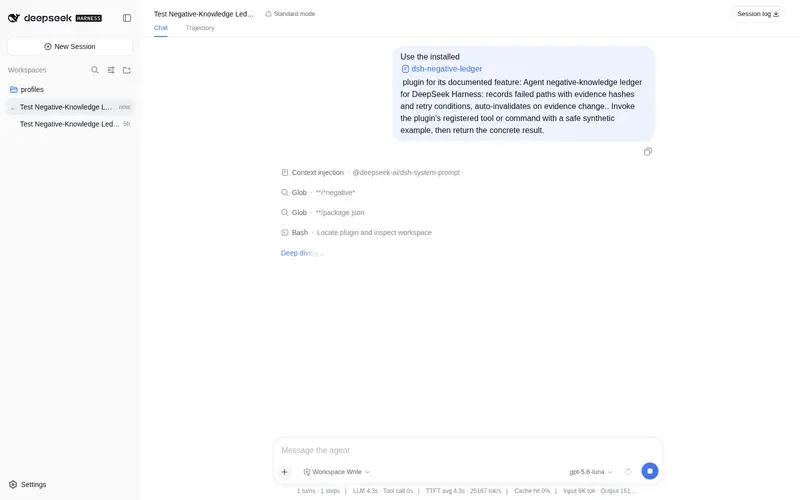
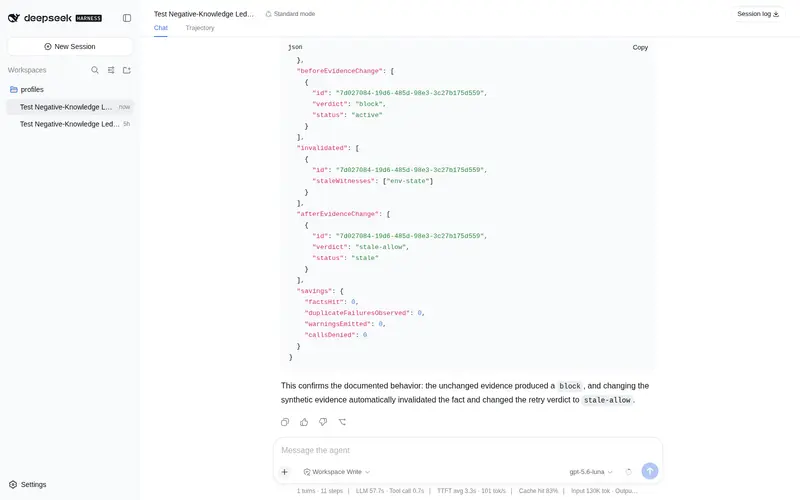
证据约束的负面知识账本:记录被证伪的路径(command_failed / file_missing)及其结果与前置条件证据,重复尝试时警告或拦截,证据变化后自动解除。
已收录
3
Memory
Bundle 已验证
预览
功能介绍
证据约束的负面知识账本:记录被证伪的路径(command_failed / file_missing)及其结果与前置条件证据,重复尝试时警告或拦截,证据变化后自动解除。
适合
- 适合多代理或长时运行的 DSH 工作流,避免跨会话重复执行已失败的命令或读取不存在的文件。
- 适合希望仅在环境证据未变化时警告或拦截重复尝试的团队。
- 适合需要持久、可检查的被证伪路径记录,而非通用记忆的工作流。
不适合
- 不适合识别写法不同但语义等价的命令;当前按精确指纹匹配。
- 不适合存储正面知识、语义召回、缓存工具结果或跟踪缺陷回归。
- 不适合使用旧版 JSONL 后端进行多进程并发写入;该后端仅支持单写入者。
- 不适合大量依赖具有非失败含义的非零退出码的工作流,因为尚未实现按工具配置记录策略。
README
dsh-negative-ledger
A negative-knowledge ledger for coding agents. It records only disproven paths — failed commands, missing files, rejected approaches, unavailable APIs — together with the evidence behind each conclusion and the conditions under which a retry becomes legitimate. When the evidence changes, the conclusion is invalidated automatically.
What it is not
- Not memory: no positive knowledge, no semantic recall.
- Not a cache: it stores conclusions, not tool results.
- Not a bug regression tracker: it covers any tool call and file read, not just fix attempts.
The core loop
- A tool call fails (non-zero exit,
FS_NOT_FOUND, …) → a negative fact is recorded with outcome witnesses (exit code, error code) and precondition witnesses (file state from DSH’sfs/observed). - The next identical attempt matches the fact’s fingerprint (normalized command + cwd, or file path).
- While every precondition witness is unchanged, the attempt is warned (
warnmode) or denied (blockmode). - Any precondition change marks the fact stale — the reminder is withdrawn and the retry is allowed. A successful retry marks it resolved.
The differentiation: a DSH-native, evidence-bound persistent negative-memory gate — failure conclusions activate and revoke themselves with the environmental evidence, and stay transactionally consistent across concurrent agents.
Quick start — one-command install
dsh plugin --profile <name> add @akslcw/dsh-negative-ledger
Installs the package and activates its bundle layer: the shipped cordis.patch.yml (declared by the dsh.bundle manifest) mounts the ledger policy with production defaults — sqlite backend, warn mode, .ledger directory, default TTLs. Verify without booting, then boot:
dsh --profile <name> --dump-config   # the "@akslcw/dsh-negative-ledger" layer and its negative-ledger row
dsh --profile <name>                 # boot
Remove: dsh plugin --profile <name> remove @akslcw/dsh-negative-ledger. A clean-environment end-to-end smoke (add → layer → headless warn + sqlite ledger → remove → profile still boots) is powershell -File smoke/plugin-add-smoke.ps1.
pnpm 11 note: pnpm ≥11 turns “ignored build scripts” into a hard error and fails the
addwithERR_PNPM_IGNORED_BUILDS: better-sqlite3. better-sqlite3 ships official prebuilds, so the ignored script is harmless — no compilation happens. In the profile directory runpnpm config set --location project strict-dep-builds false, then re-run theadd. (Allowing the build instead would compile better-sqlite3 from source and require a C++ toolchain.)
In-checkout hacking (engine and CLI only, no DSH composition):
node src/cli.ts --dir .ledger stats
node demos/run-demos.ts      # S1 command dedup, S2 missing-file dedup, S3 evidence-change invalidation
node smoke/real-mount.ts     # real-mount smoke inside a deepseek-harness checkout
Requires Node ^22.19.0 || >=24.0.0 (aligned with the official DSH engines range).
CLI
node src/cli.ts [--dir <path>] [--backend sqlite|jsonl] <list | show <id> | stale | stats>
The backend flag wins; otherwise the directory is auto-detected (ledger.db → sqlite, ledger.jsonl → jsonl); with neither present the primary sqlite backend is used.
| Command | Output |
|---|---|
list |
Every fact: status, kind, id, claim |
show <id> |
One fact as pretty JSON |
stale |
Facts invalidated by evidence change |
stats |
Honest interception counters (duplicate failures observed, warnings emitted, calls denied) |
Engine API
Two store backends sit behind one LedgerStore seam: the default transactional SQLite store (SqliteLedgerStore: WAL, revision-based optimistic concurrency, operation receipts, retry leases, JSONL import) and the legacy single-process JSONL store (JsonlLedgerStore).
-
getFact(scope, kind, fingerprint)/queryFacts(filter)— current facts with revision and active-lease summaries. -
commitAttemptDecision(request)— the only decision entry:deny/observe-warn/verify-retry(allow and stale-allow both compete for a lease); revision conflicts re-read and re-decide. -
recordFact(input, meta)— records a disproven path; repeats append versions on the same id; idempotent by operation receipt and(fact, toolCallId, operation_kind). -
transitionFacts(batch, meta)— batched, all-or-nothing state transitions (one FS observation can invalidate many facts). -
settleLease(settlement)— the lease holder’s retry outcome: succeeded → resolved, failed → new evidence version, released → fact untouched. -
summarize(scope?)— three honest counters:duplicateFailuresObserved,warningsEmitted,callsDenied. No token estimates — trajectory replay/A-B diffing owns that number.
DSH integration
The bundle layer shipped in the package is exactly:
- id: negative-ledger
  name: '@akslcw/dsh-negative-ledger'
Override the row by id in a later layer (your profile’s cordis.patch.yml) — a patch replaces the whole config, so restate every key you change:
- id: negative-ledger
  name: '@akslcw/dsh-negative-ledger'
  config:
    backend: sqlite       # sqlite (default, transactional) | jsonl (legacy single-process)
    mode: block           # off | warn | block (default warn)
    dir: .ledger          # ledger directory (default .ledger)
    commandRetryAfterMs: 300000   # TTL on auto-recorded command facts
    commandTools: [bash, pwsh]   # recorded as command_failed
    readTools: [read]            # recorded as file_missing
-
The store connection and the background invalidation queue are owned by the plugin fiber: disposal drains the queue and closes the store (HMR-safe).
-
warn(default): attachesadditionalContextsontools/post-execute; never blocks, never rewrites tool results. -
block: denies attools/pre-executebefore dispatch. Denied calls still flow through post-execute and are recognized by the plugin’s own denial prefix, so one attempt is never double-counted. - Auto-recorded command facts carry a short
afterTTL (commandRetryAfterMs, default 5 minutes):blockmode releases them automatically instead of locking a command forever on transient failures.never/manualare reserved for facts an explicit, trusted author recorded. -
off: disables recording and interception entirely. -
fs/observedevents (presentwith version, orabsent) map one-to-one ontofile-stateprecondition witnesses; the emitting execution is correlated so a model-supplied path (scoped by the session cwd) and the backend’s resolveddisplayPathwitness the same fact; every observation change drives invalidation, so file hashing is never needed. - Successful tool results resolve the fact through settlement or a lease-free transition — the reminder is withdrawn after a working retry.
- The ledger is shared across agents (subagents do not repeat the parent’s failures); counters are transactional columns (sqlite) or append-only hit lines (jsonl).
Security posture:
- Claims never embed raw command text; model-facing previews are control-character-sanitized and length-capped. Raw commands stay in the ledger FILE (they are the fingerprint) — the file is written 0600 inside a 0700 directory.
- The ledger renders facts as quoted data, never as instructions.
- Single-writer JSONL applies to the legacy backend only; the sqlite backend is multi-process (WAL).
Boundary with repeat-tool-reminder: that guard nudges on byte-identical consecutive repeats within one session; the ledger is persistent, evidence-bound, and auto-invalidating across sessions.
Known limitations and deferred work
-
Single-writer JSONL (legacy):
backend: jsonlkeeps the v0 single-process store for migrations and debugging; concurrent multi-process writers are unsupported there. The defaultbackend: sqliteis the transactional WAL store with unique indexes, idempotent operation receipts, and crash recovery. - Command fingerprints use the calling agent’s session cwd; a sandbox-policy workspace-root override is not visible to the plugin. Raw command text is preserved (no whitespace collapsing) so semantically different shell programs never collide, but equivalent re-spellings do.
- A non-zero exit does not always disprove a path (e.g.
grepexits 1 for “no match”); the short TTL and the warn-default posture bound the damage, but per-tool recording policy is deferred. - v0 matches exact fingerprints only; no semantic similarity.
-
approach_rejectedandapi_unavailablekinds exist in the model but are not wired to tools yet. - Token savings are deliberately not estimated here; the trajectory lab (#4) owns A/B and replay diffs.
- Future seams: failed_attempts in subagent contract results (#1), active/stale projection into task checkpoints (#3), repeat-failure rates in trajectory regression (#4), fail-closed promotion of high-risk paths (#2).
常见问题常见问题
在启用了 DSH 的终端中执行已验证命令 dsh plugin --profile default add github:akslcw/dsh-negative-ledger。命令会解析公开 package 元数据,并保持插件与本页展示的目录身份一致。
兼容性以页面上展示的 bundle 与 profile 状态为准。如果某个 profile 尚未检测到,请先保持禁用,并在生产启用前阅读仓库文档。
GitHub 链接和 activity 元数据是 release 与维护状态的来源。新版本发布后重新查看本页,确认目录已经观察到最新版本。