jiay98528-dev/dsh-model-sync
Writes live provider model lists into DSH settings. Composer rings show 5h/7d plan windows or metered balance for the current session model. / 把线上模型列表写进设置,输入框圆环显示当前会话的 5 小时/7 天窗口或按量剩余余额。
Listed
1
Model
Bundle verified
Preview
What it does
Writes live provider model lists into DSH settings and shows 5h/7d plan windows or metered balance for the current session model.
Best for
- Multi-provider DSH users who want newly available model IDs written into provider settings.
- Users monitoring 5-hour and 7-day plan windows for supported coding-plan providers.
- DeepSeek metered users who want remaining balance relative to a stored top-up baseline beside the active session model.
Not ideal for
- Providers without a public quota source, such as Xiaomi, when usage display is the main requirement.
- Users expecting every model list to come from a live `/models` endpoint; MiniMax, Kimi Coding, and OpenAI Codex use known catalog IDs instead.
- DSH versions whose composer markup differs from 0.1.0-rc.6, because ring placement is bound to that version's class names.
- Workflows that do not store provider credentials in DSH, since quota calls reuse those credentials.
README

dsh-model-sync
English · 中文




Writes each provider’s live model list into DeepSeek Harness settings. The composer ring follows the model this session is using. Plan routes read 5h and 7d windows, metered routes read the balance left since the last top-up. With windows and a top-up pack together, the icon draws the windows and keeps the pack in the hover card.

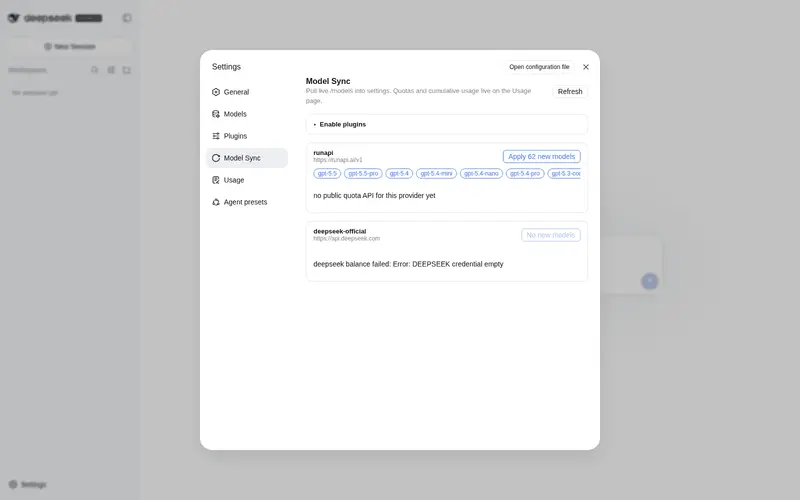
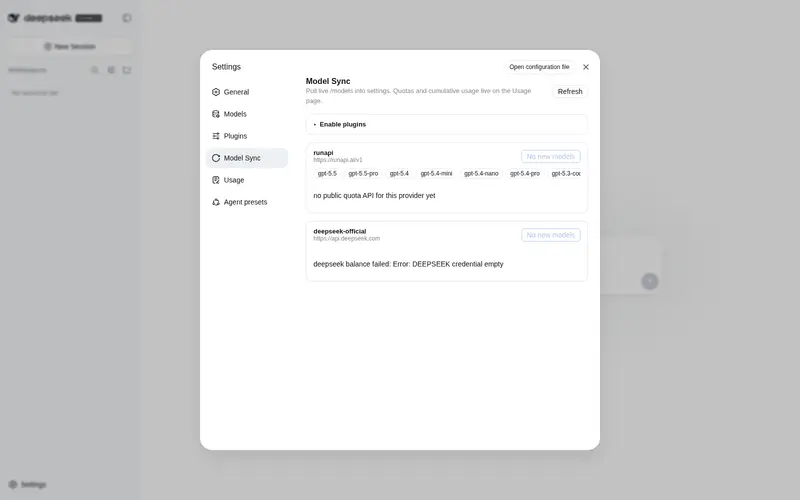
It takes two settings pages, one for fetching model ids per provider and one for per-model usage. Model Sync (sync-arrow icon) writes new model ids from each provider into settings. Usage lists plan windows, cumulative counts, and API balance. Resets show as countdowns such as 2d 3h left. The 5h and 7d windows each get their own row. UI text follows the DSH language setting, English or Chinese.
Screenshots
| 中文 | English | |
|---|---|---|
| Model Sync |  |
 |
| Usage |  |
 |
| Composer |  |
 |
A model with both limits draws two rings, inner 5h, outer 7d. Progress bar colors follow the remaining quota.
Install
On npm.
dsh plugin --profile web add dsh-model-sync
The GitHub source also ships prebuilt lib/, no allowBuilds.
dsh plugin --profile web add github:jiay98528-dev/dsh-model-sync
Restart dsh web, refresh the page, open Settings → Model Sync. The plugin is listed in the awesome-dsh-plugin market list.
The package ships a cordis.patch.yml bundle patch (dsh.bundle) and declares dsh.client.immediately: true, so it takes effect on install with no manual config.
Usage
Model Sync
- Settings → Model Sync.
- Refresh if the list is empty.
- Each card lists the provider id,
baseURL, and model chips. A blue outline marks ids not in settings yet. Apply N new models writes them tollm-pi-ai.providers.<id>.models. - The collapsed Enable plugins block toggles this plugin and the optional
sub-model-access, writing the disabled flag in cordis.patch.yml. Takes effect live.
MiniMax, Kimi Coding, and OpenAI Codex have no OpenAI /models endpoint. The plugin uses the known catalog ids.
Usage
- Settings → Usage.
- Each provider lists its 5-hour and 7-day windows, one row each, with remaining percent, vendor cumulative counts, a reset countdown, and a colored bar.
- Metered rows show
current / baseline. The first sample becomes the baseline. To count spend from before the plugin was enabled, click Use current balance as baseline. The balance row also records when the baseline was set. - The page auto-refreshes every 60 seconds. Refresh pulls immediately.
Composer rings
- Pick a model as usual.
- The ring is right of the model name and left of the context meter. It follows the session model and switches with it.
- Hover the ring for a detail card titled
provider / modelfor this session. Each window gets a row with remaining percent and reset countdown, for example5 hours left 100% · 2h 15m left. - Other providers stay on the Usage page.
Quota sources
| Provider | Icon | Source |
|---|---|---|
openai-codex |
5h / 7d | chatgpt.com/backend-api/wham/usage |
kimi-coding |
5h / 7d, top-up pack in the hover card | api.kimi.com/coding/v1/usages |
zai |
5h / 7d | api.z.ai/api/monitor/usage/quota/limit |
minimax-cn |
5h / 7d | api.minimaxi.com/v1/api/openplatform/coding_plan/remains |
xai |
7d | grok.com gRPC-web, ported from CC Switch |
deepseek-official |
balance vs last top-up | api.deepseek.com/user/balance |
xiaomi |
no data | no public plan API |
The DeepSeek metered baseline lives in $DSH_HOME/profiles/<profile>/model-sync.baseline.json. A reading above the stored baseline counts as a top-up and resets the baseline.
Config
- id: model-sync
  name: dsh-model-sync
  config:
    profile: web
    pollMs: 60000
| Field | Default | Meaning |
|---|---|---|
profile |
web |
Which $DSH_HOME/profiles/<name> to read and write |
pollMs |
60000 |
Poll interval parameter, minimum 5000. Pages currently refresh quota every 60 seconds |
Notes
- Host code lives under
node_modules. After changing and rebuilding this package, restartdsh web. Client-only edits need a page refresh. - Quota calls use credentials already stored in DSH. The plugin keeps no keys of its own.
- Ring placement is bound to DSH 0.1.0-rc.6 composer class names.
- Changelog is CHANGELOG.md.
License
MIT
Frequently Asked QuestionsFAQ
Use the verified command dsh plugin --profile default add github:jiay98528-dev/dsh-model-sync in a DSH-enabled shell. The command resolves the public package metadata and keeps the plugin attached to the catalog identity shown on this page.
Compatibility follows the bundle and profile status shown above. If a profile is not detected, keep the plugin disabled there and check the repository documentation before enabling it in production.
The GitHub link and activity metadata are the source of truth for releases and maintenance. Revisit this page after a new release to confirm the catalog has observed the latest version.