r600a-code/dsh-swarm-router
DSH plugin: sub-agent matrix swarm — routes heterogeneous tasks to the most suitable model (OpenRouter-like + cfgpu.com/llm/square), dispatches each via in-process subagents. 32/32 benchmark green.
Listed
1
Model
Bundle verified
Preview
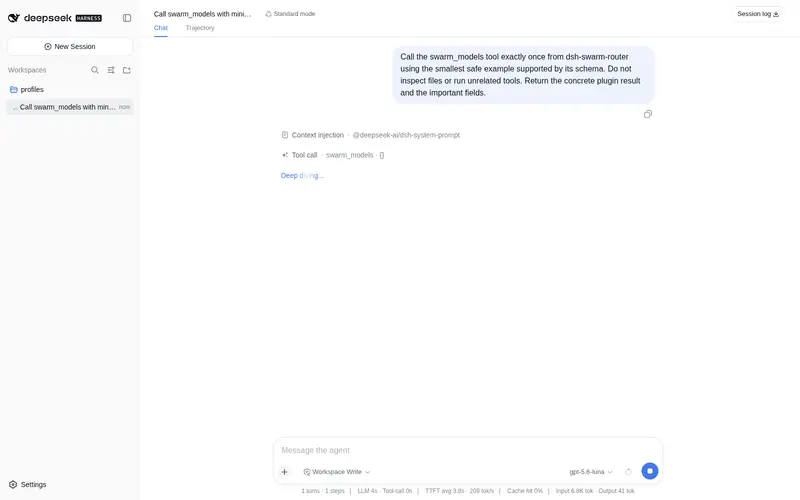
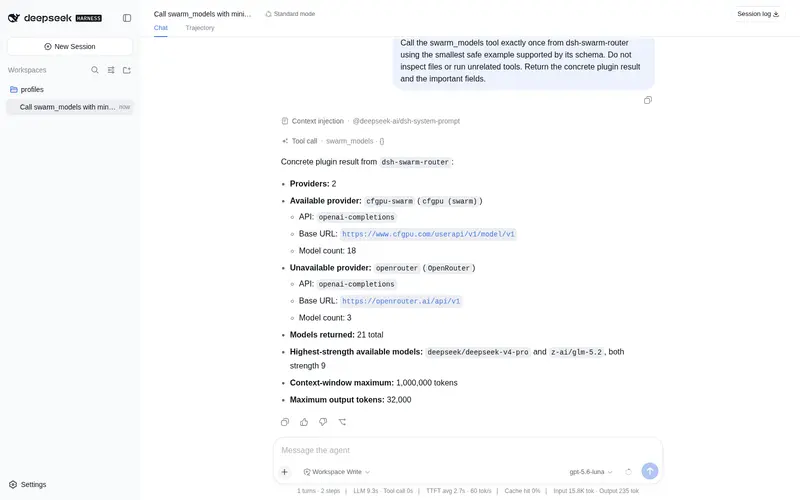
What it does
Sub-agent matrix swarm that routes heterogeneous tasks to the most suitable model from an OpenRouter-like gateway plus cfgpu.com/llm/square, dispatches each via in-process subagents or direct LLM calls, and tracks per-model token consumption with a feedback-driven ranking.
Best for
- Teams dispatching batches of heterogeneous reasoning, coding, long-context, and quick tasks.
- Users with access to multiple models through an OpenRouter-like gateway and cfgpu.com who want task-aware routing.
- Workflows that need per-model token accounting and rankings informed by recorded outcomes.
- Plugin developers who want to register additional models or task kinds through a routing service.
Not ideal for
- Single-model or occasional single-task workflows where routing and ranking add little value.
- Deployments without access or credentials for the configured model providers; unavailable models cannot be used.
- Tasks that do not fit the documented routing kinds without registering a custom kind.
- Users who do not want feedback and usage data persisted in local ranking and usage files.
README
dsh-swarm-router
| English | 中文 |
A DeepSeek Harness bundle that turns a batch of heterogeneous tasks into a sub-agent matrix swarm: it routes each task to the most suitable model from an OpenRouter-like gateway plus the cfgpu.com/llm/square catalog, then dispatches each assignment in parallel as a real in-process subagent (or a direct ctx.llm call) pinned to that model — quick tasks land on fast/cheap models, hard tasks on strong reasoning models. A formal design write-up lives in docs/PAPER.md.
子智能体矩阵蜂群:任务是行、候选模型是列,路由器为每一行选中一格,再通过 DSH 的
ctx.subagents把每格变成一个绑定到所选模型的子智能体并行下放,按任务难度匹配模型、省时提效。论文见docs/PAPER.zh.md。
The four contributions
| Contribution | What | |
|---|---|---|
| ① | Model aggregation registry + PR flow |
models/registry.json is the canonical catalog; scripts/validate-registry.mjs enforces structure (CI-ready); CONTRIBUTING.md documents the add-a-model PR flow. |
| ② | Plugin extension point |
ctx.provide('swarmRouter', api) — other plugins inject: ['swarmRouter'] to register runtime models, custom task kinds, subscribe to feedback, read rankings/usage. |
| ③ | Real-task feedback + ranking |
swarm_feedback records {correct, quality 1-5}, persisted to rankings.json; swarm_ranking shows per-model/per-kind success rate & quality; proven models are boosted in routing, failing ones demoted. |
| ④ | Token-consumption statistics (cfgpu highlighted) |
direct mode captures exact per-call prompt/completion/total from ctx.llm.stream; subagent mode captures via a global llm/stream listener attributed by sessionId; persisted to usage.json; swarm_stats shows totals/byProvider/byModel/byKind + cfgpuHighlight. |
Tools
| Tool | Mode | Calls models? |
|---|---|---|
swarm_route_preview |
— | No (pure routing plan) |
swarm_dispatch |
subagent (default) | direct
|
Yes (parallel) |
swarm_models |
— | No (list registry) |
swarm_feedback |
— | No (records an outcome) |
swarm_ranking |
— | No (reads accumulated feedback) |
swarm_stats |
— | No (reads accumulated usage) |
The router rules (how a task becomes a model)
A task is { id, kind, prompt, maxTokens? } where kind ∈ {reasoning, coding, longcontext, fast, general}. The router is pure and O(1) per task — it spends zero model-time deciding which model; the saving goes into parallel dispatch.
Step 1 — infer the kind. An explicit kind wins; otherwise the first truthy hint among {reasoning, coding, longContext, fast} is used, defaulting to general.
Step 2 — capability gate (hard filter). Each kind requires a capability tag; a model lacking it scores -∞ and is dropped:
-
reasoningrequiresreasoning;codingrequirescoding;longcontextrequireslongContext;fast/generalrequire nothing.
Step 3 — effort-matched weighted score. For the surviving models, a kind-specific linear score is computed from the catalog’s 1–10 ranks (strength, speed, cost) and capacities (contextWindow, maxTokens):
| kind | weight vector |
|---|---|
reasoning |
reasoning×3 + strength×2 + coding×0.3 + contextWindow×0.000004 |
coding |
coding×3 + strength×2.5 + longContext×0.3 |
longcontext |
contextWindow×0.00002 + strength×0.5 + coding×0.3 |
fast |
speed×3 + cost×1.5 + strength×0.3 |
general |
strength×2 + speed×0.6 + cost×0.3 + coding×0.3 |
Step 4 — penalties (the effort-matching core).
-
kind ≠ fastandmodel.fast→ −2.0 (a fast/cheap tier is under-powered for quality work). -
kind = generalandmodel.reasoning→ −2.0 (a reasoning flagship is overkill — slower, pricier — for general work). -
kind = codingandmodel.reasoning→ −0.5 (reasoning helps code but is not required; slight demotion vs. a pure coding-strong peer). -
model.unstable→ −4 (route was flaky during catalog capture). -
model.available = false→ −1000 (e.g. OpenRouter without a key). -
Ranking feedback boost (when
useRankings: true):successRate ≥ 0.9over ≥ 3 trials → +1.5;successRate ≤ 0.4→ −3.0. Real outcomes override the static catalog.
Step 5 — pick & explain. Highest score wins; ties broken by strength, then lexicographic id (deterministic). The tool returns the winner plus top-5 candidates with scores and a human-readable rationale.
Why these numbers. The penalties are asymmetric on purpose: rewarding cheapness on quality tasks is the failure mode this design exists to avoid, so the fast-model penalty (−2.0) and the reasoning-overkill penalty (−2.0) are large enough to flip a tie but small enough that a genuinely-strong cheap model can still win general when it earns it. The ranking boost (±1.5/−3.0) is smaller than the static penalties so a model must clear a real quality bar before feedback can override the catalog.
Why the design
-
Matrix, not a single pipeline. A diverse batch fans out across several models — the
distinctModelssummary is the signal that routing is doing something rather than collapsing to one model. -
Distinct LLM routes (
cfgpu-swarm,openrouter), not the machine’scfgpu.llm-pi-aimerges provider routes by key (composition base ∪ settings); distinct keys union without clash, so the swarm’s catalog never disturbs the orchestrator’s own model. A patch replaces a row’s wholeconfig, so we add routes rather than editing settings. -
Pure router, then dispatch. Separating “decide” from “do” makes routing free, testable, and preview-able (
swarm_route_preview), and lets dispatch (directvssubagent) be chosen per task. -
directmode for token truth. A one-shotctx.llm.streamreads theusagechunk directly — exact per-call accounting including cfgpu’sreasoning_tokens(when the adapter emits it).subagentmode is for tasks needing the agent loop; its usage is captured via a globalllm/streamlistener attributed bysessionId == child run.id(the only mechanism that catches child calls without scope filtering — confirmed by source research). - Feedback closes the loop. Static catalog ranks are author guesses; real task outcomes, persisted and folded into a boost, let a model that looks strong but fails in practice get demoted, and a sleeper get promoted.
Install & run
# against the default DSH_HOME (~/.dsh — needs the cfgpu credential there)
dsh plugin --profile headless add github:r600a-code/dsh-swarm-router
dsh --profile headless --dump-config | grep -E 'cfgpu-swarm|swarm-router'

# sandboxed away from ~/.dsh: a workspace-local DSH_HOME seeded with the credential
export DSH_HOME=/path/to/.dsh-home   # put .credentials.yaml (CFGPU_API_KEY) + settings.yaml there
dsh plugin --profile headless add /path/to/dsh-swarm-router
The cfgpu route needs CFGPU_API_KEY in $DSH_HOME/.credentials.yaml (or env). The OpenRouter route needs OPENROUTER_API_KEY; without it the router reports it unavailable and never dispatches to it, so the profile still boots.
Benchmark
benchmark/benchmark.json is the minimal subset: 5 cheap, heterogeneous tasks across fast/reasoning/coding/general. Success is judged by content (expected answer substring / CJK), not by the run merely completing.
dsh --profile headless "$(cat benchmark/benchmark_prompt.txt)"          # subagent mode, 5 tasks
node benchmark/verify_benchmark.mjs                                     # 27/27 green
dsh --profile headless "$(cat benchmark/benchmark_direct_prompt.txt)"   # direct mode, 3 tasks
node benchmark/verify_benchmark.mjs benchmark_direct_RESULT.json        # 31/31 green
Recorded: subagent 5 tasks → 4 distinct real cfgpu models, all correct (17×23=391, bat-ball=0.05, real is_prime, CJK translation, widgets=5). Direct 3 tasks → exact token capture per task.
Files
-
package.json—dsh.bundlemanifest. -
cordis.patch.yml—cfgpu-swarm+openrouterroutes,swarm-routerplugin row. -
index.js— the plugin: service + 6 tools. -
catalog.js— registry loader + catalog builder. -
router.js— the pure, effort-matched router. -
ranking.js— feedback → ranking + routing boost. -
store.js—rankings.json+usage.jsonpersistence. -
models/registry.json— the model aggregation registry. -
scripts/validate-registry.mjs— registry validator (CI). -
CONTRIBUTING.md— add-a-model PR flow. -
benchmark/— tasks, prompts, recorded results, verifier. -
docs/PAPER.md/docs/PAPER.zh.md— formal design write-up.
Marketplace
- Official discoverability: the
dsh-pluginGitHub topic (applied). - Community curated list: PR to
awesome-dsh-plugin; thedsh-marketplugin pulls from it automatically.
License
MIT.
Frequently Asked QuestionsFAQ
Use the verified command dsh plugin --profile default add github:r600a-code/dsh-swarm-router in a DSH-enabled shell. The command resolves the public package metadata and keeps the plugin attached to the catalog identity shown on this page.
Compatibility follows the bundle and profile status shown above. If a profile is not detected, keep the plugin disabled there and check the repository documentation before enabling it in production.
The GitHub link and activity metadata are the source of truth for releases and maintenance. Revisit this page after a new release to confirm the catalog has observed the latest version.