songoao25/dsh-chatgpt-subscription
ChatGPT Subscription - a DeepSeek Harness plugin: bind your ChatGPT account via official OAuth and chat with ChatGPT models inside DSH, using your Plus/Pro subscription quota
Listed
2
Model
Bundle verified
Preview
What it does
Bind your ChatGPT account via official OAuth and chat with ChatGPT models inside DSH, using your Plus/Pro subscription quota.
Best for
- DSH Web users with an eligible ChatGPT subscription who want to use ChatGPT models through subscription quota instead of an API key.
- Users who prefer browser-based official OAuth binding with automatic token refresh.
- Users pairing DSH model access with the Bottom Info Bar for ChatGPT quota visibility.
Not ideal for
- Users without ChatGPT Plus, Pro, or another plan that includes Codex quota.
- API-billed OpenAI workflows that do not need ChatGPT subscription routing.
- Headless environments where the required DSH Web settings page and browser OAuth flow are unavailable.
README
dsh-chatgpt-subscription
| English | 中文 |





A DeepSeek Harness plugin that lets you sign in with your ChatGPT account using the official OAuth flow and chat with ChatGPT models inside DSH, consuming your ChatGPT Plus / Pro subscription quota.
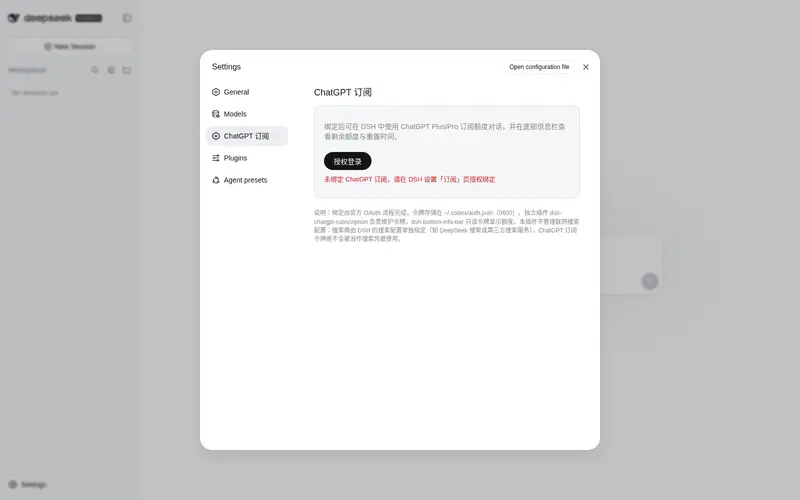
One-click official sign-in — Click 授权登录 on the new 「订阅」page in DSH Settings → your browser opens OpenAI’s official authorization page → approve → you’re bound. No API keys, no command line, no config file editing.
Features
-
Official OAuth binding — Full PKCE + state flow against
auth.openai.com, the same official mechanism used by Codex CLI and OpenCode. Your tokens are exchanged directly with OpenAI; the plugin never sees or stores your password. -
Strict official mode — Only an authorization completed through this plugin’s settings page counts as bound. Your existing
codexCLI login is left alone and is never silently reused. -
ChatGPT models in DSH — After binding, ChatGPT models (e.g.
gpt-5.6-terra,gpt-5.5,gpt-5.4) appear in the DSH model switcher as provider ChatGPT. Selecting one talks to ChatGPT directly and consumes your subscription quota. - Token guardian — The access token is auto-refreshed before expiry (JWT-aware, refresh threshold 45 min) and injected into DSH credentials. Runs once at startup and every 30 minutes; on failure it keeps the last known good state instead of crashing.
- Bind status page — The Settings → 订阅 page shows bound/unbound status, token expiry and remaining time, with 授权登录 / 重新授权 / 解绑 actions.
- Companion to Bottom Info Bar — This plugin owns binding and token maintenance; the Bottom Info Bar reads the token to display your ChatGPT quota (5-hour / weekly / monthly windows and reset times). You can use this plugin without the info bar, but the info bar’s ChatGPT quota display requires this plugin.
Requirements
-
DeepSeek Harness (
dshCLI) running the web interface (dsh web) -
pnpm (used by
dsh plugin) - A ChatGPT Plus or Pro subscription (or a plan that includes Codex quota)
Installation
Option 1 — One-command script (recommended)
git clone https://github.com/songoao25/dsh-chatgpt-subscription.git
cd dsh-chatgpt-subscription
./install.sh                # installs to the "web" profile; use --profile <name> to override
Option 2 — dsh plugin command
git clone https://github.com/songoao25/dsh-chatgpt-subscription.git
cd dsh-chatgpt-subscription
npm run build               # build lib/ from src/
dsh plugin --profile web add .
Restart
dsh webafter installing. Plugins are composed when the host process starts; a page refresh alone is not enough.
Usage
- Restart
dsh web, then open Settings (⚙️) in the sidebar. - Click 订阅 (right below 模型).
- Click 授权登录 — your browser opens the official OpenAI sign-in page.
- Sign in with your ChatGPT account and approve. The page shows 已绑定 when done.
- Open a new conversation, switch the model to a ChatGPT model (provider ChatGPT, e.g.
gpt-5.6-terra) and chat — usage counts against your subscription.
If the browser tab doesn’t open automatically, the page also calls
window.openas a fallback; allow pop-ups for DSH if prompted.
Security
- Tokens are stored only in
~/.codex/auth.json(0600, the standard location shared with Codex CLI) and in DSH’s credential store — never in logs, never in this repository. - The local OAuth callback server binds 127.0.0.1 only, validates
state(CSRF protection), and times out after 5 minutes. - Unbinding removes the binding flag and the injected credential, but keeps
~/.codex/auth.jsonuntouched — your Codex CLI login stays intact. - Zero runtime dependencies (only
reactas a peer for the client half); no network calls except the official OpenAI endpoints.
Uninstall
cd dsh-chatgpt-subscription
./uninstall.sh              # removes the plugin and the injected route/credential
Uninstall keeps ~/.codex/auth.json (your Codex CLI login) and only cleans what this plugin added: the binding flag, the openai-codex provider route, and the OPENAI_CODEX_API_KEY credential.
FAQ
Q: Do I need a ChatGPT Plus subscription?
Yes — the plugin connects your ChatGPT account; chatting with ChatGPT models consumes your subscription quota (models available depend on your plan, e.g. gpt-5.3-codex-spark requires a higher plan).
Q: Does this share my tokens?
No. Everything happens between your machine and auth.openai.com / chatgpt.com. Tokens never leave your machine and are never logged.
Q: What if the token expires? The plugin auto-refreshes it before expiry. If refresh fails (e.g. revoked), the settings page shows a clear hint to re-authorize.
Q: Does this affect my Codex CLI login?
No. The plugin writes to the same standard ~/.codex/auth.json location and preserves its structure; unbinding doesn’t delete it.
Q: Can I see my quota? Install the companion Bottom Info Bar plugin — it reads the token this plugin maintains and displays your ChatGPT quota (remaining percent and reset time) in the bottom info bar.
License
MIT © 2026 songoao25
Frequently Asked QuestionsFAQ
Use the verified command dsh plugin --profile default add github:songoao25/dsh-chatgpt-subscription in a DSH-enabled shell. The command resolves the public package metadata and keeps the plugin attached to the catalog identity shown on this page.
Compatibility follows the bundle and profile status shown above. If a profile is not detected, keep the plugin disabled there and check the repository documentation before enabling it in production.
The GitHub link and activity metadata are the source of truth for releases and maintenance. Revisit this page after a new release to confirm the catalog has observed the latest version.